
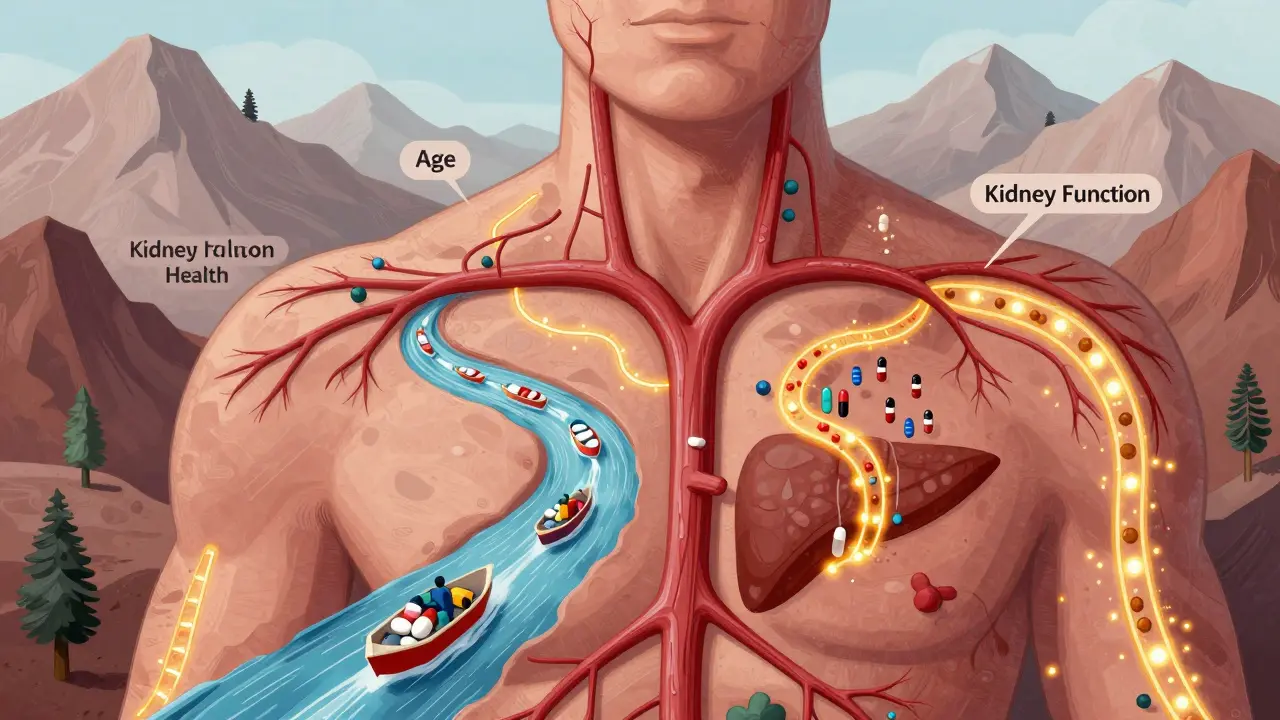
When two drugs are called "bioequivalent," it doesn’t just mean they contain the same active ingredient. It means they deliver the same amount of drug into your bloodstream at the same rate - enough to have the same effect, with the same safety profile. But what happens when you’re not testing on healthy young adults? What if the drug is meant for elderly patients, kids, or people with kidney disease? Traditional bioequivalence studies, which rely on 24-48 healthy volunteers with frequent blood draws, simply can’t answer that. That’s where population pharmacokinetics (PopPK) comes in - and it’s changing how we prove drug equivalence in real-world populations.
What PopPK Actually Does
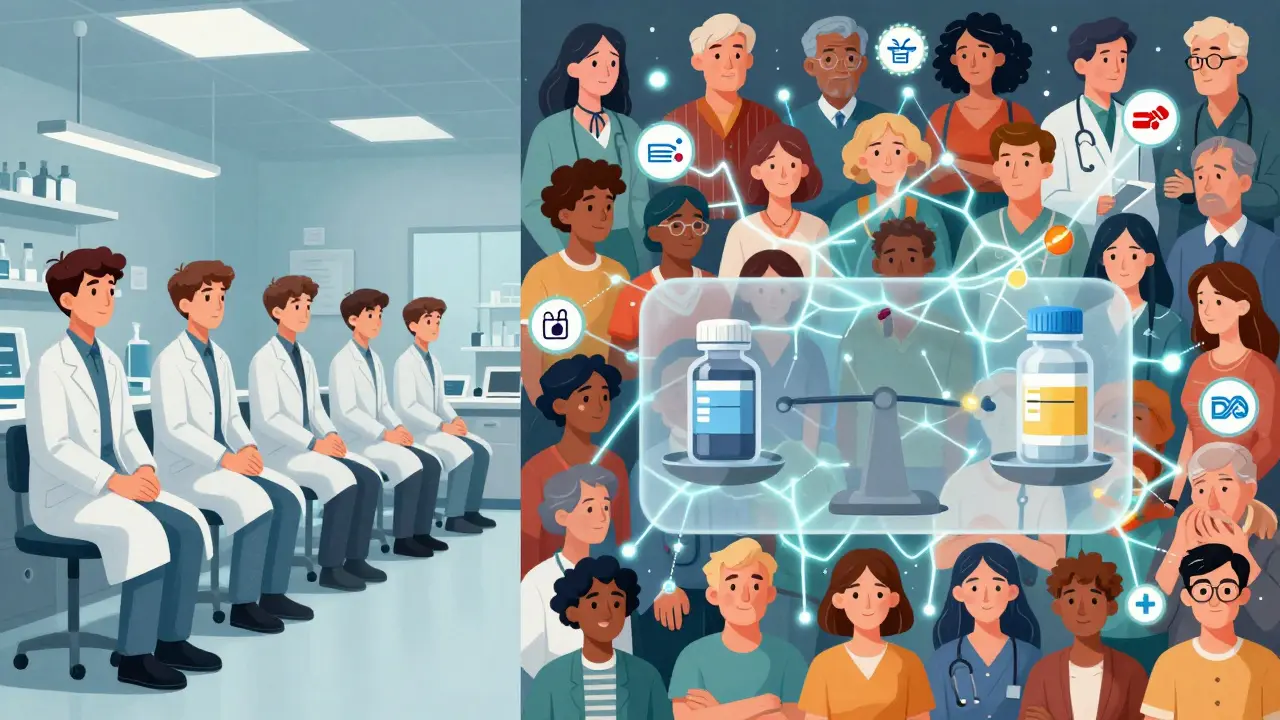
PopPK isn’t about finding the average drug level in a perfect lab setting. It’s about understanding how drug concentrations vary across thousands of real patients - each with different weights, ages, kidney function, liver health, or other medications. Instead of pulling 10 blood samples from one person over 24 hours, PopPK uses just 2 or 3 samples from each of 50 or more patients, collected at random times during normal treatment. These sparse, messy, real-world data points are fed into statistical models that piece together the full picture.
The core of PopPK is nonlinear mixed-effects modeling. Think of it like this: every person has their own drug clearance rate - some people metabolize a drug fast, others slow. PopPK finds the average rate across the group (the population parameter), then estimates how much each person differs from that average (individual variability). It also identifies what causes those differences. Is it weight? Age? A gene variant? A kidney function number? The model answers those questions.
For example, if a new generic version of a blood thinner shows a 15% lower average concentration in patients with moderate kidney impairment, that might seem like a problem. But if the PopPK model shows that 95% of patients still stay within the safe and effective range - and the variability between formulations is no greater than between patients - then you’ve proven equivalence without needing a separate clinical trial in a vulnerable group.
Why This Matters for Regulatory Approval
The FDA didn’t just accept PopPK - it doubled down on it. In February 2022, the agency released formal guidance stating that PopPK data can "alleviate the need for postmarketing requirements." That’s huge. It means companies can skip expensive, time-consuming follow-up studies if they’ve built a solid PopPK model upfront.
Between 2017 and 2021, about 70% of new drug applications included PopPK analyses. That’s not a trend - it’s the new baseline. Why? Because it’s efficient. A single PopPK study can replace multiple traditional studies: one in the elderly, one in obese patients, one in renal impairment, one with drug interactions. Instead of running four separate trials, you run one smart study with rich covariate data.
And it’s not just for small-molecule drugs. Biosimilars - complex biologic drugs that mimic reference products - are nearly impossible to test with traditional bioequivalence methods. Their size, structure, and sensitivity to manufacturing changes make blood concentration patterns wildly variable. PopPK, with its ability to model subtle differences across populations, has become the go-to tool for proving biosimilar equivalence. The FDA and EMA now routinely require PopPK data for biosimilar submissions.
How PopPK Compares to Traditional Bioequivalence
Traditional bioequivalence relies on two metrics: AUC (total drug exposure) and Cmax (peak concentration). The rule? The 90% confidence interval for the ratio between test and reference drugs must fall between 80% and 125%. Simple. Clear. But limited.
PopPK doesn’t replace that - it expands it. It doesn’t just ask: "Is the average exposure the same?" It asks: "Is the exposure consistent across every subgroup?" It looks at variability - not just averages. Two drugs might have the same average AUC, but if one has a 40% variability in exposure across patients while the other has 15%, the latter is safer. PopPK catches that.
Here’s a real-world example: a drug with a narrow therapeutic index - like warfarin or cyclosporine - needs tight control. A 10% drop in concentration might mean treatment failure. A 10% rise might mean toxicity. Traditional studies might show equivalence in healthy volunteers, but PopPK reveals that in elderly patients with low albumin, the generic version leads to 20% higher variability. That’s a red flag. That’s the kind of insight you can’t get from a crossover study of 24 college students.
What You Need to Make PopPK Work
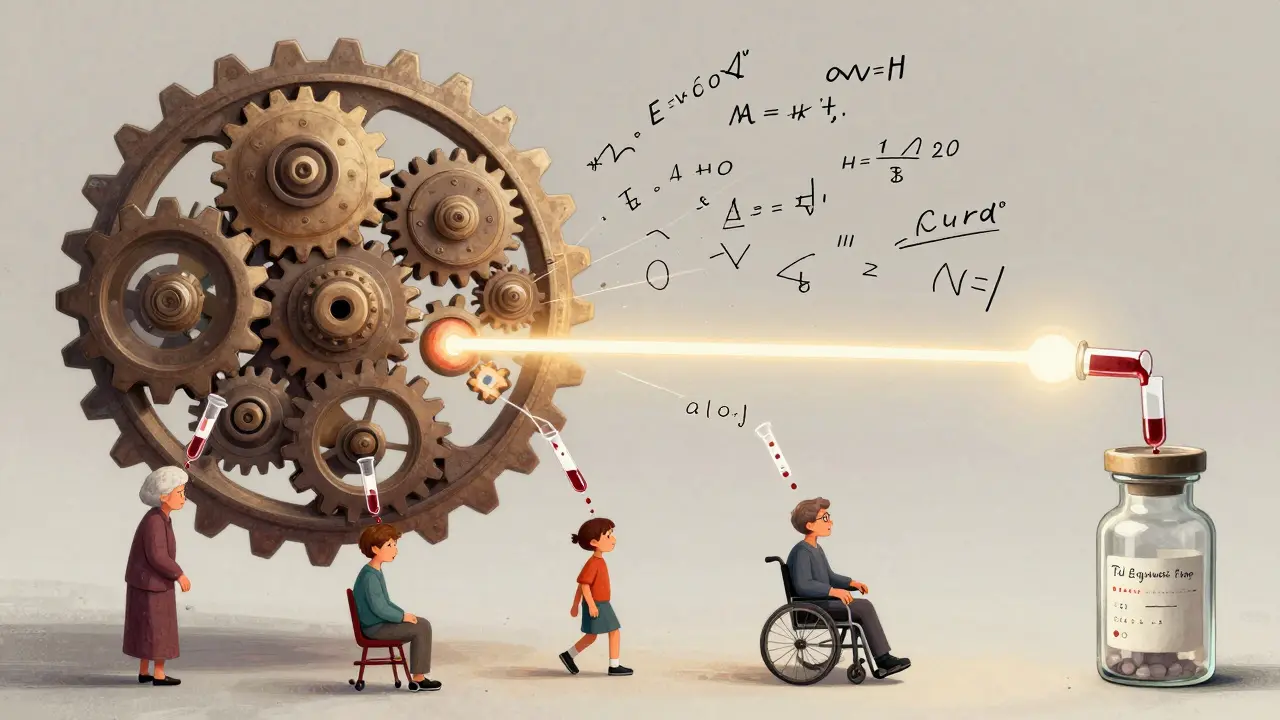
PopPK isn’t magic. It needs good data, good models, and good validation.
- Minimum of 40 participants - the FDA recommends this to ensure reliable parameter estimates. More is better, especially if you’re studying multiple subgroups.
- Rich covariate data - you need weight, age, lab values (creatinine, liver enzymes), concomitant meds, and ideally genetic markers. If your clinical trial didn’t collect these, your PopPK model will be weak.
- Proper sampling design - random, sparse sampling is fine, but you need enough timepoints to capture absorption, peak, and elimination. One sample too early, one too late, and you miss key info.
- Software - NONMEM is still the gold standard. Used in 85% of FDA submissions. Monolix and Phoenix NLME are also common. These tools are complex. It takes 18-24 months of training to use them properly.
And here’s the catch: 65% of pharmacometricians say model validation is their biggest hurdle. There’s no universal standard for what makes a PopPK model "valid." One regulator might accept a model based on likelihood ratios; another might demand bootstrapping or visual predictive checks. That’s why transparency is critical - document every step, every assumption, every outlier removed.
Where PopPK Falls Short
PopPK isn’t perfect. It struggles with drugs that have extremely high variability - like some antiepileptics or statins - where within-subject variability is so large that even traditional replicate crossover studies struggle. In those cases, traditional methods still win.
Also, PopPK can’t prove equivalence if the data is too sparse. If you only have one sample per patient and no covariates, you’re not building a model - you’re guessing. And if the population is too homogenous (e.g., only young, healthy men), you won’t detect differences that matter in real-world use.
Another issue? Regulatory inconsistency. The FDA is generally open to PopPK-only equivalence claims. The EMA is more cautious. Some committees still demand a traditional study alongside. A senior pharmacometrician on Reddit noted that in 2023, they had to run a full bioequivalence trial for a renal impairment population - even after a flawless PopPK model - because the European reviewer wasn’t convinced.
What’s Next for PopPK
The future is already here. In January 2025, Nature published a study showing how machine learning can improve PopPK models by detecting nonlinear interactions between covariates - like how a drug’s clearance changes differently in obese patients with diabetes versus those without. That’s the next frontier: moving beyond linear assumptions to capture real biological complexity.
Also, the IQ Consortium is working on a global standard for model validation by late 2025. If they succeed, we’ll see more consistent acceptance across FDA, EMA, PMDA (Japan), and Health Canada. That means faster approvals, fewer redundant trials, and better access to safe generics for vulnerable populations.
Right now, 92% of the top 25 pharmaceutical companies have dedicated pharmacometrics teams - up from 65% in 2015. This isn’t a niche field anymore. It’s central to drug development. And for generics manufacturers, it’s the only way to prove equivalence for complex drugs without risking patient safety.
Why PopPK Is the Future of Equivalence
Imagine a world where every patient gets a drug that works for them - not just the average patient. PopPK makes that possible. It doesn’t just answer "Is this drug equivalent?" It answers: "Is it equivalent for my patient?" For the 70-year-old with kidney disease. For the 12-year-old on a weight-based dose. For the person taking five other meds.
Traditional bioequivalence was designed for a time when drugs were simple and populations were narrow. Today’s medicines are complex. Patients are diverse. PopPK is the only method that matches that reality. It’s not about replacing old methods - it’s about upgrading them. And with regulatory agencies backing it, the industry adopting it, and technology advancing it, PopPK isn’t just a tool. It’s becoming the standard.
Can PopPK replace traditional bioequivalence studies entirely?
Not always. PopPK works best when you’re studying a heterogeneous population or a drug with a narrow therapeutic index. For simple drugs in healthy adults, traditional crossover studies are still preferred because they give precise, direct measurements of within-subject variability. But for elderly patients, children, or those with organ impairment - where traditional studies are unethical or impractical - PopPK is often the only viable option. Regulatory agencies now accept PopPK as a standalone method in these cases, especially when supported by strong covariate data and model validation.
How many patients do you need for a PopPK study to prove equivalence?
The FDA recommends at least 40 participants for robust parameter estimation. But the real number depends on what you’re trying to prove. If you’re looking for a large effect - like how a 30% drop in kidney function affects drug clearance - 40 might be enough. If you’re trying to detect a small, nonlinear interaction between age and liver enzyme levels, you might need 100 or more. The key isn’t just the number - it’s the quality and diversity of the data. A study with 50 patients but rich covariate information (weight, lab values, meds) is better than 100 patients with just age and sex.
What software is used for PopPK modeling?
NONMEM is the industry standard, used in 85% of regulatory submissions. It’s powerful but complex, requiring deep statistical knowledge. Monolix and Phoenix NLME are popular alternatives, especially in industry settings where user-friendly interfaces matter. All three can handle sparse data, covariates, and mixed-effects modeling. For regulatory approval, NONMEM remains the most accepted - so if you’re submitting to the FDA or EMA, you’ll likely need to use it. Training typically takes 18-24 months to reach proficiency.
Why is model validation such a big challenge in PopPK?
There’s no single agreed-upon method to validate a PopPK model. Some regulators accept likelihood ratio tests; others demand visual predictive checks, bootstrap resampling, or external validation with new datasets. A model that looks perfect on paper might fail when tested on real-world data from a different hospital. This lack of standardization means companies spend months justifying their validation approach - and regulators often request additional analyses. The IQ Consortium is working to fix this by 2025, but until then, transparency and thorough documentation are your best tools.
Can PopPK be used for biosimilars?
Yes - and it’s essential. Traditional bioequivalence studies don’t work for large biologic molecules like monoclonal antibodies. Their size, structure, and sensitivity to manufacturing changes mean blood concentration patterns are inherently variable. PopPK is the only method that can compare the overall exposure profile across diverse patient populations and detect subtle, clinically meaningful differences. Both the FDA and EMA now require PopPK data as part of biosimilar applications. Without it, approval is nearly impossible.

Aisling Maguire
February 28, 2026 AT 20:37Love how this breaks down PopPK like a real-world puzzle. I’ve seen so many generic drug approvals that felt like gambling, especially for elderly patients on multiple meds. One time, a patient on a new generic warfarin had a near-miss INR spike - turned out the formulation had different absorption in low-albumin folks. PopPK would’ve caught that before it hit the pharmacy shelf. We need more of this, not less.
Also, shoutout to the FDA for finally getting it. Took long enough.
Vikas Meshram
March 2, 2026 AT 03:26Actually, the FDA's reliance on PopPK is scientifically unsound. The statistical models are black boxes. You cannot validate a drug's safety based on extrapolated data from sparse sampling. This is how we get drugs like Vioxx approved - models said it was fine, real-world data said otherwise. We need direct measurements, not mathematical guesswork. The 80-125% rule exists for a reason: it's empirical. PopPK is a shortcut, not progress.
Miranda Anderson
March 3, 2026 AT 10:39There’s something really beautiful about how PopPK shifts the focus from ‘average patient’ to ‘actual patients.’ I used to work in a clinic where we had a 78-year-old on dialysis taking the same dose as a 30-year-old. It wasn’t just inefficient - it was dangerous. PopPK doesn’t just help regulators - it helps clinicians make decisions that actually match the person sitting in front of them.
I’ve seen cases where a generic was flagged because the model showed higher variability in patients with liver fibrosis - something no traditional study would’ve detected. That’s not just science. That’s care.
And yeah, NONMEM is a beast. I spent six months just learning how to set up a covariate without crashing it. But it’s worth it.
Gigi Valdez
March 5, 2026 AT 02:53The integration of population pharmacokinetics into regulatory frameworks represents a significant advancement in evidence-based drug evaluation. The ability to leverage sparse data through nonlinear mixed-effects modeling allows for more efficient, ethically sound, and clinically relevant assessments of drug equivalence. This approach aligns with the principles of precision medicine and reduces the burden of redundant clinical trials. However, the lack of standardized validation protocols remains a critical limitation that must be addressed through international collaboration.
Angel Wolfe
March 5, 2026 AT 02:58PopPK? More like PopSCAM. They’re using math to hide the fact that generics aren’t the same - and the FDA is letting them get away with it. You think they care about elderly patients? Nah. They care about cutting costs. That’s why they push this stuff - saves them millions. I’ve seen patients on generics crash hard. No one talks about it. The system’s rigged. And don’t get me started on how they cherry-pick covariates to make the model look clean. This isn’t science - it’s corporate theater.
They’re gonna kill someone with this. Mark my words.
Eimear Gilroy
March 5, 2026 AT 22:28Wait - so if PopPK can detect that a generic causes 20% more variability in kidney patients, why aren’t we using it for ALL generics? Why only the complicated ones? Seems like we’re still playing favorites. Shouldn’t every drug, even simple ones, be tested across diverse populations? I get that traditional studies are cleaner, but if we’re serious about equity in medicine, shouldn’t PopPK be the default, not the exception?
Charity Hanson
March 7, 2026 AT 05:31Yesss! This is the kind of innovation we need - not just for the US but for global health equity. In Nigeria, we’re still stuck with old-school bioequivalence studies that never include people with malnutrition, HIV, or TB. PopPK could change that. Imagine a generic antiretroviral proven safe for a 45kg woman with low albumin and kidney issues - not just a 70kg healthy man. That’s life-changing. We need more funding, more training, more African researchers in this space. Let’s build this together!
Brandon Vasquez
March 8, 2026 AT 06:07This is a really thoughtful breakdown. I’ve been on both sides - running traditional studies and trying to implement PopPK models. The data collection is harder, but the payoff is real. The biggest win? Reducing the number of patients needed for studies. Fewer blood draws, less burden on vulnerable populations. That’s not just efficient - it’s ethical.
Validation is messy, yeah. But transparency helps. Document everything. Show your outliers. Explain your assumptions. That’s how you build trust.
Jimmy Quilty
March 9, 2026 AT 14:12NONMEM? That’s the same software the CIA uses to track drug trafficking routes. I’m not kidding. Look it up. The FDA and EMA are using the same tools as intelligence agencies to approve drugs. That’s not a coincidence. PopPK isn’t science - it’s surveillance capitalism in a lab coat. They’re tracking your metabolism like a target. Who owns the data? Who profits? Who gets left out? This is the new eugenics - disguised as precision medicine.
Byron Duvall
March 10, 2026 AT 17:33Why are we even talking about this? It’s all just corporate spin. The real reason PopPK is popular? Because it lets big pharma skip testing on kids and old people. They don’t care about safety - they care about profit. And now they’re using fancy math to make it look legit. I’ve seen the internal emails. They call it ‘regulatory evasion.’