
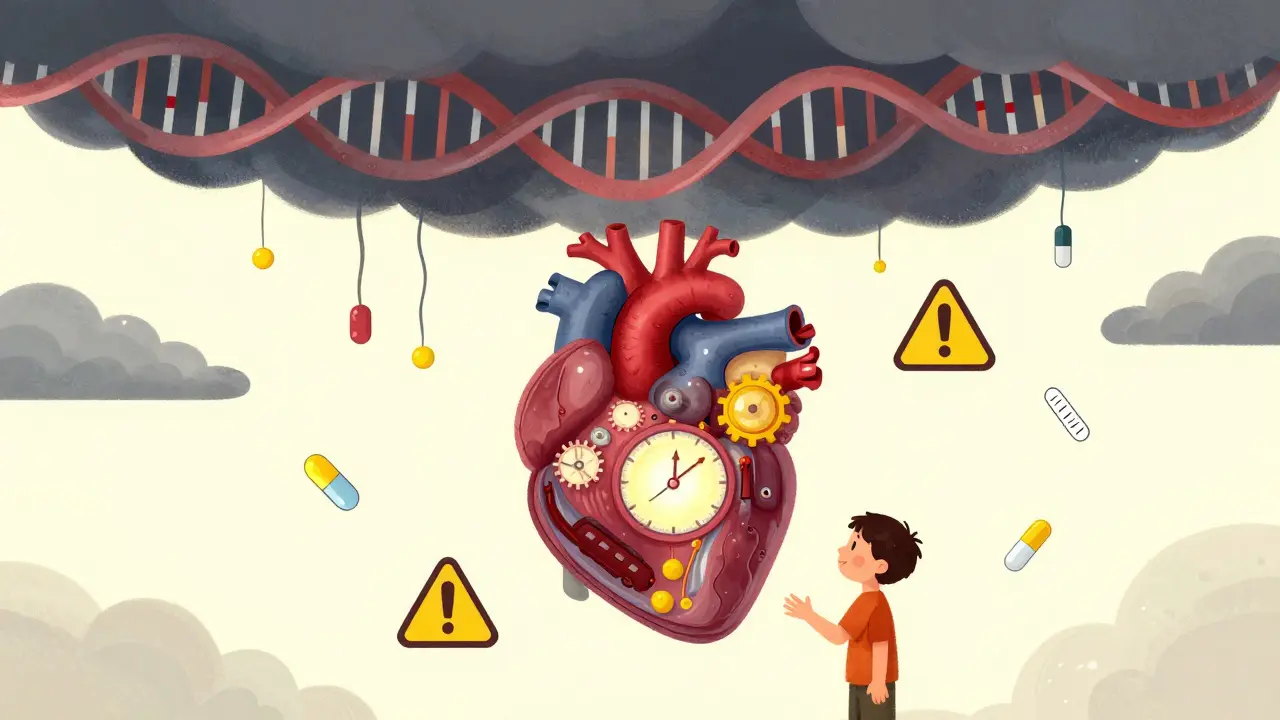
Familial hypercholesterolemia isn’t just high cholesterol. It’s a genetic time bomb. From birth, people with this condition have dangerously high levels of LDL cholesterol-so high that plaque builds up in their arteries decades before most people even think about heart disease. Left untreated, a person with familial hypercholesterolemia (FH) has up to a 20 times higher risk of having a heart attack before age 50. And here’s the kicker: 90% of them don’t even know they have it.
What Exactly Is Familial Hypercholesterolemia?
Familial hypercholesterolemia is an inherited disorder that messes up the body’s ability to clear LDL cholesterol from the blood. It’s passed down from just one parent-autosomal dominant-meaning if one of your parents has it, you have a 50% chance of inheriting it. The problem lies in the LDL receptors on liver cells. In FH, these receptors don’t work right, so LDL cholesterol piles up like traffic jammed on a highway.
There are two main types: heterozygous FH (HeFH), where you inherit the faulty gene from one parent, and homozygous FH (HoFH), where you get it from both. HeFH affects about 1 in every 200 to 250 people worldwide. HoFH is rarer-1 in 160,000 to 1 million-but far more dangerous. People with HoFH often have LDL levels over 400 mg/dL as children. Without treatment, many don’t survive past their teens.
Unlike regular high cholesterol from poor diet or lack of exercise, FH doesn’t care if you eat kale or run marathons. Your genes are running the show. That’s why lifestyle changes alone won’t cut it. You need aggressive medical treatment-starting as early as possible.
Why Most People with FH Never Get Diagnosed
Most people with FH look perfectly healthy. No symptoms. No warning signs. Until they don’t.
Some people develop visible signs: yellowish lumps on tendons (xanthomas), a white ring around the cornea (corneal arcus), or chest pain from blocked arteries. But these usually show up only after damage is already done. By then, it’s too late for prevention.
In the U.S., only 6 to 10% of people with FH are diagnosed. That means over 1.3 million Americans with FH are walking around unaware. And here’s the scary part: their risk of a heart attack is 8 to 10 times higher than someone without FH. The average age of diagnosis? 44. For someone with FH, that’s decades too late.
Doctors miss it because they’re not looking for it. Many still think high cholesterol is just a result of eating too much cheese or butter. But FH isn’t about diet. It’s about DNA. And if you don’t test for it, you won’t find it.
How to Spot FH Before It’s Too Late
The best chance to catch FH early is through screening. Two proven methods exist: universal screening and cascade screening.
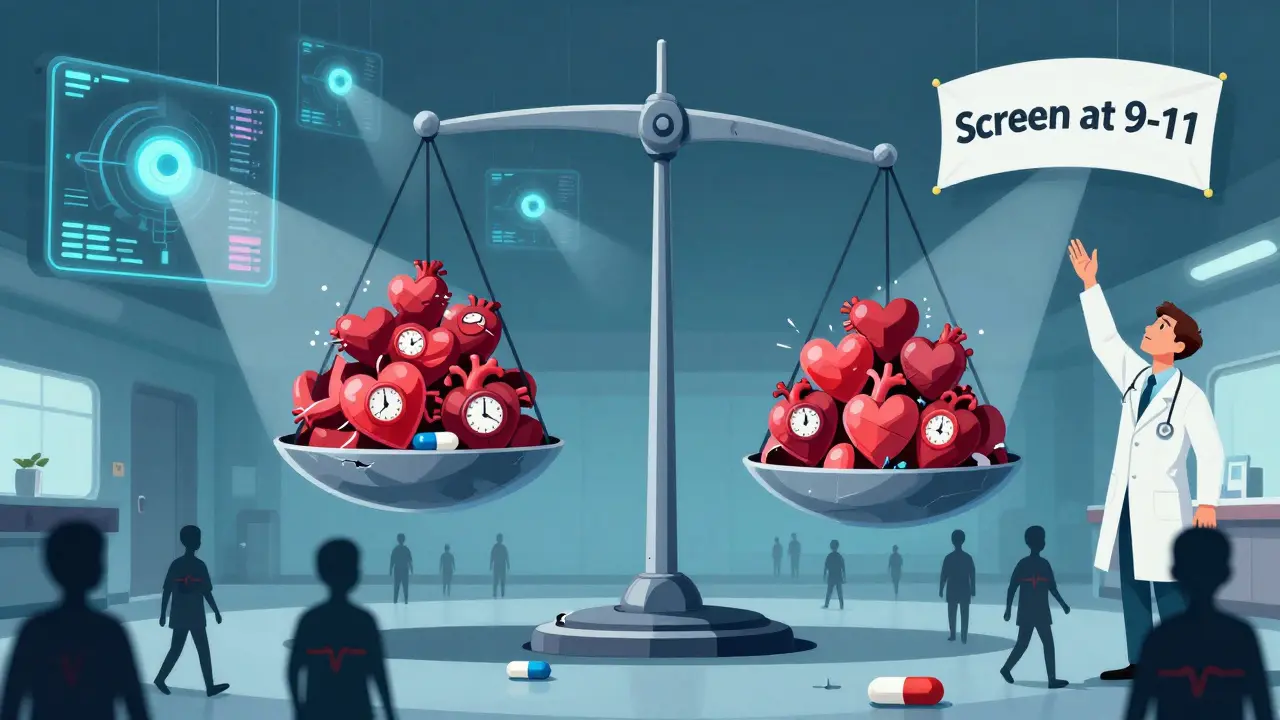
Universal screening means testing all children once between ages 9 and 11. The American Academy of Pediatrics and the American Heart Association both recommend this. Why? Because LDL levels in kids with FH are already sky-high by age 5. If you wait until adulthood, you’re already behind.
Normal LDL for a child is under 110 mg/dL. If a child’s LDL is above 160 mg/dL, FH is strongly suspected. That’s not just high-it’s a red flag. And if you find it early, you can start treatment before any artery damage occurs.
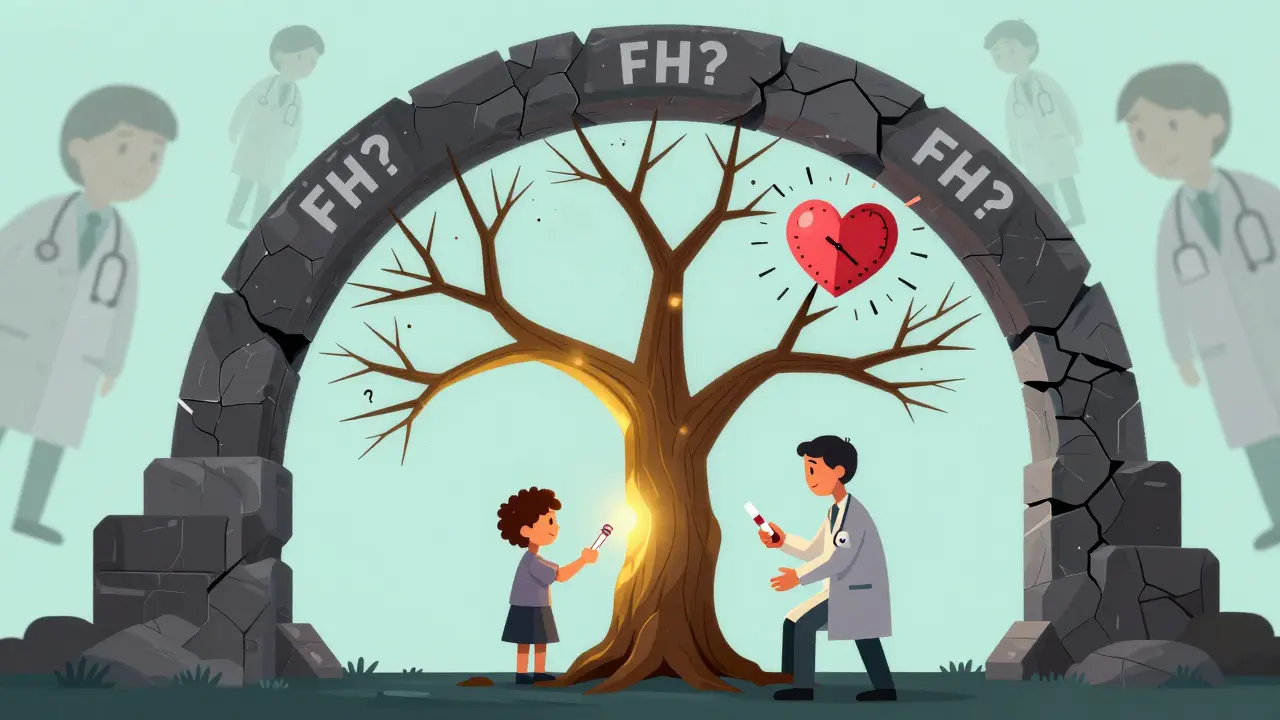
Cascade screening is how you find the rest of the family. Once someone is diagnosed with FH, you test their first-degree relatives: parents, siblings, kids. Then their second-degree relatives: aunts, uncles, nieces, nephews. Because FH is autosomal dominant, each of those relatives has a 50% chance of having it too.
It’s one of the most cost-effective public health tools we have. For every person diagnosed, you can identify 2 to 4 more at risk. The Netherlands has been doing this since the 1990s. They’ve found over 18,000 cases. In the U.S.? Only 30 to 40% of eligible families get screened. That’s a massive failure.
Genetic testing is the gold standard for confirmation. But it’s expensive and not always accessible. That’s why doctors use clinical tools like the Dutch Lipid Clinic Network (DLCN) criteria, which combine LDL levels, family history, physical signs, and personal history to make a diagnosis-even without a genetic test.
Aggressive Treatment Starts Early-Even in Children
There’s no waiting. No “let’s try diet first.” For FH, treatment must be aggressive and started early.
For children with HeFH, statins are recommended as early as age 8 to 10. For those with HoFH, treatment may begin as early as age 2. Yes, you read that right. Two-year-olds on statins. And it works.
Studies from the Netherlands and South Africa show that kids with FH who start statins early and keep taking them have nearly normal life expectancy. That’s not a guess. That’s data. That’s science.
Statins are the foundation. But most people with FH need more. That’s where ezetimibe comes in-it blocks cholesterol absorption in the gut. And for those who still aren’t hitting targets, PCSK9 inhibitors like evolocumab or inclisiran are game-changers. Inclisiran is especially convenient: just two shots a year. No daily pills. Better adherence. Better outcomes.
The goal? Lower LDL by at least 50% from baseline, and get it below 100 mg/dL for adults and below 135 mg/dL for kids. That’s not a suggestion. That’s the standard set by the European Society of Cardiology and the American Heart Association.
And here’s what’s shocking: even among those diagnosed, only 2.9% of U.S. adults with FH get their relatives screened. That’s less than 1 in 30. Meanwhile, in the Netherlands, over 80% of families go through cascade screening. The difference? Systematic programs. National registries. Clear protocols. We’re not just behind-we’re failing.
Who’s at Highest Risk?
FH doesn’t pick sides, but it does cluster. Certain populations have much higher rates:
- Afrikaners in South Africa: 1 in 70
- French Canadians: 1 in 80
- Lebanese Christians: 1 in 85
- Ashkenazi Jews: 1 in 67
If you come from one of these groups, and you have high cholesterol-or a family history of early heart disease-you need to get tested. Even if you feel fine.
And it’s not just about your own risk. It’s about your kids. Your siblings. Your parents. One diagnosis can save a whole family.
The Future: AI, Registries, and Fixing the System
Technology is finally catching up. Machine learning models are being trained to scan electronic health records for red flags: high LDL, family history of early heart attacks, xanthomas. One 2023 study showed AI could identify FH cases with 92% accuracy-far better than doctors relying on memory or paper charts.
And national registries? They work. The Netherlands, UK, and Norway have them. They track every diagnosed case. They automatically trigger cascade screening. They make sure no one slips through. In those countries, diagnosis rates are 20 to 30%. In the U.S.? Still stuck at 6 to 10%.
The CDC calls FH a Tier 1 genomic application-meaning we have enough evidence to say: this is something we must act on. It’s not experimental. It’s proven. It’s ready.
The biggest barrier? Awareness. Lack of lipid specialists. Insurance denying genetic tests. Pediatricians not screening kids. The U.S. has only one lipidologist for every 1.5 million people. That’s not a shortage. That’s a crisis.
But here’s the good news: we have the tools. We know how to find it. We know how to treat it. We know what happens if we don’t.
Without action, the CDC predicts 250,000 premature deaths from undiagnosed FH in the U.S. over the next decade. With full implementation of screening and treatment, we could prevent 180,000 of them.
What You Can Do Right Now
If you’re an adult with LDL over 190 mg/dL, or if you’ve had a heart attack before age 55 (men) or 60 (women), get tested for FH. Ask for a lipid panel and a family history review.
If you have a child, ask their pediatrician about cholesterol screening at age 9 to 11. Don’t wait for symptoms. Don’t assume it’s just “bad genes.” Demand the test.
If you’ve been diagnosed with FH, tell your family. Encourage them to get tested. Don’t wait for them to have a heart attack.
Familial hypercholesterolemia isn’t a death sentence. It’s a treatable condition. But only if we catch it early-and treat it hard.

anthony martinez
January 10, 2026 AT 21:28So let me get this straight-we have a genetic condition that kills people before 50, affects 1 in 250, and we’re still treating it like it’s a lifestyle choice? We screen for autism in toddlers but wait until someone’s having a heart attack to check for FH? Brilliant.
Ritwik Bose
January 12, 2026 AT 17:53Thank you for this comprehensive and deeply important post. In India, awareness remains alarmingly low, even among physicians. I have seen patients with LDL above 300 mg/dL dismissed as 'overweight' or 'non-compliant.' The cultural stigma around genetic conditions further delays diagnosis. Cascade screening must be integrated into public health policy-this is not a privilege, it is a right.
Jaqueline santos bau
January 13, 2026 AT 20:51OMG I just found out my uncle had a heart attack at 42 and they only found out he had FH after he died?? Like?? How is this not on every TV show?? My mom’s side of the family is basically a walking clinical trial and no one ever got tested?? I’m crying. I’m getting my kids tested tomorrow. I’m telling everyone. This is the most important thing I’ve read all year.
Aurora Memo
January 14, 2026 AT 06:14I’m a nurse in a pediatric clinic and we’ve started screening at age 10 per guidelines. One child last month had an LDL of 280. No symptoms. No obesity. Just pure genetics. The parents were devastated-until we told them treatment could give their child a full life. That moment? That’s why we do this. Early detection isn’t optional. It’s everything.
chandra tan
January 14, 2026 AT 15:49Bro in India we don’t even have cholesterol tests in rural areas. My cousin’s dad died at 45 and they thought it was ‘stress.’ Now I’m pushing my whole family to get tested. If one of us has it, everyone needs to know. No drama. Just blood tests.
Dwayne Dickson
January 16, 2026 AT 03:42The systemic failure here is not merely clinical-it is epistemological. The medical establishment continues to operate under a behavioral determinism paradigm, conflating acquired dyslipidemia with monogenic disorders. This cognitive bias results in catastrophic diagnostic omission. PCSK9 inhibitors are not 'expensive novelties'-they are life-preserving interventions that must be covered without prior authorization.
Ted Conerly
January 16, 2026 AT 09:52My 9-year-old got screened last year-LDL was 182. We started a statin. She’s fine. No side effects. No drama. Just a kid who can grow up without needing a bypass by 35. If your doc says 'wait and see'-find a new doc. This isn’t risky. It’s responsible.
Faith Edwards
January 18, 2026 AT 02:38It’s almost poetic how the American healthcare system can spend billions on experimental gene therapies while ignoring a proven, affordable, and universally accessible intervention that could prevent hundreds of thousands of deaths. We are not incompetent-we are morally bankrupt.
Jay Amparo
January 18, 2026 AT 23:27I’m from Kolkata and I’ve been telling everyone I know: if your parent had a heart attack before 50, get tested. I didn’t know FH existed until my brother’s LDL hit 310. We’re doing cascade screening now. My aunt, my cousin, my uncle-all tested. One of them has it. We caught it early. That’s not luck. That’s action.
Lisa Cozad
January 19, 2026 AT 20:48My mom’s side has a history of early heart disease. I never thought it was genetic-thought it was just 'bad luck.' Got tested at 32. LDL 210. Started statins. Now I’m pushing my 11-year-old niece for a screening. It’s not fear. It’s love.
Saumya Roy Chaudhuri
January 21, 2026 AT 03:24Actually, you’re all wrong. FH is overdiagnosed. Most people with high LDL just eat too much sugar. I read a paper in The Lancet last year that said statins in kids increase diabetes risk. You’re all just panicking because of Big Pharma ads.
Ian Cheung
January 21, 2026 AT 04:20My kid’s LDL was 190 at 10. We started statins. No one believed me. Now she’s 14 and her LDL is 85. I’ve got screenshots. I’ve got labs. I’ve got a daughter who won’t die before she graduates college. You don’t need a genetic test to know when something’s broken. You just need to look.
Mario Bros
January 23, 2026 AT 01:13Just had my 8-year-old tested. LDL 205. Started on a low-dose statin. Kid’s fine. No weird side effects. We’re doing the whole family next. If you’re not testing your kids, you’re playing Russian roulette with their heart.
Jake Nunez
January 23, 2026 AT 13:48My dad died at 47. They said it was 'stress.' Turns out he had FH. I got tested at 30. LDL 240. Started statins. Now I’m telling my sister to get her kids checked. No more silence. No more 'maybe.' This is real.
Christine Milne
January 25, 2026 AT 13:27This is just another liberal agenda to expand Medicaid coverage under the guise of 'genomic medicine.' In my family, we’ve always had high cholesterol. We eat meat. We work hard. We don’t need pills. We need discipline. And we don’t need the government telling us what to do.