

The U.S. Food and Drug Administration (FDA) doesn’t just approve brand-name drugs - it also ensures that millions of Americans can access affordable, high-quality generic medications. Behind this system is the FDA Office of Generic Drugs (a division within the Center for Drug Evaluation and Research (CDER) responsible for overseeing the development, review, and approval of generic drugs in the United States). Since its elevation to a "super office" in 2013, OGD has become the central force driving the availability of generic drugs, handling everything from scientific reviews to global policy coordination.
What Exactly Does the FDA Office of Generic Drugs Do?
At its core, OGD reviews and approves Abbreviated New Drug Applications (ANDAs). These are the filings drug companies submit to prove their generic versions are as safe and effective as the original brand-name drugs. But it’s not just about checking paperwork. OGD ensures that a generic pill has the same active ingredient, strength, dosage form, and route of administration as the brand drug. It also confirms the generic works the same way in the body - a process called bioequivalence.
OGD doesn’t just approve drugs. It sets the standards. That means defining how much of a drug must be absorbed into the bloodstream to be considered equivalent. For example, if a brand-name drug delivers 95% of its active ingredient, the generic must fall within 80-125% of that level. These aren’t arbitrary numbers - they’re based on years of clinical data and scientific modeling.
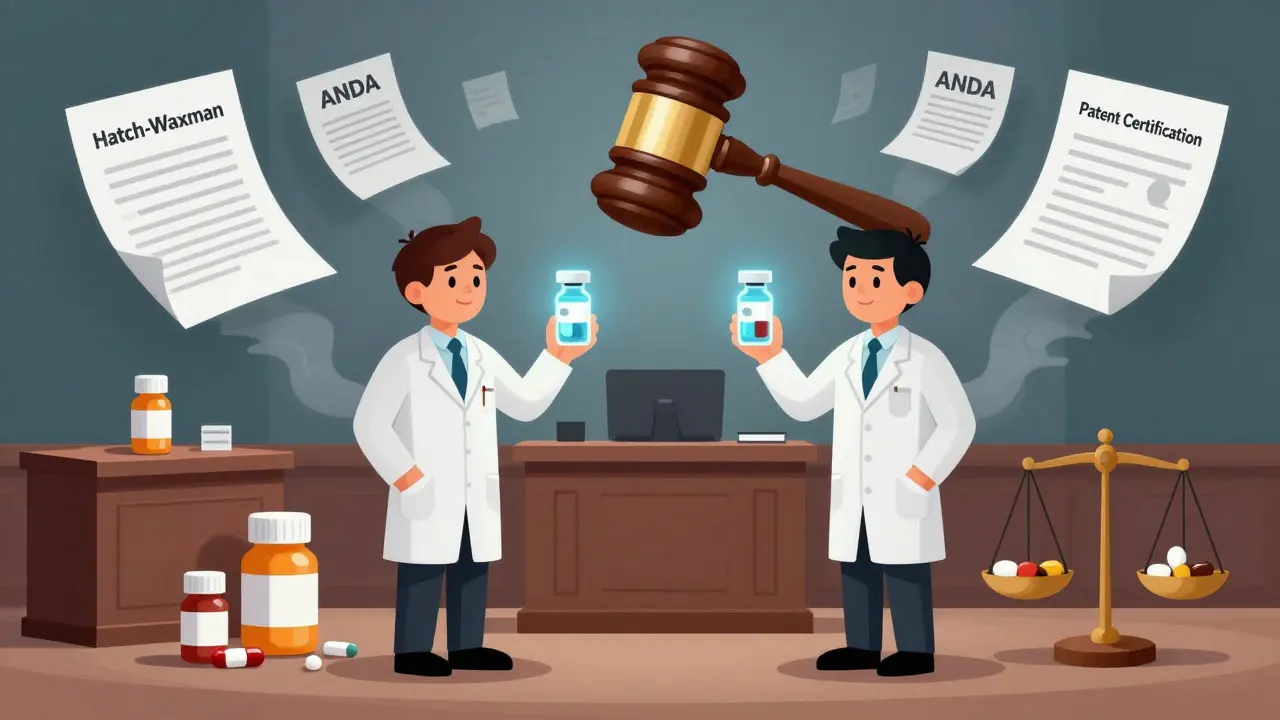
OGD also handles patent and exclusivity issues under the Hatch-Waxman Act. This law balances innovation with access: it gives brand-name companies a few extra years of market protection to recoup R&D costs, but it also creates a clear path for generics to enter the market once patents expire. OGD’s legal team tracks patent certifications, resolves disputes, and determines whether a generic can be approved before a patent runs out.
How Is OGD Structured to Handle This Work?
OGD isn’t one big team. It’s broken into five specialized offices, all under the leadership of the Immediate Office (IO). Each has a clear mission:
- Immediate Office (IO): The command center. It sets strategy, coordinates across teams, and acts as the FDA’s top authority on generic drugs. It includes the Division of Legal and Regulatory Support (advises on Hatch-Waxman Act issues and regulatory compliance) and the Global Generic Drug Affairs Team (works with international regulators to align standards).
- Office of Bioequivalence (OB): This team runs the science behind "same effect." They design and review studies that prove a generic drug behaves like the brand in the body. They also manage the OGD Safety and Surveillance Team, which monitors adverse events tied to generics.
- Office of Generic Drug Policy: Handles the rules. This office interprets laws like Hatch-Waxman, drafts new guidance for industry, and responds to questions from Congress, foreign governments, and manufacturers. It’s the bridge between law and practice.
- Office of Regulatory Operations (ORO): The engine room. Its Regulatory Project Managers (RPMs) oversee every single ANDA review from start to finish. They assign reviewers, track deadlines, and make sure OGD hits its GDUFA goals - meaning generics don’t sit on a shelf for years.
- Office of Research and Standards (ORS): Builds the future. This team develops new testing methods, uses modeling to predict drug behavior, and improves how quality is measured. They’re the ones pushing the science forward so reviews stay accurate and efficient.
Together, these offices turn complex science into real-world access. In 2024 alone, OGD approved over 1,200 generic drugs - many of them first-time entries that cut prices by 80% or more.
How GDUFA Keeps the System Running
OGD doesn’t get all its funding from Congress. Instead, it relies on the Generic Drug User Fee Amendments (GDUFA) (a system where generic manufacturers pay fees to fund FDA reviews). First launched in 2012 and renewed every five years, GDUFA gives OGD predictable funding to hire reviewers, upgrade systems, and reduce backlogs.
Without GDUFA, the review process would be slower. In the early 2010s, some ANDAs sat for over three years. Today, thanks to GDUFA, 90% of standard applications are reviewed within 10 months. That’s not luck - it’s a result of clear targets, accountability, and dedicated resources.
Manufacturers pay fees based on the number and complexity of applications. In return, OGD commits to meeting deadlines, publishing guidance, and improving transparency. This isn’t a handout - it’s a partnership. The system works because both sides have skin in the game.
Why This Matters for Patients
Think about insulin. A brand-name vial might cost $300. A generic version? $25. That’s not a small difference - it’s life or death for millions.
OGD’s work directly impacts those numbers. By approving generics faster and with more certainty, it forces competition into the market. And competition drives prices down. In fact, generics now make up 90% of all prescriptions filled in the U.S., but cost only 15% of what brand drugs do.
But it’s not just about cost. It’s about access. When a drug shortage hits - like during the pandemic with antibiotics or heart medications - OGD prioritizes those applications. It fast-tracks reviews, works with manufacturers to fix production issues, and ensures patients don’t go without.
And it’s not just American patients. Through its Global Generic Drug Affairs Team, OGD shares data and standards with regulators in Canada, the EU, India, and beyond. This helps prevent unsafe generics from entering the U.S. supply chain and ensures that U.S.-made generics meet global quality benchmarks.
How OGD Ensures Quality and Safety
Some people think "generic" means "lower quality." That’s a myth.
OGD holds generics to the same manufacturing standards as brand drugs. Every facility - whether in the U.S., India, or China - must pass an FDA inspection before its products can be sold. OGD’s Office of Regulatory Operations coordinates these inspections and tracks compliance.
OGD also monitors adverse events. If a generic drug causes more side effects than expected, the Safety and Surveillance Team investigates. They look at data from hospitals, pharmacies, and the FDA’s own databases. If a pattern emerges, they can require label changes, issue safety alerts, or even pull the product.
And they don’t wait for problems to happen. Through the Office of Research and Standards, OGD uses predictive modeling to flag potential issues before they reach patients. For example, if a new manufacturing process changes how a drug dissolves, OGD’s scientists can simulate the impact on absorption - without waiting for clinical trials.

What Happens After Approval?
Approval isn’t the end. It’s just the beginning.
OGD keeps watching. Once a generic hits the market, it’s subject to ongoing inspections. If a manufacturer changes its formula, location, or equipment, they must notify OGD - and often submit new data. OGD also tracks real-world usage through post-market surveillance programs.
Even small changes matter. A shift in inactive ingredients - like a different filler or coating - can affect how a drug works in people with allergies or sensitivities. OGD’s team reviews those changes carefully.
This isn’t bureaucracy. It’s protection. It’s what keeps a patient on a generic blood pressure pill confident that today’s dose will work just like yesterday’s.
| Function | How It’s Done | Impact |
|---|---|---|
| Review ANDAs | Regulatory Project Managers oversee each application, assigning reviewers and tracking deadlines | 90% of applications reviewed within 10 months under GDUFA |
| Set Bioequivalence Standards | Office of Bioequivalence designs and validates testing protocols | Ensures generics absorb at the same rate and extent as brand drugs |
| Manage Hatch-Waxman Issues | Division of Legal and Regulatory Support tracks patents and exclusivity periods | Prevents illegal delays in generic entry |
| Coordinate Global Standards | Global Generic Drug Affairs Team shares data with international regulators | Reduces unsafe imports and aligns quality benchmarks worldwide |
| Monitor Post-Market Safety | OGD Safety and Surveillance Team analyzes adverse event reports | Identifies and addresses risks before they become widespread |
Common Misconceptions About Generic Drugs
There’s a lot of confusion around generics. Here’s the truth:
- "Generics are made in worse facilities." False. OGD inspects all manufacturing sites - foreign and domestic - using the same standards. Many brand-name drugs are made in the same factories as generics.
- "Generics don’t work as well." False. Bioequivalence studies show they perform identically in the body. Millions of people use them daily without issue.
- "The FDA only approves generics to save money." False. OGD’s mandate is safety and effectiveness - not cost. But saving money is a natural result of competition.
- "If a generic is cheaper, it must be inferior." False. Manufacturing costs have dropped due to scale and efficiency. Quality hasn’t.
The bottom line? OGD doesn’t cut corners. It cuts waste - and that’s what makes generics both safe and affordable.
What is an ANDA?
An Abbreviated New Drug Application (ANDA) is the formal request a company submits to the FDA to market a generic version of a brand-name drug. Unlike a full New Drug Application (NDA), which requires full clinical trials, an ANDA relies on data proving the generic is bioequivalent to the original. This saves time and cost while ensuring safety and effectiveness.
How long does it take for OGD to approve a generic drug?
Under GDUFA, OGD aims to complete its review of a standard ANDA within 10 months. Complex applications, like those involving injectables or drugs with special delivery systems, may take longer - up to 15 months. Priority applications, such as those for drugs in shortage or first generics, are reviewed faster, often within 6 months.
Do generic drugs have the same side effects as brand-name drugs?
Yes - because they contain the same active ingredient and work the same way in the body. Side effects are tied to the active ingredient, not the brand name. However, inactive ingredients (like fillers or dyes) can differ. In rare cases, these may cause allergic reactions in sensitive individuals. OGD monitors these cases and requires labeling changes if needed.
Can a generic drug be approved before the brand’s patent expires?
Yes, under specific conditions. The Hatch-Waxman Act allows generics to file ANDAs before a patent expires, but they must certify that the patent is invalid, unenforceable, or won’t be infringed. This often leads to legal challenges, but if the generic wins, it can launch immediately after patent expiration - sometimes even before, if exclusivity rights allow.
Is the FDA Office of Generic Drugs involved in drug shortages?
Yes. OGD prioritizes applications for drugs in shortage, especially first generics that can increase supply. They work with manufacturers to resolve production issues, fast-track reviews, and sometimes even help coordinate supply chains. In 2023, OGD helped resolve over 40 drug shortages by accelerating generic approvals.
What’s Next for the Office of Generic Drugs?
OGD is evolving. With more complex drugs entering the market - like biosimilars, complex injectables, and inhalers - the office is investing in new tools. Machine learning is being used to predict review bottlenecks. Real-time data from global manufacturers is helping detect quality issues earlier.
They’re also expanding global partnerships. As more drugs are made overseas, OGD is deepening ties with regulators in India, China, and the EU to share inspection data and avoid duplication. This isn’t just about efficiency - it’s about safety.
And the pressure to act is growing. With over 100 drugs in short supply and millions of Americans struggling to afford prescriptions, OGD’s role has never been more critical. Their job isn’t to be fast - it’s to be right. And they’re getting better at both.
Tom Sanders
March 10, 2026 AT 02:03Scott Easterling
March 10, 2026 AT 02:20Erica Santos
March 11, 2026 AT 02:56Philip Mattawashish
March 12, 2026 AT 19:04Nicholas Gama
March 13, 2026 AT 23:09Mantooth Lehto
March 15, 2026 AT 05:56Melba Miller
March 16, 2026 AT 23:23George Vou
March 17, 2026 AT 16:20Mary Beth Brook
March 18, 2026 AT 17:29Neeti Rustagi
March 20, 2026 AT 08:21Katy Shamitz
March 20, 2026 AT 15:11