
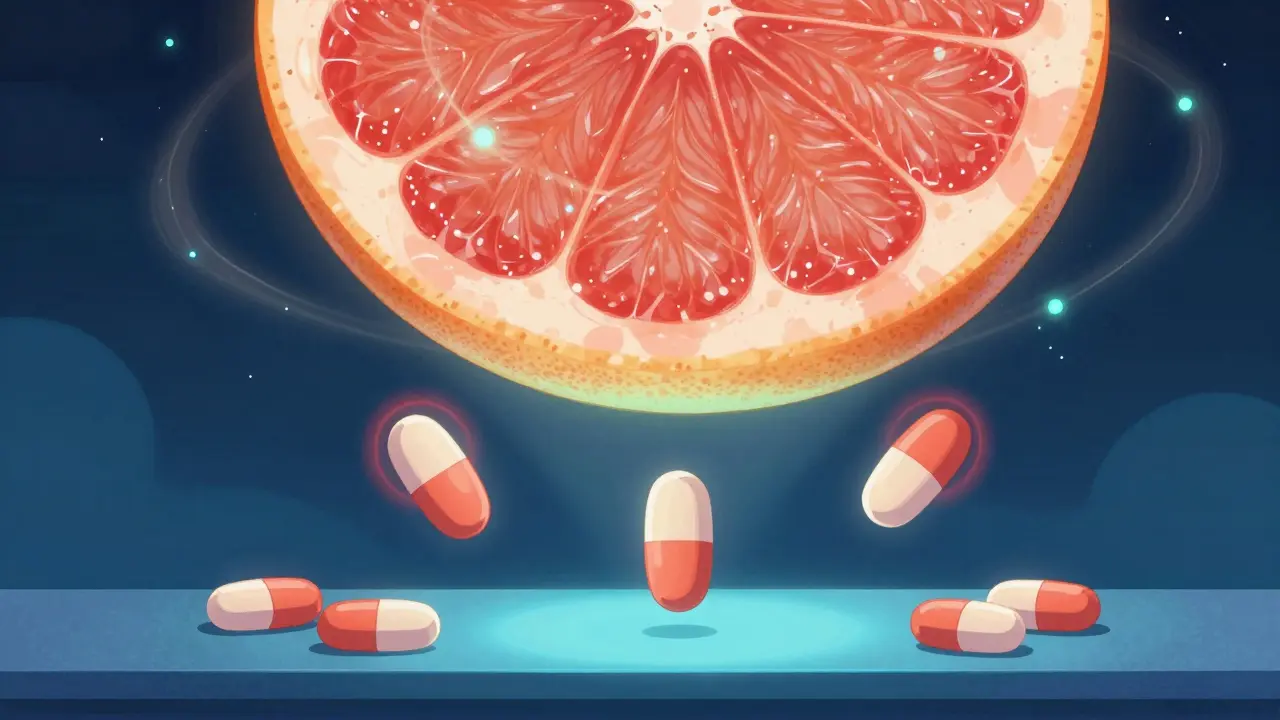
Grapefruit-Statins Interaction Calculator
Your Statin Information
Your Grapefruit Consumption
Enter your statin type, dose, and grapefruit consumption to see your risk level.
If you take a statin and love grapefruit, you might be wondering: how much is too much? A single glass of juice? Half a fruit? Is it safe? The answer isn’t simple - but it’s not as scary as some warnings make it seem. The real issue isn’t grapefruit itself. It’s how it changes what your body does with certain statins. And that change can be dangerous - but only under specific conditions.
Which Statins Are at Risk?
Not all statins react the same way with grapefruit. Only three are known to have a strong interaction: simvastatin (a cholesterol-lowering drug sold as Zocor or FloLipid), atorvastatin (sold as Lipitor), and lovastatin (sold as Mevacor). These are metabolized by an enzyme in your gut called CYP3A4. Grapefruit blocks that enzyme - and when it does, your body absorbs way more of the drug than it should.That’s not true for other statins. pravastatin (Pravachol), rosuvastatin (Crestor), fluvastatin (Lescol), and pitavastatin (Livalo or Zypitamag) use different pathways. They’re safe to take with grapefruit. If you’re on one of these, you can enjoy your fruit without worry.
How Grapefruit Changes Drug Levels
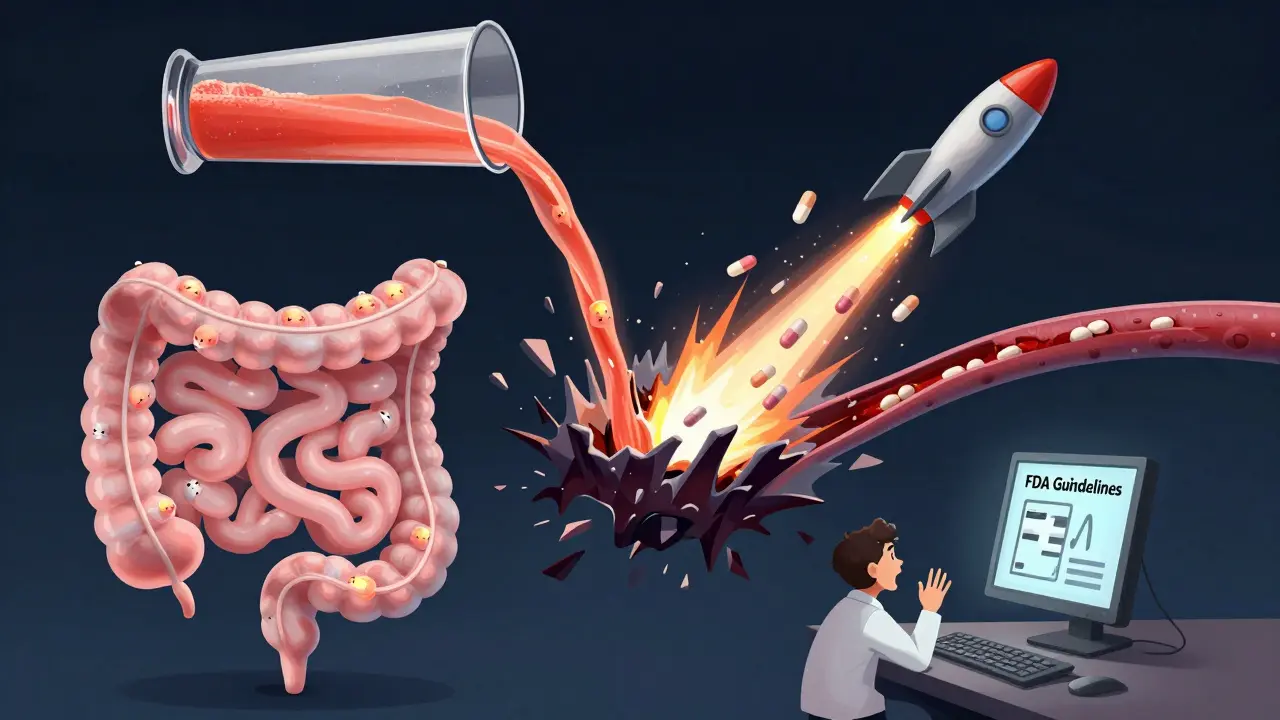
Grapefruit doesn’t just make your statin stronger - it can make it much stronger. The key culprits are chemicals called furanocoumarins (specifically bergamottin and 6',7'-dihydroxybergamottin). These compounds permanently disable CYP3A4 enzymes in your small intestine. Normally, these enzymes break down statins before they enter your bloodstream. When they’re blocked, up to 90% more of the drug gets absorbed.A 2006 study with 10 healthy volunteers showed what this looks like in real numbers. Drinking just 200 ml (about 8 oz) of grapefruit juice daily increased simvastatin levels in the blood by 3.6 times. Peak levels jumped by nearly 4 times. That’s not a small bump - it’s a massive surge. And this isn’t just theory. Real cases of muscle damage, including rhabdomyolysis (a serious condition where muscle tissue breaks down), have been linked to this combo.
What’s the Dangerous Dose?
There’s no single answer. But research gives us clear thresholds.The FDA (U.S. Food and Drug Administration) says a single serving - 200 to 250 ml (8 oz) of grapefruit juice - is enough to trigger a significant interaction with high-risk statins. That’s one glass. Not a whole pitcher. Not a large bottle. Just one standard glass.
But here’s the catch: not everyone reacts the same. A 2012 study from the Canadian Medical Association Journal found that after drinking one 250 ml serving, some people had zero increase in drug levels. Others had an 8-fold increase. Why? Genetics. Age. Other medications. Even how often you eat grapefruit. People who regularly consume it may develop some tolerance. Others, especially older adults or those with liver issues, are far more sensitive.
For someone taking 80 mg of simvastatin - the highest dose - even one glass of juice could push drug levels into dangerous territory. That’s why guidelines say: avoid grapefruit completely if you’re on high-dose simvastatin.
When Is It Probably Safe?
If you’re on a low or moderate dose of simvastatin (20 mg or 40 mg) and you love grapefruit, you might not need to quit cold turkey.A 2007 study in American Family Physician found that with normal doses of lovastatin (40 mg) and one 8 oz glass of juice daily, plasma levels rose only slightly - and no adverse events were reported. Similar findings came from the Cleveland Clinic in 2016: half a grapefruit or one glass of juice is generally acceptable for most people on standard doses.
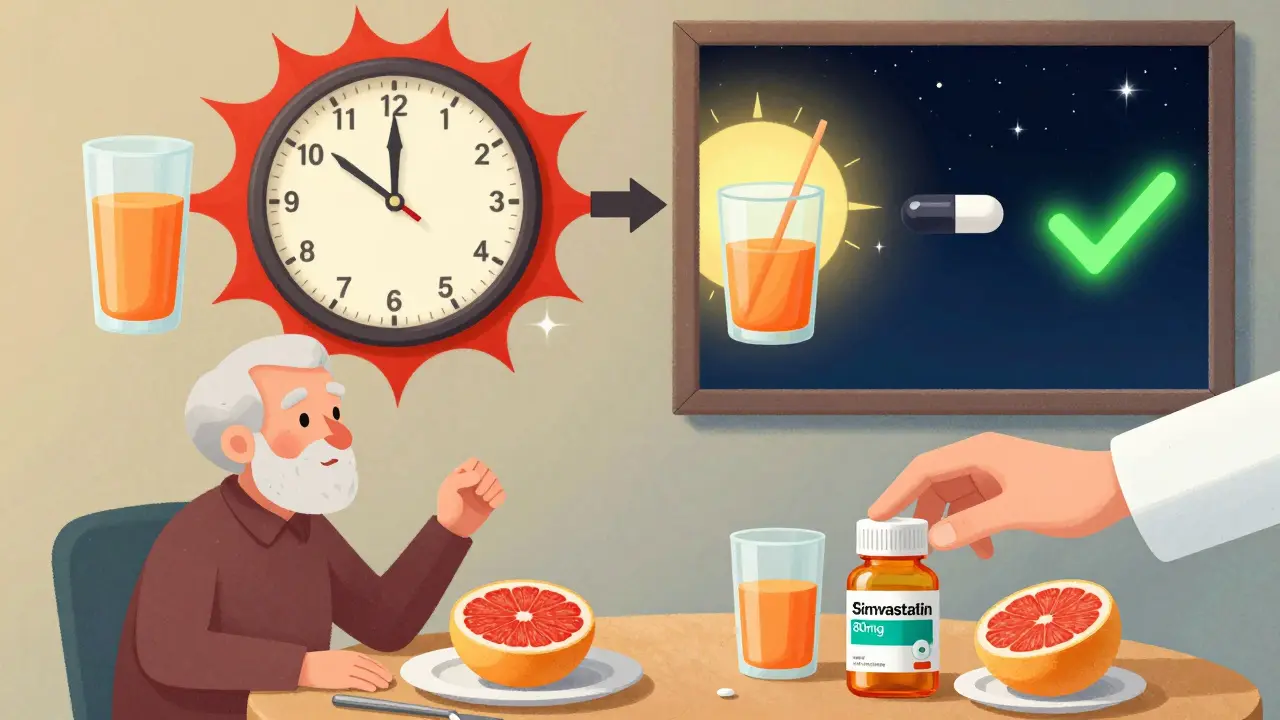
Timing matters too. Statins like simvastatin and lovastatin work best when taken at night. If you drink grapefruit juice in the morning and take your statin at bedtime, the interaction window shrinks. The American Academy of Family Physicians recommends this strategy: juice in the morning, pill at night.
Still, don’t get complacent. The FDA defines “excessive” consumption as 1.2 liters per day - that’s five 8 oz glasses. At that level, the risk becomes very high, no matter what statin you’re on.
What About Other Forms of Grapefruit?
The interaction isn’t just about juice. Whole grapefruit, grapefruit pulp, and even some grapefruit-flavored sodas or supplements can contain enough furanocoumarins to cause problems. So if you’re on simvastatin or atorvastatin, don’t assume that eating the fruit instead of drinking juice is safer. The chemicals are in the flesh and peel.And it’s not just grapefruit. Seville oranges, pomelos, and tangelos can have similar effects. If you’re unsure, stick to sweet oranges or other citrus that’s not related to grapefruit.
What Are the Real Risks?
The scariest outcome is rhabdomyolysis - a condition where muscle cells break down and leak into the bloodstream. This can damage your kidneys and, in rare cases, be fatal. Between 1990 and 2021, the FDA recorded only 17 confirmed cases of rhabdomyolysis linked to grapefruit and statins. That’s rare. But it happens.Most cases involve people who:
- Take high-dose simvastatin (60 mg or 80 mg)
- Drink multiple glasses of grapefruit juice daily
- Are over 65 or have kidney/liver problems
- Take other drugs that also affect CYP3A4, like certain antibiotics or blood pressure meds
If you’re young, healthy, and on a low dose, your risk is extremely low. But if you’re older, on a high dose, or take other meds - even one glass a day could be too much.
What Should You Do?
There’s no one-size-fits-all answer. But here’s how to think about it:- Check your statin. If it’s simvastatin, atorvastatin, or lovastatin - pay attention. If it’s rosuvastatin, pravastatin, or pitavastatin - you’re fine.
- Know your dose. High-dose simvastatin (60+ mg)? Avoid grapefruit entirely. Low or moderate dose (20-40 mg)? One glass a day may be okay - but monitor for symptoms.
- Watch for signs. Muscle pain, weakness, or dark urine? Call your doctor. These are early signs of muscle damage.
- Time it right. Drink grapefruit juice in the morning. Take your statin at night. This reduces overlap.
- Consider switching. If you love grapefruit and take a high-risk statin long-term, talk to your doctor about switching to a safe alternative like rosuvastatin or pravastatin. You can still get the cholesterol-lowering benefits without the risk.
The European Atherosclerosis Society says it best: personalized counseling beats blanket warnings. Your doctor doesn’t need to tell you to quit grapefruit. They need to know how much you drink, what statin you take, and how your body responds. That’s the only way to make a smart call.
Bottom Line
Grapefruit isn’t poison. Statins aren’t dangerous. But together, under the right conditions, they can be risky. For most people on low or moderate doses, one glass of juice a day is unlikely to cause harm - especially if taken at a different time than the pill. But if you’re on high-dose simvastatin, or you’re over 65, or you take other medications - skip it. There are too many variables to guess.The safest move? Talk to your doctor. Bring your bottle. Tell them how much grapefruit you eat. Let them help you decide - not a warning label, not a website, not a rumor. You deserve care that fits your life - not one that scares you away from something you love.
Can I drink grapefruit juice if I take simvastatin?
It depends. If you take 80 mg of simvastatin, avoid grapefruit completely. If you take 20 mg or 40 mg, one 8 oz glass per day may be safe - especially if you drink it in the morning and take your pill at night. But even then, monitor for muscle pain or dark urine. Talk to your doctor before assuming it’s okay.
Is grapefruit dangerous with all statins?
No. Only simvastatin, atorvastatin, and lovastatin are affected. Pravastatin, rosuvastatin, fluvastatin, and pitavastatin are safe. Check your medication label or ask your pharmacist. If your statin isn’t on the high-risk list, you can enjoy grapefruit without worry.
How much grapefruit juice is too much?
The FDA says 200-250 ml (about 8 oz) is enough to cause a significant interaction with high-risk statins. One glass a day can be risky for some people. Five or more glasses a day (1.2 liters) is considered excessive and highly dangerous. Even one glass can be too much if you’re on a high dose or take other interacting drugs.
Can I eat grapefruit instead of drinking juice?
Yes, but it’s not safer. The same chemicals that block CYP3A4 are in the flesh and peel of grapefruit. Half a grapefruit contains enough furanocoumarins to cause the same interaction as a glass of juice. Don’t assume eating it is better - it’s not.
What if I accidentally drank grapefruit juice with my statin?
One accidental glass is unlikely to cause harm. But if you’re on a high dose of simvastatin or have other risk factors (age, kidney disease, other medications), watch for muscle pain, weakness, or dark urine for the next few days. If those symptoms appear, contact your doctor immediately. Otherwise, avoid it going forward.
Should I switch statins if I love grapefruit?
If you regularly consume grapefruit and are on simvastatin or atorvastatin, switching to rosuvastatin or pravastatin is often the best long-term solution. These statins work just as well, have fewer drug interactions, and let you enjoy grapefruit without risk. Talk to your doctor - it’s a simple change that could improve your safety and quality of life.

Buddy Nataatmadja
March 13, 2026 AT 13:42Also, I love that this post didn’t just say ‘avoid everything’ - it gave nuance. Rare these days.
mir yasir
March 14, 2026 AT 10:05Stephanie Paluch
March 15, 2026 AT 17:49My doctor was like ‘you’re fine’ and I’m like ‘thank god bc I love this fruit’
Also side note: if you’re scared of grapefruit, try blood oranges. Same vibe, zero drama. 🙌
tynece roberts
March 17, 2026 AT 10:20i take atorvastatin and i drink like 1 glass of juice like 3x a week? is that bad? do i need to stop? what if i switch to orange juice? wait no wait orange juice is fine right? or is it? my head hurts
and also why does everything have to be so complicated?? i just wanna eat my fruit and not have a heart attack
Hugh Breen
March 19, 2026 AT 05:36Look - I’m not a doctor, but I’ve been helping my mom manage her meds for 8 years. She’s 72, on simvastatin 20mg, drinks grapefruit juice every morning. We called her pharmacist. They said ‘it’s fine if it’s one glass and she takes it at night.’
But here’s the thing - most people don’t call. They just panic and quit grapefruit forever. Or worse, they keep drinking and ignore muscle pain.
Knowledge is power. Talk to your pharmacist. Ask questions. Don’t let fear make your decisions for you. 💪🍊
Byron Boror
March 19, 2026 AT 12:09Lorna Brown
March 19, 2026 AT 14:15What struck me most was the line about personalized counseling. We treat health like a software update - ‘download the fix, ignore context.’ But bodies aren’t code. Genetics, age, diet, stress, sleep - they all shift the math.
I wonder how many people have quit grapefruit unnecessarily… and how many have ignored warning signs because they assumed ‘one glass’ was harmless. The real risk isn’t the fruit. It’s the assumption.
Rex Regum
March 20, 2026 AT 04:10Meanwhile, real science says: 17 cases in 30 years? That’s less than lightning strikes. You’re more likely to die from a vending machine falling on you than from grapefruit and statins. Stop living in fear. Eat the fruit. Live your life.