
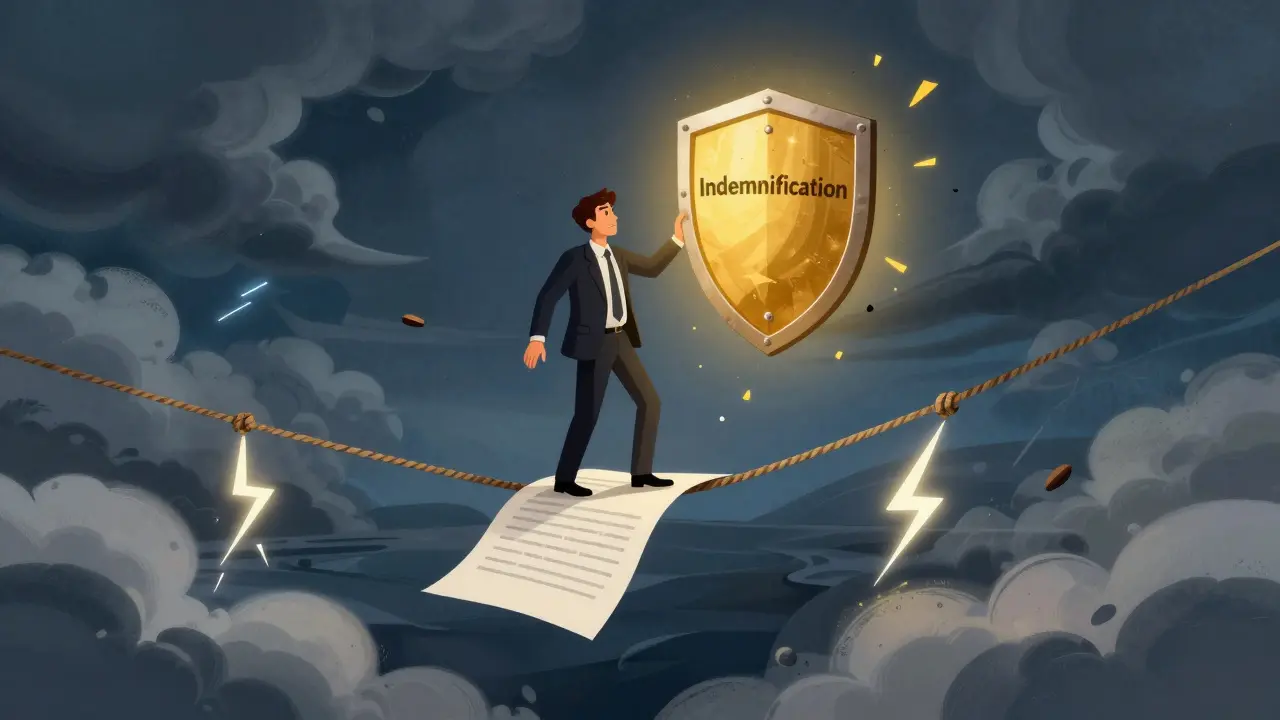
You sign a contract. It looks clean. The terms seem fair. But buried on page forty-two is a sentence about indemnification, which is a legal mechanism where one party agrees to compensate another for losses, damages, or liabilities incurred due to specific events. You skim past it. Months later, a third party sues your company. Suddenly, that skipped sentence isn't just text; it's a financial lifeline-or a disaster.
In generic transactions, whether you are buying software, hiring a contractor, or merging companies, understanding who pays when things go wrong is the single most critical part of the deal. This isn't about reading every word of a novel. It is about knowing exactly how risk moves from one pocket to another.
What Exactly Is Indemnification?
Let’s strip away the legalese. At its core, indemnification is a promise. One party (the indemnifier) promises to pay the other party (the indemnitee) if a specific bad thing happens.
Think of it like an insurance policy written by your business partner instead of an insurance company. If your vendor breaches a copyright law because of the code they sold you, they don’t just say "sorry." They write you a check for the lawyers’ fees and the settlement. That is indemnification in action. According to legal analysis from Thomson Reuters, these clauses appear in nearly all commercial agreements because they serve as essential mechanisms for allocating risk between parties.
The goal is certainty. You want to know that if a specific event occurs, the financial burden won’t fall on your shoulders unexpectedly. As noted by Icertis, if the outlined event happens, the indemnifying party is obligated to cover expenses, damages, and legal fees.
The Three Pillars: Indemnify, Defend, Hold Harmless
Most people use these words interchangeably, but in a court of law, they mean three very different things. Mixing them up can cost you thousands in litigation strategy.
- To Indemnify: This means reimbursement. If you lose money because of the other party’s actions, they pay you back. Morgan Lewis cites California case law stating that to 'indemnify' means to pay or compensate the other party for its legal liabilities or losses.
- To Defend: This is about active protection. The indemnifier doesn’t just pay the bill at the end; they hire the lawyers and manage the lawsuit while it is happening. This includes paying legal fees as they accrue.
- To Hold Harmless: This prevents the indemnitee from being sued in the first place for certain liabilities. It essentially says, "You cannot pursue me for liability that I am exposed to due to my own actions related to this contract."
When drafting or reviewing a contract, look for the phrase "indemnify, defend, and hold harmless." This combination gives the strongest protection to the indemnitee. If you are the one providing the indemnity, try to limit it to just "indemnify" so you aren’t forced to control a defense you might not agree with.
Seven Critical Elements Every Clause Must Have
A vague indemnity clause is useless. To work, it needs precision. Icertis identifies seven critical elements that define the scope and power of the agreement. If your contract misses any of these, you have a gap in your armor.
- Scope of Indemnification: What exactly is covered? Does it include legal fees? Third-party claims? Damages resulting from negligence? Be specific. "All losses" is too broad and may be unenforceable in some jurisdictions.
- Triggering Events: What sets the clause in motion? Common triggers include breaches of contract, negligence, misconduct, or IP infringement. For example, if a data breach occurs due to a vendor's failure to maintain security, that specific event triggers their obligation to indemnify you.
- Duration: How long does this last? Does it end when the contract ends? Or does it survive for years after termination? In M&A deals, survival periods can stretch for five years or more.
- Limitations and Exclusions: Are there caps? Most contracts exclude "consequential damages" (like lost profits) from indemnification unless specifically stated otherwise. There is usually a dollar cap on total liability.
- Procedures for Claims: How do you notify the other party? You must follow strict timelines. If you fail to notify the indemnifier within ten days of a lawsuit, you might lose your right to be indemnified entirely.
- Insurance Requirements: Does the indemnifier need to carry specific insurance policies to cover these risks? This ensures they actually have the money to pay you if they go bankrupt.
- Jurisdiction and Governing Law: Where will disputes be resolved? Laws vary significantly by state. Some states distinguish heavily between indemnification and hold-harmless clauses.

Mutual vs. Unilateral: Who Protects Whom?
Not all indemnification structures are created equal. The structure depends heavily on bargaining power.
Unilateral indemnification is common when one party holds significant leverage. For instance, a large enterprise buyer will often require a small software vendor to unilaterally indemnify them against claims that the software infringes on someone else's IP rights. The vendor has little choice but to accept.
Mutual indemnification means both parties agree to compensate each other for losses arising from their respective breaches. This is less common in standard commercial sales but frequent in construction contracts or partnerships where both sides share similar risks, such as injury to employees or subcontractors.
| Feature | Unilateral | Mutual |
|---|---|---|
| Direction of Risk | One-way (Seller to Buyer) | Two-way (Both Parties) |
| Bargaining Power | Imbalanced | Relatively Equal |
| Common Use Case | Software Licensing, SaaS | Construction, Joint Ventures |
| Negotiation Complexity | Lower (for the stronger party) | Higher (requires balance) |
Risk Allocation in Mergers and Acquisitions
In mergers and acquisitions (M&A), indemnification is the heavyweight champion of negotiation. Whiteford Law notes that these provisions are a key M&A risk allocation device, providing post-closing protection for buyers against seller breaches. Here, the stakes are higher, and the clauses are more sophisticated.
McLane identifies three critical transactional elements in M&A indemnities:
- Survival Periods: Fundamental representations (like tax matters and equity ownership) typically survive longer than non-fundamental ones (like employee benefits). Buyers want long tails; sellers want short ones.
- The Basket (Deductible): This is the threshold amount the buyer must absorb before the seller has to pay anything. It prevents the seller from paying for every tiny, trivial claim. Think of it like an insurance deductible.
- The Cap: The maximum amount the seller will ever have to pay. This provides finality and limits the seller's exposure.
Davis Wright Tremaine emphasizes that indemnification provisions typically create more risk exposure for sellers than buyers. Therefore, sellers should narrow the scope of indemnification to the extent possible. However, eliminating it entirely is rare except in unusual circumstances.
Practical Tips for Negotiating Indemnity Clauses
You don’t need to be a lawyer to spot a bad indemnity clause, but you do need to know what to look for. Here is how to protect yourself during negotiations.
1. Define "Losses" Clearly Don’t leave it open-ended. Specify that "losses" include reasonable attorneys’ fees, settlements, judgments, and investigation costs. If you don’t list them, the other side might argue they only owe you the direct damage amount, leaving you with massive legal bills.
2. Control the Defense The party controlling the defense controls the litigation strategy. ContractNerds highlights that control rights affect risk exposure given that the one who controls the defense is charged with the litigation strategy which can directly impact the cost of litigation. If you are the indemnitee, ensure you have the right to approve settlements, especially those involving admissions of liability.
3. Watch the Triggers Ensure the triggering events are specific. Avoid broad language like "any act or omission." Instead, tie it to "breach of confidentiality," "IP infringement," or "gross negligence." This prevents the indemnifier from having to pay for minor, everyday issues that should be handled through standard warranty remedies.
4. Check the Insurance A promise is only as good as the ability to pay. Require the indemnifier to maintain General Liability or Professional Liability insurance with sufficient coverage limits. Ask for proof of insurance annually.
Common Pitfalls to Avoid
Even experienced professionals make mistakes here. Here are the most common traps.
The Silent Survival If the contract doesn’t specify a survival period for indemnities, courts may imply a "reasonable" time, which varies wildly by jurisdiction. Always explicitly state the duration. "Indemnities shall survive for three years following the closing date" leaves no room for argument.
Ignoring Consequential Damages Many contracts explicitly exclude consequential damages (lost profits, loss of reputation). If your primary risk is losing future revenue, a standard indemnity might not cover it. You need a specific carve-out that allows indemnification for consequential damages in cases of gross negligence or willful misconduct.
Failure to Notify This is the easiest way to void your protection. If a claim arises, you must notify the indemnifier immediately according to the contract’s timeline. Delaying notification can be seen as prejudicing the indemnifier’s ability to defend themselves, releasing them from their obligations.
Conclusion: Precision Over Perfection
You cannot eliminate risk in business. You can only allocate it. Indemnification is the tool that allows you to move that risk to the party best able to manage or insure against it. Whether you are a startup selling a simple service or a corporation acquiring a competitor, the principles remain the same: define the scope, set the triggers, establish the limits, and follow the procedures.
Don’t let boilerplate language dictate your financial safety. Read the clause. Understand the difference between indemnifying and defending. And remember, in the world of generic transactions, the person who reads the fine print usually keeps the money.
What is the difference between liability and indemnification?
Liability refers to the legal responsibility for something, such as damages or injuries. Indemnification is a contractual agreement where one party agrees to compensate the other for losses resulting from that liability. Essentially, liability is the risk itself, while indemnification is the transfer of the financial burden of that risk to another party.
Is an indemnification clause always enforceable?
Not always. Courts may strike down indemnification clauses that are overly broad, violate public policy, or attempt to indemnify a party for their own gross negligence or willful misconduct. Enforceability also depends on the specific laws of the governing jurisdiction, as some states restrict indemnity for one's own negligence.
What is a "basket" in an indemnification clause?
A basket (or deductible) is a threshold amount that the indemnitee must incur before the indemnifier is required to pay. For example, if the basket is $50,000, the buyer absorbs the first $50,000 of losses. The seller only indemnifies amounts exceeding that figure. This prevents claims for minor, trivial issues.
How long do indemnification obligations last?
The duration, known as the survival period, is negotiated in the contract. In generic commercial transactions, it might last for the term of the agreement plus one year. In M&A deals, fundamental representations may survive for five years or more, while non-fundamental ones might expire sooner. Without a specified period, courts may determine a "reasonable" time, which creates uncertainty.
Should I require insurance for indemnification?
Yes, ideally. Requiring the indemnifying party to maintain specific insurance coverage (such as General Liability or Professional Liability) ensures they have the financial resources to fulfill their indemnification obligations. It protects you if the indemnifier goes bankrupt or lacks sufficient assets to pay a large claim.


Madison Jones
May 11, 2026 AT 19:50Oh my gosh, this is such a crucial topic!!! I can't stress enough how important it is to read those fine print sections! It really saves you from so much heartache later on!! You did an amazing job breaking down the legalese into something we can actually understand!!!
Nilesh Mandani
May 12, 2026 AT 23:06The concept of indemnification is essentially a transfer of risk which many people overlook until it's too late. In my experience working with contracts in India and abroad, the distinction between 'defend' and 'indemnify' is where most disputes arise. It's not just about money but about control over the narrative of the lawsuit.
Jake Williams
May 13, 2026 AT 09:11Another boring legal guide for people who can't handle basic responsibility. If you sign a contract without reading it, that's on you, not the other party. The system works fine if everyone just did their due diligence instead of relying on these 'practical guides'.
Guy Birtwhistle
May 13, 2026 AT 11:36Sarcasm aside, Jake has a point about personal responsibility, though your guide is undeniably useful for those who need hand-holding through corporate BS. The part about controlling the defense is key because lawyers love to settle quickly to save fees, often at the expense of your long-term reputation.
Kenny Pines
May 14, 2026 AT 07:41I totally agree with Guy here 🤝 The control aspect is huge. Also, emojis are great for communication right? 😂 Just kidding, but seriously, knowing who controls the litigation strategy is vital.
Liz and Nick
May 14, 2026 AT 17:06this is all just corporate speak to scare small businesses into hiring expensive lawyers why cant we just have honest deals like they used to make everything so complicated now its disgusting
Brian Fibelkorn
May 16, 2026 AT 03:41The notion that one can simply 'have honest deals' is naive at best. Legal frameworks exist precisely because human nature is inherently flawed and self-serving. Indemnification clauses are not 'corporate speak' but essential mechanisms for risk allocation in complex transactions. Ignoring them invites chaos.
Chelsea Grdina
May 16, 2026 AT 16:38Hi there! As someone who navigates cross-border contracts between Canada and the US, I find the jurisdiction section particularly fascinating. The differences in how states interpret 'hold harmless' clauses can be night and day. It's really important to consider the cultural context of business negotiations as well, as trust levels vary significantly depending on the region and industry norms. 🌎📄
Brian Lee
May 18, 2026 AT 05:29Good info. I always forget to check the survival period. My last contract ended up costing me because i didnt notice the clause survived for 5 years after termination. Thanks for the reminder to look out for that stuff.
Sarah Grenberg
May 19, 2026 AT 21:03Brian, your experience highlights exactly why attention to detail is paramount. It is truly empowering to share these insights so others can avoid similar pitfalls. Let us continue to support each other in navigating these complex professional landscapes.
Sarah Kwiatkowski
May 20, 2026 AT 12:18I'm curious about the basket deductible in M&A deals. Is there a standard percentage that buyers usually push for? I've seen ranges from 1% to 5% of deal value but wonder if there's a sweet spot that sellers accept more readily.
Brian LeClercq
May 20, 2026 AT 17:22Let us dispense with the mediocrity of 'standard percentages.' There is no sweet spot; there is only leverage. A seller with nothing to hide should demand zero basket. A buyer with nothing to fear should demand unlimited liability. The rest is merely theater for the weak-minded.
Frances Kendall
May 20, 2026 AT 22:00Brian LeClercq, while your stance is bold, it ignores the practical realities of negotiation. Most parties seek balance rather than absolute dominance. The 'basket' serves as a filter for nuisance claims, allowing both sides to focus on material breaches. It is a tool for efficiency, not just a weapon of war.
Natali Brown
May 21, 2026 AT 22:55It is so important to remember that behind every clause is a person trying to protect their livelihood. I feel for the vendors who get squeezed by unilateral terms. We should strive for mutual respect in these agreements. It makes the whole process less stressful for everyone involved. :)
David Rangkhal
May 23, 2026 AT 00:34Respectfully, Natali, while empathy is noble, business is transactional. However, David Rangkhal here thinks insurance requirements are the most underrated part of this post. Without proof of insurance, indemnification is just paper promises. 🔥