

You love your furry friend, but they might be making you miserable. If you are sneezing every time your cat jumps on the couch or your dog snuggles into bed, you are dealing with pet allergies. About 10% of people in the U.S. suffer from this condition, according to the American Lung Association. The frustrating part? You don't have to give up your pet to feel better. While you can never completely eliminate allergens from a home with animals, you can drastically cut down exposure using specific, evidence-based strategies.
First, let's clear up a huge myth. It is not the hair that makes you sick. Pet hair is just a vehicle. The real culprit is pet dander, which is microscopic flakes of skin shed by cats, dogs, and other animals. These tiny particles carry proteins like Fel d 1 (in cats) and Can f 1 (in dogs). These proteins stick to everything-your clothes, your furniture, and even the air itself. They are so light they stay airborne for hours and can linger in dust for months. Understanding this sticky nature of dander is key to fighting it.
Creating a Pet-Free Sanctuary
The single most effective thing you can do is keep your pet out of your bedroom. Dr. Sandra Hong from Cleveland Clinic notes that designating the bedroom as a pet-free zone can reduce nighttime allergy symptoms by up to 40%. Think about it: you spend roughly one-third of your life sleeping. If your bedroom is a sanctuary, you get a long break from allergen exposure every day.
This doesn't mean your pet has to sleep outside. Just close the door. To make this work, you need to manage how much dander your pet carries onto their bedding and toys. Since pets groom themselves constantly, they spread saliva containing allergens all over their fur. When that fur sheds, the dander goes everywhere. By keeping them out of the room where you sleep, you protect your most vulnerable time-when your immune system is resting.
Vacuuming and Air Filtration That Actually Works
Your current vacuum cleaner might be spreading allergens around rather than trapping them. Standard vacuums often blow fine particles back into the air because their filters aren't tight enough. You need a vacuum with a true HEPA filter, which is a high-efficiency particulate air filter capable of trapping 99.97% of particles as small as 0.3 microns.
Research from Filtrete shows that HEPA vacuums are 30-50% more effective at capturing pet dander than standard models. Aim to vacuum your main living areas two to three times a week. It takes about 15-20 minutes per session, but it makes a massive difference. Pair this with an air purifier that also uses a HEPA filter. Properly sized units can reduce airborne allergens in a room by 40-60%. Place the purifier in the room where you spend the most time, ideally near the floor since heavy dander tends to settle there.
| Tool / Strategy | Effectiveness Metric | Key Consideration |
|---|---|---|
| HEPA Vacuum Cleaner | Captures 99.97% of particles <0.3 microns | Must replace filters regularly (every 6-12 months) |
| HEPA Air Purifier | Reduces airborne allergens by 40-60% | Must be correctly sized for the room volume |
| Hard Flooring (vs Carpet) | Holds 50-75% less dander than carpet | Easier to clean but requires frequent mopping/vacuuming |
| Bedroom Exclusion | Reduces nighttime symptoms by up to 40% | Requires strict discipline to keep pet out |

Flooring and Furniture Choices
If you are renovating or buying new furniture, your choices matter. Carpets act like sponges for dander. Once those microscopic flakes get deep into the fibers, they are nearly impossible to remove completely. Hard surfaces like hardwood, tile, or linoleum harbor 50-75% less pet dander than carpeted floors, according to analysis from Allergy Fort Worth. You can wipe them down easily. When it comes to furniture, avoid heavy fabrics if possible. Leather or vinyl sofas are easier to wipe clean. If you must have fabric couches, use removable covers that you can wash weekly. Wash all pet bedding and your own bedding in hot water-at least 130°F (54°C)-once a week. This temperature is crucial because cooler water won't kill the allergens effectively; it just moves them around.
Grooming Your Pet to Reduce Shedding
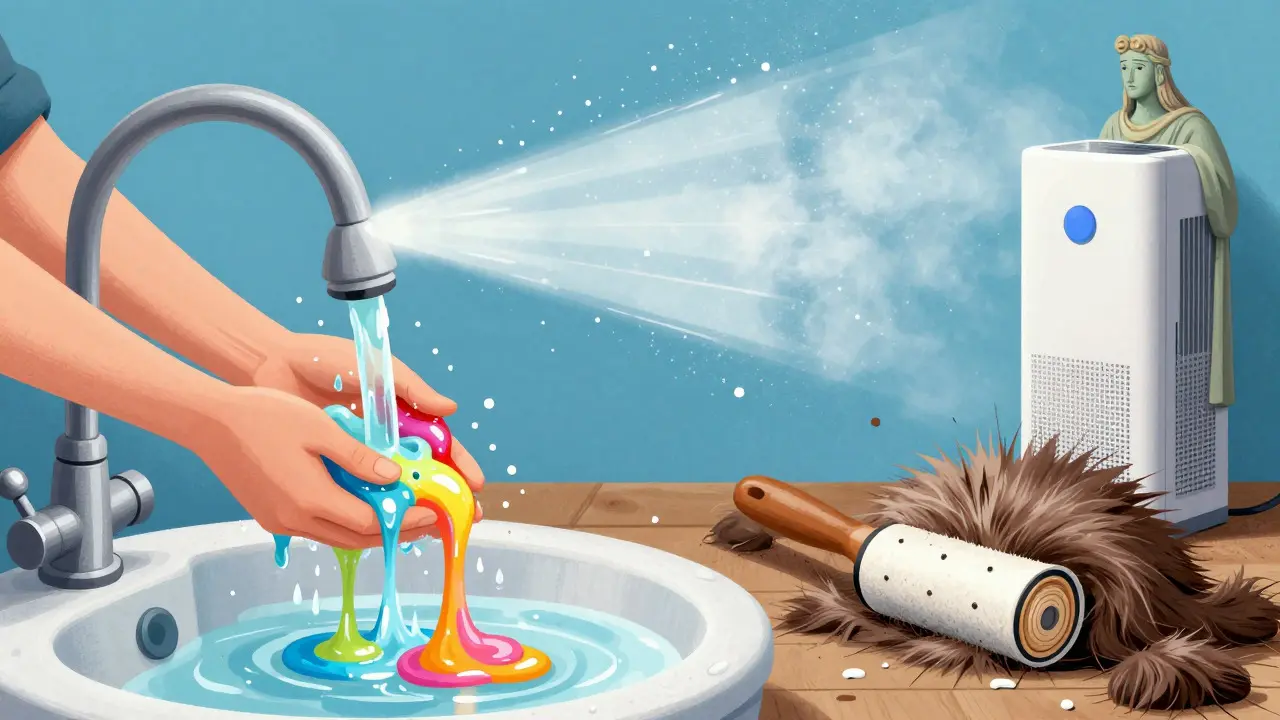
Bathing your pet helps wash away loose dander and allergens from their coat. The recommendation is to bathe them once a week. However, this is easier said than done. Data from Ohio State University Veterinary Medical Center shows that 60% of cat owners struggle with regular bathing due to feline resistance, compared to 35% of dog owners. If your pet hates baths, try these alternatives:
- Dry shampoo sprays: Use anti-allergen sprays designed to neutralize proteins. Independent testing shows these can reduce allergen potency on surfaces by 30-70% for 24-72 hours.
- Wiping down: Use damp cloths or specialized grooming wipes to rub down your pet's coat daily. This physically removes loose dander before it falls off.
- Professional grooming: Take your pet to a groomer who can bathe them in a separate location, preventing dander from settling in your home during the process.
Medical Management and Long-Term Relief
Environmental controls are the foundation, but sometimes they aren't enough. For immediate relief, over-the-counter antihistamines can help 60-70% of mild allergy sufferers within an hour. Look for non-drowsy options like loratadine or cetirizine. Nasal corticosteroid sprays are another powerful tool that reduces inflammation in the nasal passages directly.
For long-term solutions, consider immunotherapy. Allergy shots have been shown to provide lasting relief for 80-85% of patients after a 3-5 year course. More recently, the FDA approved Odactra, a sublingual tablet for cat allergies, in 2023. This pill sits under the tongue and works similarly to shots but offers greater convenience. Clinical trials showed an 80% symptom reduction for users. Talk to an allergist to see if this is right for you. Delaying treatment for years, as 40% of pet owners do, only leads to worse symptoms and lower quality of life.
Daily Habits for Immediate Impact
Small changes in your daily routine can stop allergens from spreading. Wash your hands immediately after petting your animal. This simple step reduces allergen transfer to your face by 90%. Avoid rubbing your eyes after handling your pet. Change your clothes after spending extended time playing with your pet, especially if you've been on the floor or sofa. Use lint rollers on your clothing and upholstery daily to pick up surface dander. These habits take seconds but prevent the cumulative buildup of allergens in your environment.
Is there really such thing as a hypoallergenic pet?
No. According to experts like Dr. David Stukus, no dog or cat breed is truly hypoallergenic. All furry or feathered animals produce dander, saliva, and urine proteins that trigger allergies. Some breeds may shed less hair, which reduces the amount of dander released into the air, but they still produce the allergenic proteins. Individual variation exists between animals, so one cat might trigger fewer symptoms than another, but zero risk does not exist.
How long does it take to see improvement with home strategies?
Most people report noticeable symptom improvement within 4-6 weeks of consistently implementing environmental controls. This includes keeping pets out of the bedroom, vacuuming with a HEPA filter 2-3 times a week, and washing bedding in hot water. Full benefits, such as a 50-70% reduction in measurable allergens, typically appear after about 3 months of strict adherence to these routines.
What is the best way to clean pet dander from carpets?
The best way is to vacuum frequently with a machine equipped with a true HEPA filter. Standard vacuums often recirculate fine dander particles back into the air. If possible, replacing carpet with hard flooring like wood or tile is the most effective long-term solution, as hard surfaces hold 50-75% less dander. For existing carpets, steam cleaning can help, but it must be followed by thorough drying to prevent mold, and frequent HEPA vacuuming remains essential.
Do air purifiers actually work for pet allergies?
Yes, but only if they have a true HEPA filter. Studies show that properly sized HEPA air purifiers can reduce airborne pet allergen concentrations by 40-60% in standard rooms. They are most effective when placed in rooms where you spend the most time, such as the living room or bedroom. Ensure the unit's Clean Air Delivery Rate (CADR) matches the size of your room for optimal performance.
Should I bathe my cat or dog weekly?
Weekly bathing is recommended to wash away allergens from their coat. However, many pets resist this. If your pet struggles with baths, you can use alternative methods like daily wiping with damp cloths or using dry shampoo sprays designed to neutralize allergens. Consistency is key; whether you bathe or wipe, doing it regularly prevents the buildup of dander and saliva proteins on their fur.



Trey Newkerk
July 21, 2026 AT 12:10Oh, look at you. Another article trying to solve the existential crisis of loving a creature that biologically rejects your presence. It is poetic in its cruelty. You spend thousands on HEPA filters and hot water washes, yet you still wake up with itchy eyes because nature doesn't care about your comfort. The real issue isn't the dander; it's your refusal to accept that you are not the center of this ecosystem. Your pet doesn't love you back in the way you want. They tolerate you. And now they are killing you slowly with microscopic skin flakes. Beautiful.
Charles PINSON
July 22, 2026 AT 04:54The average person lacks the intellectual fortitude to understand that 'hypoallergenic' is a marketing construct designed for the gullible masses who cannot afford proper medical intervention. While you scrub your floors, the elite simply undergo immunotherapy or move to environments where such trivialities do not impede their productivity. Your obsession with vacuuming is a symptom of a broader societal decline in hygiene standards and personal responsibility.
John Anderson
July 23, 2026 AT 19:17You let them sleep in your bed. That is the problem. Simple as that. Close the door. Stop coddling the animal. If you can't handle a closed door, get rid of the pet. It is selfish to keep an animal if it makes you sick. Fix it or lose it.
Patrick Plummer
July 24, 2026 AT 11:36But what if the cat wants to be there?! What if the dog feels abandoned?! You are ignoring the emotional toll on the ANIMAL! They suffer too! Why must we always prioritize human convenience over the spiritual bond? It is cruel! It is cold! You are monsters for wanting to breathe freely!
Kieran Healy
July 25, 2026 AT 08:10I feel like people forget how hard it is to live with allergies while loving pets :/ I have two cats and I sneeze all the time but I just use wipes every day. It helps a bit. Don't give up on them though! They are family :) Just try to be patient with yourself.
Kevin Burke
July 25, 2026 AT 09:48The true philosopher understands that suffering is inherent to existence. Your allergy is merely the universe reminding you of your mortality and your separation from the natural world. By fighting the dander, you fight reality itself. Accept the itch. Embrace the sneeze. In doing so, you transcend the physical limitations of your body and achieve a state of pure, unadulterated awareness. Or just buy a better vacuum. Whatever works for your ego.
neal vince
July 26, 2026 AT 01:17It is evident that most homeowners fail to comprehend the technical specifications of particulate matter. A standard vacuum is useless. You require a sealed-system HEPA filtration unit. Furthermore, your HVAC system likely recirculates allergens if you have not installed MERV-13 filters. This is basic engineering. Why do people ignore basic engineering?
Sinead Doyle
July 27, 2026 AT 02:37Big Pharma wants you to think it's just dander lol. It's the fluoride in the water mixing with the pet saliva creating a toxic sludge that weakens your immune system. They don't want you to know that washing bedding in hot water activates the proteins instead of killing them. Wake up sheeple. Odactra is a tracking device under your tongue. Trust no one.
Emily Schor
July 27, 2026 AT 05:16I found that using lint rollers on my clothes before sitting down really helps. It's a small step but it keeps the couch cleaner. Also, keeping the bedroom door closed is tough when the dog whines, but it does help me sleep better without waking up congested.
Arun Krishnan
July 29, 2026 AT 02:16Great tips here everyone. Remember, consistency is key. Start with one change, like the bedroom rule, and build from there. You can do this. Your health matters. Keep going!
Bobby Christiansen
July 30, 2026 AT 07:11Ugh, why is everything so complicated?! I just want to hug my dog without crying! People say 'just get rid of it' but that's so mean! My dog is my soulmate! I hate this post for making me feel guilty about loving him too much! Why can't science just fix it already?! :((
anna arifiana
July 30, 2026 AT 19:51And then, of course, the experts will tell you that you must bathe your pet weekly, which is absurd, because any owner knows that bathing a cat is akin to wrestling a greased pig, and thus, the advice is rendered practically useless by its own impracticality, leading one to question the sanity of those who propose such rigorous regimens for creatures that were never meant to be domesticated in the first place, let alone subjected to the indignity of soap and water on a regular basis, which serves only to strip their natural oils and cause further irritation, thereby exacerbating the very problem it seeks to solve, in a vicious cycle of futility.
Marie-Gladys Darcelin
August 1, 2026 AT 15:19It is quite apparent that the general public suffers from a severe lack of discipline regarding household management. To allow a pet into one's sleeping quarters is an affront to order and hygiene. One must establish boundaries immediately. If one cannot enforce a simple rule, one is unfit for pet ownership. Period.
Kyle Bonnette-Lykens
August 3, 2026 AT 14:04carpet is bad. wood is good. vacuum more. end of story.
Jasmine Agito
August 4, 2026 AT 06:52I actually tried the sublingual tablets mentioned in the article and they made a huge difference after a few months. It wasn't instant, but I could finally sleep through the night. If you're struggling, maybe talk to an allergist about long-term options rather than just relying on cleaning. It saved my relationship with my cat.