
PPI Prescription Calculator for Heart Patients
Risk Assessment Tool
This tool helps determine if you need a proton pump inhibitor (PPI) with antiplatelet therapy based on your specific risk factors. Always consult your doctor before making treatment changes.
When you’re on dual antiplatelet therapy - usually aspirin plus clopidogrel, prasugrel, or ticagrelor - your blood doesn’t clot as easily. That’s good for preventing heart attacks and strokes. But it also means your stomach lining is more vulnerable. The risk of a serious gastrointestinal (GI) bleed jumps by 30% to 50% in the first month after starting these drugs. And for many patients, that bleed isn’t just a nuisance - it’s life-threatening.
Why GI Bleeds Happen with Antiplatelets
Aspirin and other antiplatelet drugs work by blocking platelets from sticking together. That’s why they prevent clots in arteries. But those same platelets help repair tiny tears in the stomach lining caused by acid. Without them, even normal stomach acid can start eating away at the tissue. The result? Ulcers, erosions, and sometimes major bleeding that requires hospitalization or blood transfusions. Studies show that aspirin alone increases GI complications by 2 to 4 times compared to no treatment. When you add a second antiplatelet like clopidogrel, the risk climbs even higher. In fact, nearly 75% of serious GI bleeds in these patients happen within the first 30 days after starting treatment. That’s why doctors now routinely recommend a proton pump inhibitor - or PPI - alongside these drugs.What Are Proton Pump Inhibitors?
PPIs are medications that shut down the acid-producing pumps in your stomach. They’re not antacids. They don’t just neutralize acid - they stop your body from making it in the first place. This gives your stomach lining time to heal. The most common PPIs used with antiplatelets are:- Omeprazole (20-40 mg daily)
- Esomeprazole (20-40 mg daily)
- Pantoprazole (40 mg daily)
Not All PPIs Are Created Equal
Here’s where things get tricky. Not every PPI works the same way with every antiplatelet drug. Omeprazole is the most studied. It’s cheap, effective, and widely available. But it interferes with how your body processes clopidogrel. Clopidogrel needs to be activated by an enzyme called CYP2C19. Omeprazole blocks that enzyme. Studies show this can reduce clopidogrel’s effect by up to 30%. That means your blood might start clotting again - and that’s dangerous if you’ve had a stent. Pantoprazole and esomeprazole, on the other hand, barely touch CYP2C19. That makes them the safer choices when clopidogrel is part of your treatment. A 2025 study of nearly 97,000 Korean stroke patients found that those on pantoprazole or esomeprazole had a 37% lower risk of GI bleeding - with no increase in heart attacks or strokes. If you’re on ticagrelor or prasugrel instead of clopidogrel, you don’t have to worry about this interaction. These drugs don’t rely on CYP2C19. So you can safely use omeprazole if needed. But if you’re on clopidogrel, choose pantoprazole or esomeprazole.PPIs vs. H2 Blockers: Why PPIs Win
Some doctors try histamine-2 receptor antagonists (H2RAs) like famotidine or ranitidine as a cheaper alternative. But they don’t cut it. A 2017 meta-analysis in JAMA Internal Medicine compared PPIs and H2RAs head-to-head. PPIs reduced upper GI bleeding risk by 60%. H2RAs? Just 30%. The absolute difference? 1.8% vs. 0.9%. That might sound small, but in a population of thousands, it means hundreds of preventable bleeds. PPIs also work longer. H2RAs lose effectiveness over time as your body gets used to them. PPIs don’t. That’s why guidelines from the European Society of Cardiology (2023) and others strongly recommend PPIs - not H2RAs - for GI protection in high-risk patients.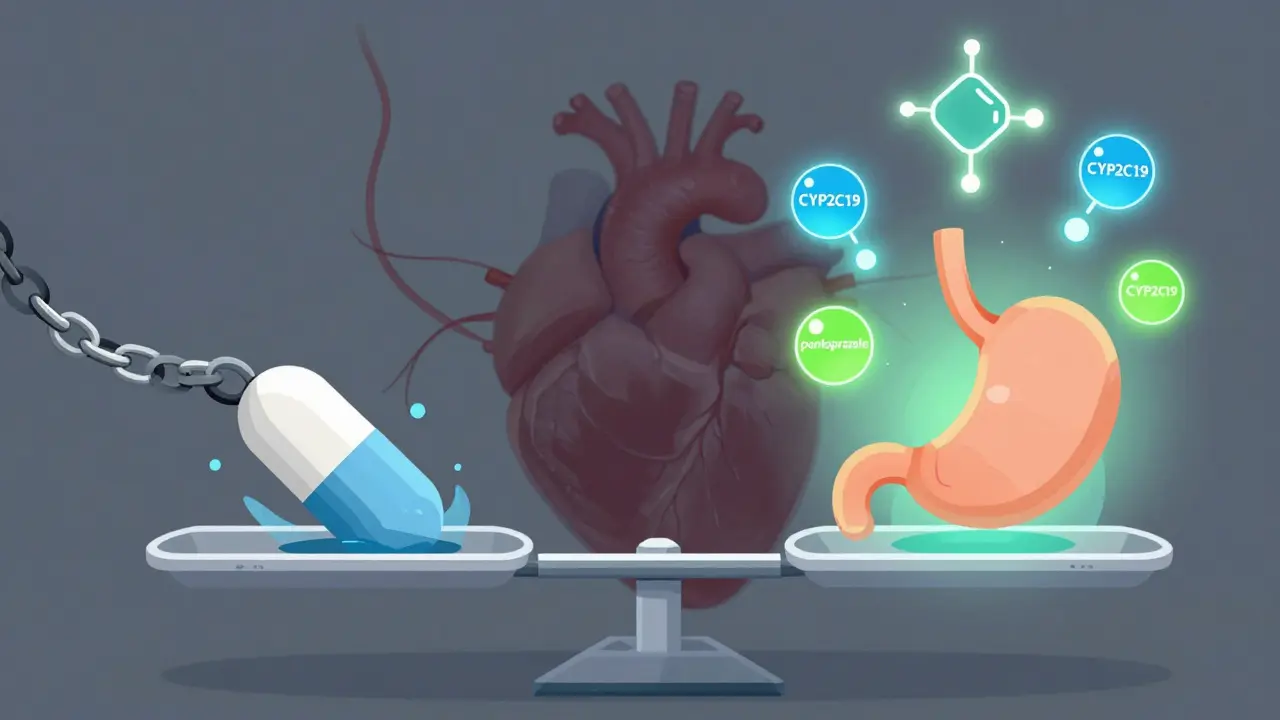
Who Really Needs a PPI?
Not everyone on antiplatelets needs a PPI. That’s the key point. Overprescribing is a real problem. The 2023 ESC guidelines say you should only add a PPI if you have at least two of these risk factors:- History of GI bleeding or ulcers
- Age 65 or older
- Taking blood thinners like warfarin or apixaban
- Using NSAIDs (like ibuprofen or naproxen)
- Taking corticosteroids (like prednisone)
When to Start - and How Long to Stay
Start the PPI on day one of your antiplatelet therapy. Don’t wait. The highest risk window is the first 30 days. If you wait until you have symptoms, it’s too late. How long should you stay on it? Most guidelines say 6 to 12 months. That covers the peak risk period after a heart attack, stent, or stroke. After that, if you’re not at high risk, you can stop. But if you’re still on dual therapy beyond a year - maybe because you have a very high risk of another event - then continuing the PPI makes sense. A 2024 study showed that even after 12 months, the protective effect of PPIs held strong. So if your doctor says you need long-term DAPT, you probably need long-term PPI too.Cost, Access, and Real-World Use
Pantoprazole and esomeprazole are available as generics in the UK and US. A month’s supply costs less than £10. That’s cheaper than a single hospital visit for a GI bleed. A 2019 study found that for high-risk patients, PPI prophylaxis saved $1,200 per year by avoiding complications. For low-risk patients? It cost more than it saved. So targeting the right people isn’t just safer - it’s smarter financially. In Europe, about 60% of DAPT patients get a PPI. In the US, it’s closer to 45%. Why? Many doctors still aren’t trained on the nuances. A 2022 survey found that 45% of cardiologists weren’t sure who qualified for PPIs. And patients? One in three worry about taking too many pills. That’s why clear communication matters.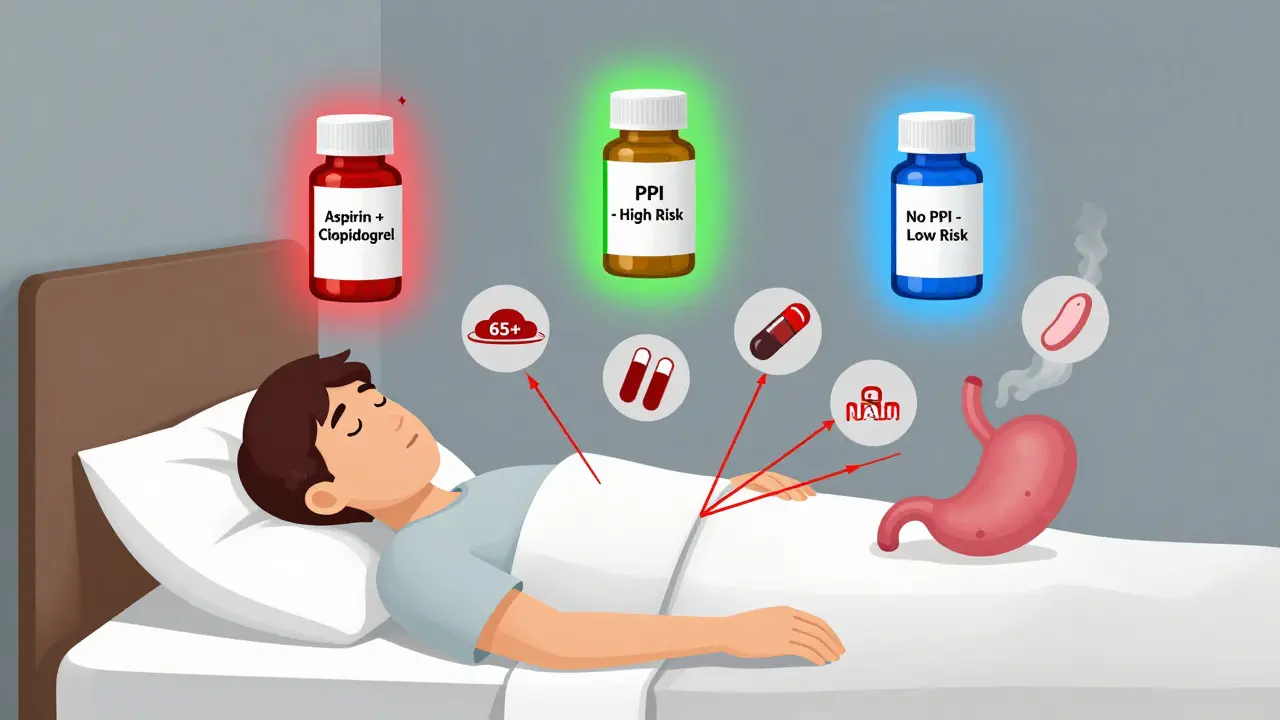
The Future: Better Drugs on the Horizon
A new class of acid blockers called potassium-competitive acid blockers (P-CABs) is coming. The first one, vonoprazan, is under FDA review. It works faster, lasts longer, and doesn’t interfere with clopidogrel at all. Early trials show it’s just as good as esomeprazole at preventing bleeds - without the drug interaction risk. By 2027, genetic testing might guide treatment. Some people have a gene variant (CYP2C19*2) that makes clopidogrel less effective. If you have it, you might need a different antiplatelet - or a different PPI. We’re not there yet, but the pieces are falling into place.What to Do Right Now
If you’re on aspirin plus clopidogrel:- Ask your doctor if you’re at risk for GI bleeding - check the five factors above.
- If yes, ask for pantoprazole or esomeprazole. Avoid omeprazole.
- Start it the same day you start your antiplatelets.
- Don’t stop it after 30 days unless your doctor says so.
- If you’re on ticagrelor or prasugrel, you can use any PPI - but still only if you have risk factors.
Final Thought
This isn’t about taking more pills. It’s about taking the right ones. Proton pump inhibitors save lives when used correctly. But they can cause harm when used blindly. The goal isn’t to blanket every heart patient with acid blockers. It’s to protect the ones who need it - and leave the rest alone.Can I take omeprazole with clopidogrel?
It’s not recommended. Omeprazole reduces clopidogrel’s effectiveness by about 30% because it blocks the CYP2C19 enzyme needed to activate the drug. This could increase your risk of heart attack or stroke. Use pantoprazole or esomeprazole instead if you’re on clopidogrel.
Do I need a PPI if I’m only on aspirin?
Only if you have two or more risk factors: age 65+, history of ulcers, taking NSAIDs or steroids, or on a blood thinner. If you’re young and healthy, the risks of long-term PPI use (like kidney issues or infections) may outweigh the benefits.
How long should I take a PPI with antiplatelets?
Most patients need it for 6 to 12 months - the period of highest bleeding risk. If you’re on long-term dual therapy (beyond a year), your doctor may advise continuing. Always discuss stopping with your provider.
Are PPIs safe for long-term use?
For people at high risk of GI bleeding, yes - the benefits outweigh the risks. But for low-risk patients, long-term use is linked to higher chances of C. difficile infection, pneumonia, and kidney problems. Don’t take them longer than needed.
Can I switch from clopidogrel to another antiplatelet to avoid PPIs?
Yes - if you’re at high risk for GI bleeding and need a PPI, switching from clopidogrel to ticagrelor or prasugrel may allow you to use any PPI safely. But this isn’t always possible. Your doctor will weigh your heart risk against bleeding risk before changing your meds.



Justin Rodriguez
March 3, 2026 AT 03:03Just wanted to say this post nailed it. I’ve been a pharmacist for 12 years and I still see so many patients on omeprazole with clopidogrel. No one tells them why it’s a problem until they have a stent clot. The CYP2C19 interaction isn’t theoretical - it’s measurable, and it kills people quietly.
When I explain it, I use the car analogy: clopidogrel is the engine, omeprazole is the blanket smothering the spark plug. Pantoprazole? That’s just a window crack - lets the engine breathe.
Also, 6–12 months is the sweet spot. Beyond that, unless they’re on warfarin + NSAIDs + age 72? Just stop it. The C. diff risk isn’t worth it.
And yes - generic pantoprazole is $3 at Walmart. No excuse to overprescribe.
Raman Kapri
March 3, 2026 AT 17:12This entire article is a textbook example of medical overcomplication. You claim to be reducing GI bleeding risk, yet you ignore the elephant in the room: most GI bleeds in these patients are caused by NSAID use, not acid. Why aren’t we telling patients to stop ibuprofen first? Why are we medicating their biology instead of changing their behavior?
Furthermore, the notion that PPIs are ‘safe’ for high-risk patients is dangerously naive. The 2023 ESC guidelines are based on observational data, not RCTs. You’re treating a symptom, not a cause. And now we’re seeing kidney injury, dementia, and bone fractures linked to long-term PPI use. This isn’t medicine - it’s pharmacological band-aiding.
Megan Nayak
March 5, 2026 AT 12:31Oh honey. You just gave a 2,000-word lecture on PPIs like it’s a TED Talk and we’re all sitting in a silent auditorium with our hands folded. Let me translate: ‘I’m a doctor and I’m scared you’ll die, so here’s a pill.’
But here’s the real truth no one says: PPIs are the new Prozac. We hand them out like candy because it’s easier than asking, ‘Do you drink coffee? Do you smoke? Do you eat spicy food at midnight?’
And don’t even get me started on the ‘CYP2C19’ drama. It’s like we’re all playing chess with our stomachs while the real game - lifestyle - is burning down.
Also, ‘esomeprazole is safer’? It’s just omeprazole with a spa day and a higher price tag. You’re selling a brand, not a biology.
And yes, I’m the person who stopped my PPI after 4 months. No bleeding. No heart attack. Just better sleep and less bloating. Maybe the body knows what it’s doing?
Also, I’m not a doctor. But I read the internet. And that’s terrifying.
Tildi Fletes
March 6, 2026 AT 20:57The evidence supporting the differential interaction between PPIs and antiplatelets is robust and reproducible. Omeprazole’s inhibition of CYP2C19 is well-documented in multiple pharmacokinetic studies, including those by the FDA and the European Medicines Agency. The clinical consequence - reduced active metabolite formation of clopidogrel - has been associated with increased cardiovascular events in multiple cohort studies.
Pantoprazole and esomeprazole demonstrate minimal CYP2C19 inhibition, with AUC ratios for clopidogrel’s active metabolite remaining above 85% of baseline. This is not anecdotal. It is pharmacologically quantifiable.
Furthermore, the COGENT trial’s 34% reduction in major GI bleeding is statistically significant (p<0.01) with a number needed to treat of 71. This meets or exceeds the threshold for clinical utility in preventive cardiology.
Guideline recommendations from ESC, ACC, and AHA are not arbitrary. They are synthesized from meta-analyses of over 120,000 patient-years of data. Dismissing them as ‘overprescribing’ ignores the magnitude of preventable mortality.
Siri Elena
March 8, 2026 AT 00:13Oh my god, I just read this entire thing like it was a novel. I thought I was going to die from boredom. Then I realized - this is what happens when doctors write blogs instead of patients.
‘PPIs reduce bleeding by 34%’ - wow. That’s like saying ‘wearing a helmet reduces head injuries by 34%’ and then asking if you want to wear one while skydiving.
But wait - why are we even talking about this? Why not just tell people: ‘Don’t take ibuprofen. Stop drinking. Eat a salad. Sleep. And if you’re still bleeding, maybe you shouldn’t be on two blood thinners?’
Instead, we give you five pills and call it ‘care.’
Also, ‘pantoprazole or esomeprazole’? Sure. And I’ll take the $10 generic. Not the $40 ‘premium’ version. My insurance doesn’t care about your brand loyalty.
Also, I’m not on clopidogrel. But I read this and now I’m scared. Thanks, doc.
Pankaj Gupta
March 9, 2026 AT 14:24While the clinical guidance presented is largely accurate, I would like to offer a nuance often overlooked: the concept of ‘risk stratification’ must be contextualized within socioeconomic and healthcare access disparities. In the United States, for instance, patients in rural areas may not have access to pantoprazole or esomeprazole, while omeprazole remains universally available. In India, where I practice, generic omeprazole is the only affordable option for 80% of patients on dual antiplatelet therapy.
Therefore, while pharmacologically ideal, the recommendation to avoid omeprazole may be ethically problematic in resource-constrained settings. A pragmatic approach - combining omeprazole with strict avoidance of NSAIDs, alcohol, and smoking - may yield comparable outcomes in low-risk populations.
Additionally, the 2025 Korean study referenced was conducted in a population with lower baseline NSAID use and higher tea consumption, both of which may influence gastric mucosal integrity. Generalizability to Western cohorts requires caution.
Chris Beckman
March 10, 2026 AT 07:28Okay so I read this whole thing and I’m like… why do we even have this many pills? I’m on aspirin and clopidogrel and I took omeprazole because my friend said it was good. Now I’m reading this and I’m like… I’m a dumbass? I didn’t even know about CYP2C19. My doctor just said ‘take this.’
Also, I’ve been on PPI for 2 years. I’m 52. No ulcers. No NSAIDs. No blood thinners. Just… took it. Now I’m scared I’m gonna get kidney failure or something. I don’t even know what C. diff is. I think it’s a dog.
Can I just stop? Will I die? I’m gonna call my doc tomorrow. But also… why didn’t anyone tell me this before? This is like finding out your toothpaste has arsenic in it.
Also, pantoprazole? Sounds like a robot. I’ll just take the green one. Whatever.
Betsy Silverman
March 10, 2026 AT 18:35I’ve been on clopidogrel since my stent in 2021. I started on omeprazole because it was free at the clinic. Then my pharmacist pulled me aside last month and said, ‘You might want to switch.’ I did. Switched to pantoprazole. No change in how I feel. No stomach issues. No weird side effects.
But here’s the thing - I didn’t know any of this until someone took 30 seconds to explain it. Not a pamphlet. Not a website. A human. In a pharmacy.
So maybe the real takeaway isn’t which PPI to use… but how we talk to people. We assume they know. They don’t. And we don’t ask.
Also, I drink tea. Not coffee. No NSAIDs. I eat oatmeal. Maybe that’s why I didn’t bleed. Or maybe I just got lucky.
Either way - thank you for the clarity. I’m glad I switched.
Ivan Viktor
March 11, 2026 AT 01:03So basically: if you’re rich, take esomeprazole. If you’re poor, take omeprazole and hope. If you’re a doctor, write a 3,000-word essay. If you’re a patient, just take the pill and nod.
Meanwhile, my uncle took aspirin and a banana and lived to 92.
Science is cool. But sometimes, the answer is just… don’t be dumb.