

When a pharmacist hands you a generic version of your prescription, you might assume it’s the same as the brand-name drug. For most medications, that’s true. But for NTI drugs-narrow therapeutic index medications-that assumption can be dangerous. These are drugs where even a tiny change in dose or blood level can cause serious harm: seizures, blood clots, heart rhythm problems, or even death. And while the federal government says generics are safe to swap, 27 states have passed laws that block or restrict those substitutions. The result? A patchwork of rules that confuse patients, pharmacists, and doctors alike.
What Makes a Drug an NTI Drug?
NTI stands for narrow therapeutic index. That means the difference between a dose that works and a dose that harms is very small. Think of it like walking a tightrope. A slight stumble, and you fall. Drugs like warfarin (a blood thinner), levothyroxine (for thyroid problems), lithium (for bipolar disorder), and phenytoin (for seizures) fall into this category. A 5% to 10% change in blood concentration can mean the difference between control and crisis.
The FDA doesn’t officially label any drug as NTI in its Orange Book-the official list of approved drugs and their therapeutic equivalence ratings. But pharmacists and clinicians have known for decades which ones need extra care. States stepped in because they saw patients getting hurt when generics were swapped without warning. In 2023, a study in the Journal of the American Pharmacists Association found that states with NTI substitution rules saw 18.7% fewer adverse events tied to warfarin. That sounds small-just a 0.3% drop in total events-but for the people affected, it’s everything.
How States Handle NTI Substitution: Three Different Models
There’s no national standard. Instead, states use three main approaches:
- Mandatory substitution states: Pharmacists must switch to generics unless the doctor writes “dispense as written.” This is the default in most states, but even here, NTI drugs often get special treatment.
- Permissive substitution states: Pharmacists can substitute, but aren’t required to. They’re allowed to use their judgment.
- Restrictive substitution states: These states ban substitutions for specific drugs, no matter what. This is where things get complicated.
Take Kentucky. Its Board of Pharmacy has a published list of NTI drugs that can’t be swapped: digitalis, warfarin, and several antiepileptics. If a prescription comes in for brand-name Dilantin, the pharmacist can’t give you phenytoin unless the doctor says it’s okay. Pennsylvania does the same. Their list includes levothyroxine, lithium, and carbamazepine.
South Carolina doesn’t ban substitutions outright. Instead, they recommend against it for three groups: NTI drugs like lithium, brand-name drugs like Synthroid or Premarin, and so-called “critical drugs” like insulin, anticoagulants, and time-release asthma meds. It’s not a law, but pharmacists who ignore it risk professional consequences.
Tennessee is different. They allow substitution for most A-rated drugs, but make one hard rule: no substitutions for antiepileptic drugs if the patient has epilepsy or seizures. That’s it. No list. No broad restrictions. Just one clear exception.
California and Texas: Specific Rules for Specific Risks
California doesn’t use the term “NTI.” Instead, it calls them “critical dose drugs.” The state defines them as medications where a 10% or less change in blood concentration can be dangerous. That includes warfarin, digoxin, phenytoin, and levothyroxine. Pharmacists must notify the prescriber whenever they swap one of these drugs. It’s not a block-it’s a checkpoint.
Texas takes a narrower approach. Their law only protects one group: patients with epilepsy. Pharmacists can’t substitute anticonvulsants for them without the prescriber’s explicit permission. It’s not about the drug class-it’s about the patient’s condition. That’s a smarter, more targeted rule.
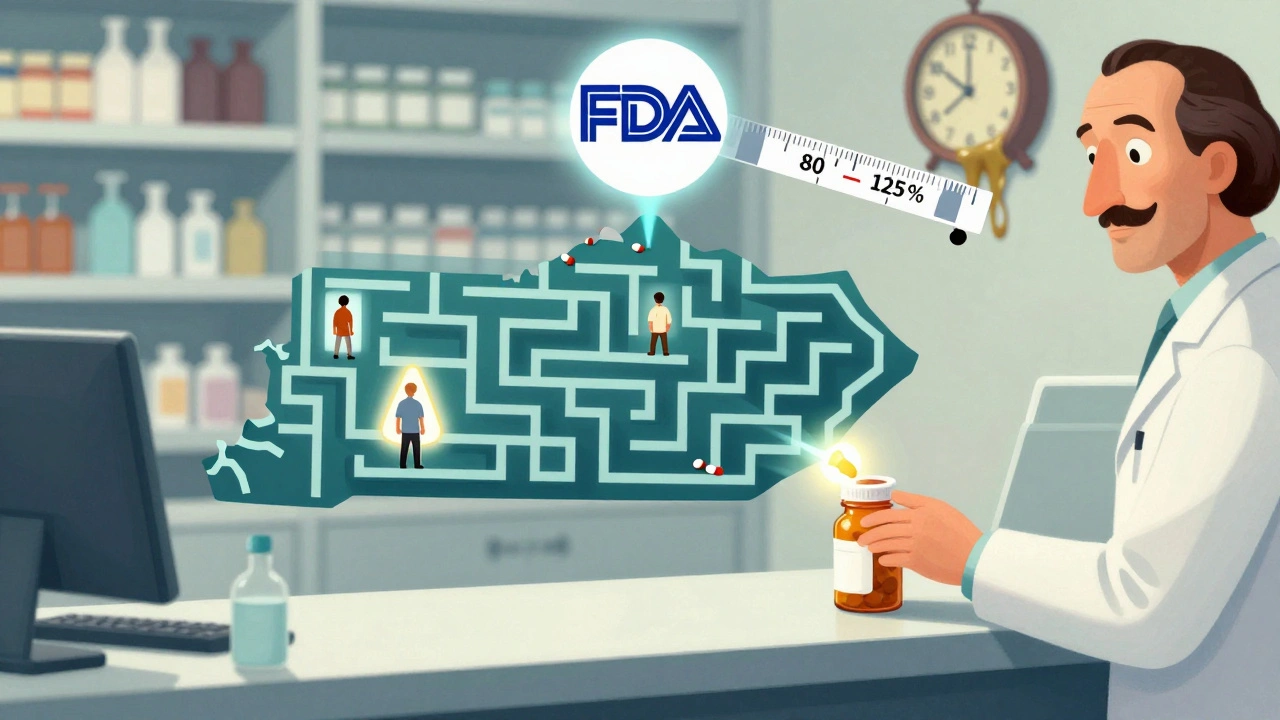
Why the FDA Doesn’t Agree
The FDA says all A-rated generics are safe to swap, even for NTI drugs. Their stance, unchanged since 1997, is that the 80%-125% bioequivalence range used to approve generics is sufficient for all drugs. They argue that if a generic passes the same tests as the brand, it’s interchangeable.
But doctors and pharmacists who work with these drugs every day see a different reality. Dr. Jerry Avorn from Harvard says the 20% bioequivalence window is too wide for drugs like levothyroxine. A patient stabilized on Synthroid might switch to a generic, and their TSH levels jump out of range. A 2023 meta-analysis found that 32.4% of patients on brand-name levothyroxine had to adjust their dose after switching to generic. That’s more than one in three. For someone with heart disease or an older adult, that’s risky.
The FDA even created an NTI drug list in 1995-for internal use. But they never made it public or official. That contradiction fuels the debate. Why create a list if it doesn’t matter?
What This Means for Pharmacists
Imagine you work for a pharmacy chain with locations in Tennessee, Kentucky, and Ohio. In Tennessee, you can’t swap antiepileptics for epilepsy patients. In Kentucky, you can’t swap warfarin at all. In Ohio, you can swap anything with an A rating. You’re tired. It’s 8 p.m. The system flashes a substitution alert. Do you follow the state law? The chain’s policy? The prescriber’s note? A 2023 survey found that 41.7% of pharmacists had accidentally broken a substitution law in the past year because rules changed from state to state.
Some pharmacies use software that flags NTI drugs and blocks substitutions based on the patient’s state. But not all systems are updated. And when a patient fills a prescription in one state and gets refills in another, the rules don’t follow them. A patient might get a generic in Georgia, then switch to brand in Florida because their doctor moved. The pharmacist in Florida doesn’t know the history. That’s how errors happen.

The Push for a National Standard
Change is coming-but slowly. In January 2024, the National Association of Boards of Pharmacy launched the Model State NTI Substitution Act. It proposes a single, evidence-based list of NTI drugs that all states could adopt. Twelve states have already introduced versions of this bill. The goal? Reduce confusion, lower errors, and protect patients without creating a bureaucratic mess.
The FDA, under pressure from the Senate Committee on Aging, announced in September 2024 that it’s reconsidering its position. A 2023 GAO report found nearly 3,000 adverse events linked to NTI drug substitutions between 2019 and 2023. That’s not a small number. Industry analysts predict that by 2027, 38 states will have adopted standardized rules. That could cut prescription errors by over 20%.
But there’s a trade-off. Standardization might mean fewer generic substitutions for NTI drugs. That could raise costs. Right now, NTI restrictions account for only 2.3% of all substitution opportunities. But that 2.3% represents some of the most vulnerable patients in the system.
What Patients Should Do
If you take an NTI drug, don’t assume your generic is interchangeable. Ask your pharmacist: “Is this substitution allowed in my state?” Check your prescription bottle. Does it say “dispense as written”? If not, ask your doctor to add it. Keep a list of your NTI medications. Share it with every new provider. If your dose feels off after a switch-fatigue, heart palpitations, mood changes, tremors-get your blood tested. Don’t wait.
And if you’re switching states? Bring your medication list. Ask your new pharmacy to verify your drug’s status. Don’t let a change in zip code put your health at risk.
Are all generic drugs safe to substitute for NTI medications?
No. While the FDA considers all A-rated generics bioequivalent, many states restrict substitutions for drugs like warfarin, levothyroxine, lithium, and antiepileptics because small changes in blood levels can cause serious harm. Some states ban substitutions outright, while others require prescriber approval or notification.
Which states prohibit NTI drug substitutions?
As of 2024, 27 states have laws restricting NTI drug substitutions. States like Kentucky, Pennsylvania, and South Carolina maintain formal lists of prohibited drugs. California and Texas have targeted rules-California requires prescriber notification, and Texas bans substitutions for epilepsy patients. Other states allow substitution but encourage caution. There is no single national list.
What NTI drugs are most commonly restricted?
The most commonly restricted NTI drugs include warfarin (blood thinner), levothyroxine (thyroid hormone), lithium (mood stabilizer), phenytoin and carbamazepine (antiepileptics), digoxin (heart medication), and cyclosporine (immunosuppressant). These drugs have narrow margins between effective and toxic doses.
Can a pharmacist substitute an NTI drug without telling the doctor?
In most states, pharmacists are required to notify the prescriber before substituting an NTI drug. California mandates this. Other states, like Tennessee, allow substitution unless the drug is for epilepsy. In restrictive states like Kentucky, substitution is banned entirely. Always check your state’s law and ask your pharmacist for details.
Why does the FDA allow substitutions if states say they’re risky?
The FDA believes the current bioequivalence standards (80%-125% blood concentration range) are sufficient for all drugs, including NTI medications. They argue that if a generic passes the same tests as the brand, it’s safe. But critics say this range is too wide for sensitive drugs, and that real-world patient outcomes show higher risks. The FDA is now reconsidering its stance after evidence of thousands of adverse events.
What should I do if my generic NTI drug doesn’t seem to work the same?
Contact your doctor immediately. Do not stop or change your dose. Request a blood test to check your drug levels. Ask whether a generic substitution occurred and whether your state allows it. If your medication was switched without your knowledge, ask your pharmacist to document it and consider switching back to the brand. Your health is not worth the risk.
What’s Next for NTI Drug Rules?
The system is messy, but it’s not stuck. With 12 states already adopting the Model NTI Substitution Act, and the FDA reopening its review, a more unified approach is likely. By 2027, most states will probably follow a single list of restricted drugs. That will make life easier for pharmacists, safer for patients, and less costly for insurers.
Until then, the burden falls on you-the patient. Know your drugs. Ask questions. Keep records. Don’t let a change in pharmacy or state become a health crisis.



patrick sui
December 3, 2025 AT 10:33Wow, this is a wild patchwork of rules. I work in pharma compliance in Dublin, and the fact that Kentucky bans warfarin swaps but Tennessee only cares about epilepsy patients is insane. The FDA’s 80%-125% bioequivalence window is a joke for levothyroxine-my aunt’s TSH went from 2.1 to 8.9 after a switch. No joke. 😬
Conor Forde
December 3, 2025 AT 12:30So let me get this straight-some states think a pill that’s 20% weaker is ‘the same’? That’s like saying a Ferrari and a Yugo are ‘equivalent’ because both have four wheels and an engine. The FDA’s been asleep at the wheel since 1997. Someone wake up the bureaucrats. 🤬
Declan O Reilly
December 4, 2025 AT 16:48This isn’t just about pills-it’s about trust. When you’re on lithium or warfarin, your body becomes a precision instrument. A generic swap isn’t a cost-saving measure-it’s a gamble with someone’s life. And yet we treat it like choosing between Coke and Pepsi. We’ve lost touch with what ‘healing’ really means. 🌱
ANN JACOBS
December 6, 2025 AT 10:34As a registered nurse with over 28 years of clinical experience, I must emphasize that the variability in state regulations regarding narrow therapeutic index (NTI) drug substitution presents a significant, systemic risk to patient safety. The absence of a federally mandated, evidence-based standard creates unnecessary confusion, increases the likelihood of iatrogenic harm, and disproportionately affects elderly, low-income, and rural populations who lack the resources to navigate this labyrinth. I strongly advocate for the immediate adoption of the Model State NTI Substitution Act as proposed by the National Association of Boards of Pharmacy.
Nnaemeka Kingsley
December 6, 2025 AT 11:03Man, this is deep. I’m from Nigeria and we don’t even have this problem because generics are all we got. But I see what you mean-some meds you can’t mess with. My cousin took generic thyroid stuff and got real sick. He had to go back to brand. Just tell the doc, ‘no swaps’-simple. 🙏
Kshitij Shah
December 8, 2025 AT 07:30Oh wow, 27 states think they’re smarter than the FDA? Cool story. Meanwhile, in India, we’ve got 12 brands of levothyroxine on the shelf and no one’s dropping dead. Maybe the real problem isn’t the generic-it’s that Americans treat their meds like sacred relics. Chill. 😏
Sean McCarthy
December 8, 2025 AT 07:54According to the GAO report cited: 3,000 adverse events between 2019-2023. That’s 0.0004% of total prescriptions filled. The risk is statistically negligible. Meanwhile, generic substitution saves $100B annually. The real crisis? Overmedication, not substitution. This article is fearmongering dressed as public health. 📉
Jaswinder Singh
December 9, 2025 AT 21:19You people are acting like switching generics is some kind of betrayal. I’ve been on warfarin for 12 years. I’ve switched generics 5 times. My INR never flinched. Stop scaring people. Your fear isn’t helping-it’s making patients paranoid and pharmacies waste time. The FDA knows what they’re doing. Stop the drama.
Bee Floyd
December 10, 2025 AT 03:20It’s wild how the same system that lets you buy 500mg of pseudoephedrine without a prescription can’t handle a 10% bioequivalence window for life-saving meds. We prioritize convenience over safety… then act shocked when someone gets hurt. I don’t know. Just… feels broken. 🤷♂️
Courtney Co
December 10, 2025 AT 05:29Wait-so if I’m on levothyroxine and I move from California to Texas, do I have to get a whole new prescription? What if I’m traveling? What if I’m in a car accident and they give me a generic? Am I gonna die because some pharmacist didn’t know the rules? This is a nightmare. I need a lawyer, not a pharmacist. 😭
Shashank Vira
December 10, 2025 AT 23:23Let us not forget: the FDA’s bioequivalence standards were designed for mass-market, profit-driven pharmaceutical consolidation-not for the nuanced pharmacokinetics of neuroendocrine regulators. The very notion that a single 20% window can govern the stability of lithium in bipolar patients is a grotesque reductionism-a triumph of corporate logic over clinical wisdom. This isn’t policy. It’s pharmaceutical colonialism.