
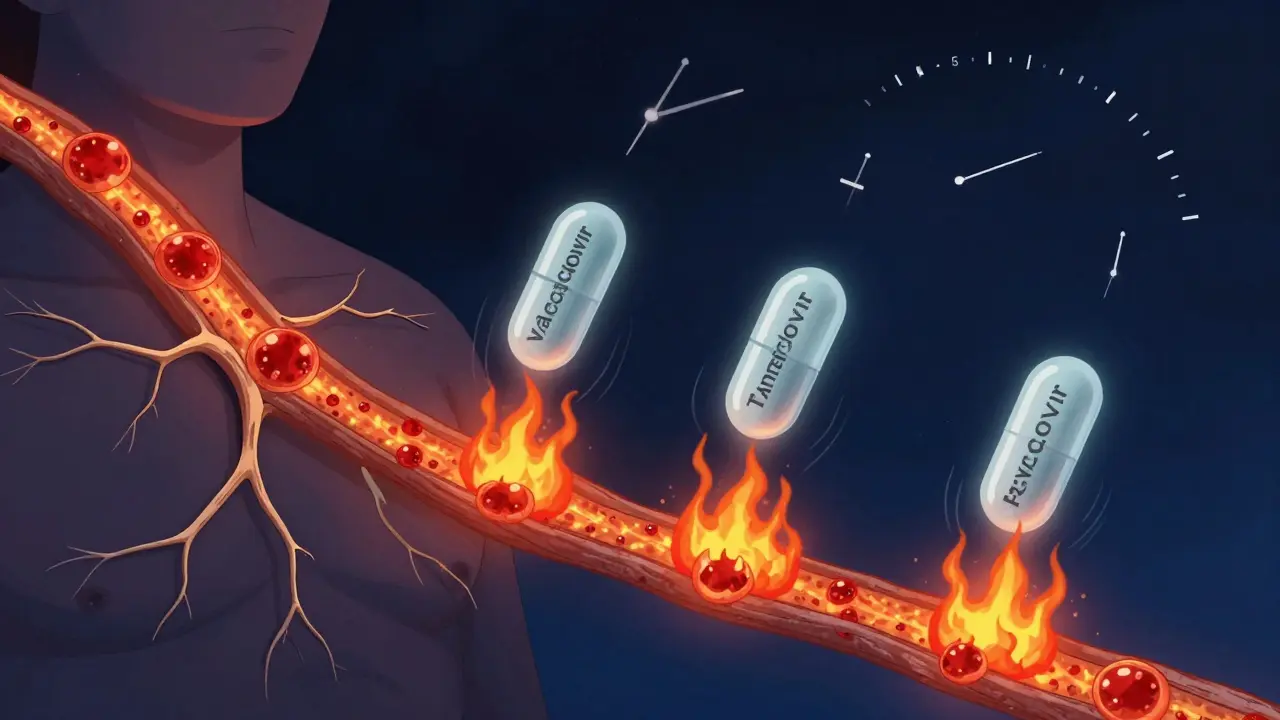
Shingles isn’t just a rash. It’s a burning, stabbing, electric shock-like pain that can last for weeks-or even years. If you’ve ever had it, you know it’s not something you can just ‘tough out.’ The good news? There are real, science-backed ways to cut the pain short and stop it from turning into something worse. The key? Acting fast.
What Happens When Shingles Strikes
Shingles, or herpes zoster, happens when the chickenpox virus-long hidden in your nerves-wakes up. It’s not new. It’s old. You had chickenpox as a kid. The virus never left. It just waited. And now, maybe because you’re older, stressed, or your immune system is down, it’s back. It bursts out along a nerve path, usually on one side of your body, and turns the skin into a red, blistering mess. But the worst part? The pain comes before the rash. Sometimes days before. You feel tingling, itching, or a deep ache, like a muscle cramp that won’t let go. That’s your body’s warning.
By the time the blisters show up, the virus has already been copying itself inside your nerves. That’s why timing matters more than anything.
Antivirals: The Only Treatment That Stops Shingles in Its Tracks
There’s no cure for shingles. But there are three antiviral drugs that can change the whole game: valacyclovir, famciclovir, and acyclovir. They don’t kill the virus. They slow it down. And if you start them within 72 hours of the first sign of rash, they can cut the healing time by 2 to 3 days and reduce the pain by about 30%.
Valacyclovir (Valtrex) is the most commonly prescribed. You take 1,000 mg three times a day for 7 days. It’s easier than acyclovir, which requires five doses a day. Famciclovir (Famvir) is a middle ground-three times a day, but lower doses. Studies show valacyclovir may do slightly better at reducing pain than acyclovir, but all three work similarly on healing blisters and side effects.
Here’s the catch: if you wait more than 72 hours, the benefit drops sharply. By day 5, it’s barely there. That’s because the virus has already damaged your nerves. Once that damage is done, antivirals can’t undo it. That’s why so many people end up with long-term pain-they didn’t get treatment early enough.
For people with weak immune systems-those on chemotherapy, with HIV, or taking steroids-antivirals aren’t optional. They’re life-saving. These patients get worse outbreaks, higher risk of eye damage, and longer hospital stays. Delaying treatment here can lead to blindness or nerve damage that never heals.
The Eye Problem Nobody Talks About
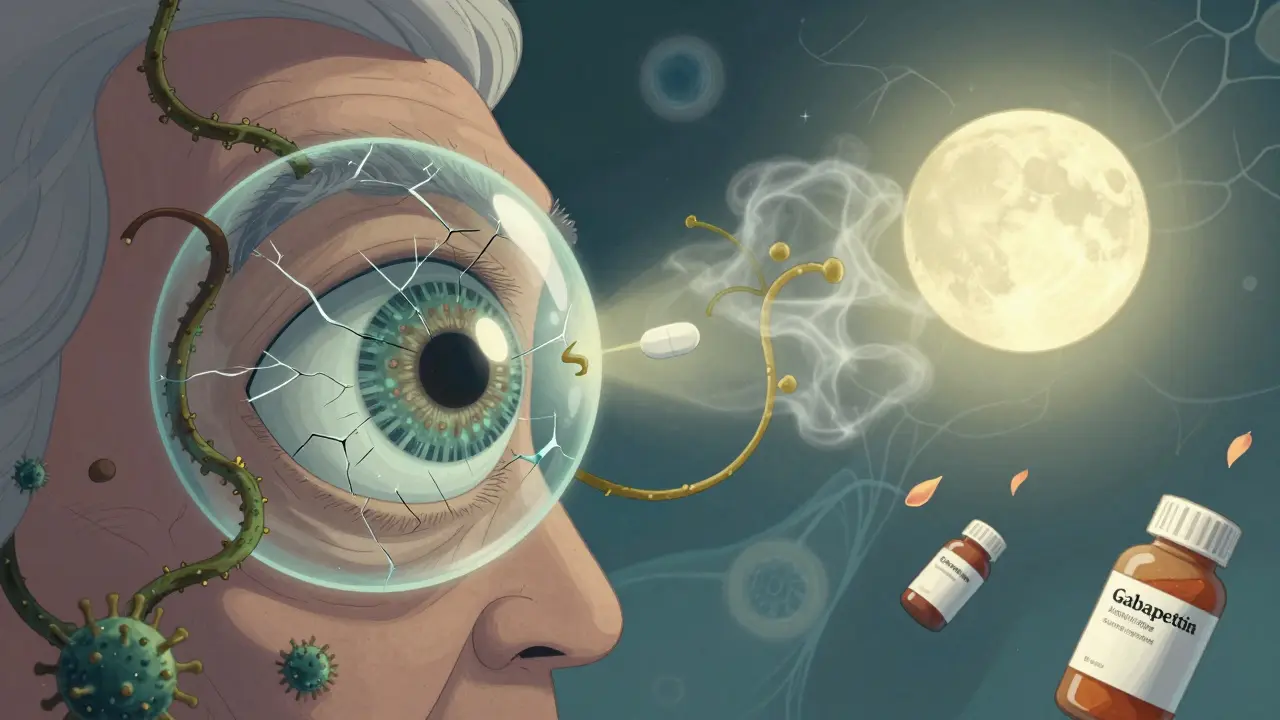
One in five shingles cases involve the eye. That’s called herpes zoster ophthalmicus. And it’s dangerous. The virus can attack the cornea, the iris, even the optic nerve. Without treatment, it can cause scarring, glaucoma, or permanent vision loss.
The Zoster Eye Disease Study (ZEDS), published in late 2023, changed everything. Researchers found that taking a low dose of valacyclovir-500 mg once a day-for 18 months reduced new or worsening eye disease by 26%. It also cut the number of flare-ups by 30%. Even better? People on this long-term plan used 22-25% less pain medication like gabapentin. That’s huge. Older adults often get dizzy or confused from those drugs. Reducing their use means better balance, fewer falls, and more independence.
Doctors are starting to recommend this for anyone with shingles near the eye. It’s not standard yet, but the evidence is strong.
Does It Prevent Long-Term Pain? The Truth
This is where things get messy. Many people believe taking antivirals stops post-herpetic neuralgia (PHN)-the chronic nerve pain that lingers after the rash is gone. But the science says otherwise.
The Cochrane Review, a gold-standard analysis, found no proof that acyclovir reduces PHN at six months. Yet other studies, including one from 2011, say early treatment lowers the risk. Why the contradiction? Maybe it depends on how early you start. Maybe it depends on your age. Maybe it depends on how much damage the virus did before you took the pill.
Real-world data tells a different story. On PatientsLikeMe, 62% of 1,200 people said they avoided PHN because they started antivirals within 48 hours. But 38% still got it. That’s not failure. That’s reality. Shingles is unpredictable. But if you act fast, your odds improve. A lot.
And here’s the kicker: if you’re over 60, your chance of PHN jumps to 30%. That’s why doctors push so hard for early treatment. It’s not about guaranteeing you won’t get chronic pain. It’s about giving yourself the best shot.
Pain Management: Beyond the Pills
Antivirals don’t touch the nerve pain. That needs its own plan. And it’s not just about opioids. In fact, opioids are a bad fit. They don’t work well on nerve pain, and they carry a high risk of addiction.
Here’s what actually helps:
- Gabapentin or pregabalin: These are seizure meds repurposed for nerve pain. Start low-300 mg once a day-and slowly increase. Many need 1,800-3,600 mg daily. Side effects? Drowsiness, dizziness, swelling. Worth it for many.
- Amitriptyline: An old-school antidepressant. Takes 2-4 weeks to work. Dose: 25-75 mg at night. Helps with sleep and pain. Even if you’re not depressed, it works.
- Lidocaine patches: Stick these on the painful area for 12 hours, then take off for 12. No system-wide side effects. Great for localized pain.
- Capsaicin cream (0.075%): Made from chili peppers. It burns at first-then numbs. Apply 3-4 times a day. It takes weeks to build up, but some people swear by it.
Some doctors add short-term steroids like prednisone to reduce inflammation. But this is controversial. Steroids weaken your immune system. If you’re already at risk for complications, it might do more harm than good.
What About the Shingles Vaccine?
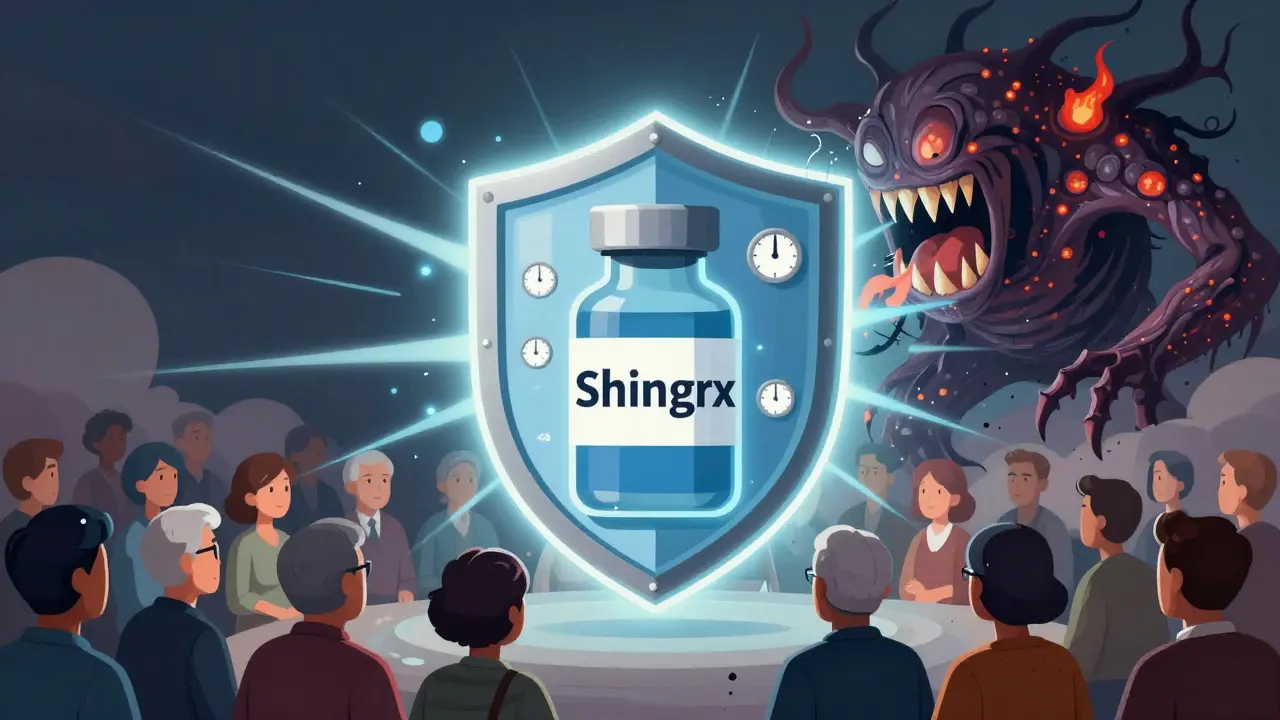
Shingrix is the best tool we have to avoid shingles altogether. Two shots, 2-6 months apart, cut your risk by over 90%. Even if you get shingles after the vaccine, it’s milder. Less pain. Fewer blisters. Lower chance of PHN.
The CDC recommends it for everyone over 50, even if you had shingles before or got the old vaccine (Zostavax). It’s not a cure. But it’s prevention. And it’s safe. Side effects? Sore arm, fatigue, headache. Lasts a day or two. Far better than the real thing.
What to Do If You Think You Have Shingles
Don’t wait. Don’t Google. Don’t hope it goes away.
- Look for pain, tingling, or burning on one side of your body-face, chest, back, waist. No rash yet? Doesn’t matter.
- Call your doctor or go to an urgent care clinic today.
- Ask for antivirals. Name valacyclovir. Say you’re within 72 hours of symptoms.
- If the rash is near your eye, say so. Ask about long-term low-dose treatment.
- Start pain management early. Don’t wait for the pain to get worse.
Cost? A 7-day course of valacyclovir runs $85-$150 without insurance. But the CDC says early treatment saves $487 per person by preventing ER visits, nerve damage, and long-term care. That’s not a cost. That’s an investment.
Bottom Line
Shingles isn’t just a rash. It’s a neurological attack. The sooner you treat it, the less damage it does. Antivirals won’t make you 100% better, but they give you the best chance to avoid years of pain. Pain meds help, but they’re not a fix. The vaccine is your shield. And if you’re over 50? You should already have had both shots.
If you’re reading this because you’re feeling that strange tingling on your side-don’t wait. Call your doctor. Now. Your future self will thank you.
Can shingles be cured with antivirals?
No, shingles can’t be cured. Antivirals like valacyclovir don’t kill the virus. They slow it down, which helps reduce pain, speed up healing, and lower the risk of complications. But the virus stays in your nerves forever. Treatment is about damage control, not elimination.
How soon do antivirals need to be started for shingles?
Within 72 hours of the rash appearing. Some studies show even better results if started within 48 hours. After 72 hours, the benefit drops sharply because the virus has already damaged nerves. If you’re unsure whether it’s shingles, get checked anyway-don’t wait for the rash to confirm it.
Which antiviral is best for shingles: valacyclovir, famciclovir, or acyclovir?
Valacyclovir is the most commonly prescribed because it’s easier to take-only three times a day. Studies suggest it may reduce pain slightly better than acyclovir. All three are effective at healing blisters. Side effects are similar: headache, nausea, dizziness. Your doctor will choose based on your health, kidney function, and insurance coverage.
Can shingles cause long-term nerve pain?
Yes. About 10-18% of people develop post-herpetic neuralgia (PHN), where nerve pain lasts months or years after the rash clears. That number jumps to 30% for people over 60. Early antiviral treatment reduces-but doesn’t eliminate-the risk. Pain management with gabapentin, amitriptyline, or lidocaine patches is often needed for months.
Is the shingles vaccine worth it if I’ve already had shingles?
Yes. Having shingles once doesn’t protect you from getting it again. The CDC recommends Shingrix even if you’ve had shingles, had the old Zostavax vaccine, or are over 50. Shingrix cuts your risk of another outbreak by over 90% and makes any future case much milder.
Can I use over-the-counter pain relievers for shingles?
Ibuprofen or acetaminophen can help with mild discomfort, but they won’t touch the nerve pain that defines shingles. For burning, shooting, or electric shock-like pain, you need prescription nerve pain meds like gabapentin or amitriptyline. OTC pills are not enough.
Can shingles spread to other people?
You can’t give someone shingles. But if someone has never had chickenpox or the chickenpox vaccine, and they touch the fluid from your blisters, they can get chickenpox. Keep the rash covered, avoid contact with pregnant women, newborns, and people with weak immune systems until the blisters crust over.
How long does shingles pain last?
The rash usually heals in 2-4 weeks. But nerve pain can linger. For most, it fades within a few months. For 10-18%, it becomes chronic-lasting months or years. That’s post-herpetic neuralgia. The longer the pain lasts after the rash clears, the less likely it is to go away. Early treatment helps, but doesn’t guarantee prevention.


Palesa Makuru
January 1, 2026 AT 16:00Wow, this is the most thorough thing I’ve read on shingles yet-like, actually useful, not just fluff. I had it last year at 42 and thought I was just getting old. Turns out I ignored the tingling for three days because I was ‘too busy.’ Now I have PHN and a $12,000 medical bill. Don’t be me.
Wren Hamley
January 2, 2026 AT 05:39Antivirals don’t cure-they contain. The virus is a latent tenant in your dorsal root ganglia, and antivirals are just the eviction notice with a 72-hour window. Once it’s breached the myelin sheath? You’re dealing with neuroinflammation, not infection. That’s why gabapentin’s the real MVP-it modulates voltage-gated calcium channels, not just masks pain. Also, lidocaine patches > opioids. Always.
veronica guillen giles
January 2, 2026 AT 23:16Oh sweet mercy, another person who thinks ‘early treatment’ means ‘call your doctor when you’re already on the floor crying.’ You don’t need a PhD to know if your skin feels like it’s being lit on fire with a blowtorch-you need a phone. And a will to live.
Vincent Sunio
January 3, 2026 AT 12:44There is a fundamental misstatement here: the Cochrane Review does not state that acyclovir has no effect on PHN-it states that the evidence is insufficient to confirm a statistically significant reduction in incidence beyond 6 months. The wording in the article is misleading and potentially dangerous. Also, famciclovir is not a ‘middle ground’-it has superior bioavailability. This piece reads like a marketing brochure disguised as medical advice.
Neela Sharma
January 5, 2026 AT 10:11My aunt got shingles after her husband passed. She didn’t go to the doctor for 5 days. The pain? It lived in her bones like a ghost. She started gabapentin, used capsaicin like it was holy water, and now she dances with her grandkids again. Not cured. But alive. That’s enough.
innocent massawe
January 6, 2026 AT 00:27Thank you for this. I'm from Nigeria and we don't talk about this enough. My uncle lost vision in one eye because he thought it was just a bug bite. Now he can't drive. Please share this with people who think medicine is only for hospitals. 🙏
Angela Goree
January 6, 2026 AT 09:58Shingrix? Of course it’s worth it! The CDC says so, the FDA says so, the NIH says so-why are people still arguing? We’re not talking about a flu shot here. We’re talking about preventing a living nightmare that costs the system billions. If you’re over 50 and haven’t gotten it, you’re not just being lazy-you’re gambling with your nervous system. And that’s not American. That’s just stupid.
Michael Burgess
January 6, 2026 AT 14:09Just had my second Shingrix shot last month. Sore arm for two days, felt like I’d been hit by a truck. Worth it. My mom had shingles at 71 and spent 11 months on gabapentin. She still wakes up screaming sometimes. I’m not letting that happen to me. Also-lidocaine patches are magic. I put one on my shoulder after work and suddenly I can sleep. No drugs. No side effects. Just… peace. 🤍
Angela Fisher
January 8, 2026 AT 01:32Wait… so antivirals don’t cure it… and the vaccine doesn’t guarantee you won’t get it… and the pain meds just make you sleepy… and the virus is just LIVING in your nerves forever… and the eye damage is silent until it’s too late… and the CDC says you need two shots but insurance won’t cover it unless you’re 60+… and the whole system is rigged to make you suffer until you’re old enough to qualify for help… is this a government experiment? Are we being tested? Why is no one talking about this? 🤔
Liam Tanner
January 9, 2026 AT 13:38My dad’s 73. Got shingles last winter. Took valacyclovir within 48 hours. Rash cleared in 10 days. No PHN. No eye issues. No hospital. He still takes gabapentin at night, but he’s walking the dog again. Point is: it’s not magic. But it’s not hopeless either. Do the thing. Even if you’re scared.
Brittany Wallace
January 10, 2026 AT 01:02I’m 28 and got shingles after my mom died. I didn’t know it was possible this young. I thought it was just for old people. I didn’t go to the doctor for a week. I’m still dealing with tingling. This post made me cry-not because it was sad, but because it felt like someone finally saw me. You’re not alone. And you’re not weak. You just need to act. Before it’s too late.
Ian Detrick
January 10, 2026 AT 10:04Shingles is the universe’s way of whispering: ‘You’re not invincible.’ It doesn’t care if you’re fit, rich, or young. It waits. It watches. It remembers every time you skipped sleep, ate junk, ignored stress. The virus doesn’t hate you-it just knows you’re vulnerable. The vaccine isn’t a luxury. It’s a quiet act of rebellion against entropy. Take it. Not for your body. For your future self-who’s still awake at 3 a.m., wondering why their skin still burns.
Ian Ring
January 10, 2026 AT 10:31Just a quick note: if you're near an eye, SAY SO. I didn't. I thought it was just a headache. Turns out, I had zoster ophthalmicus. Two surgeries later, I can still see-but I lost depth perception. Don't be like me. Call. Today. Not tomorrow. TODAY.