
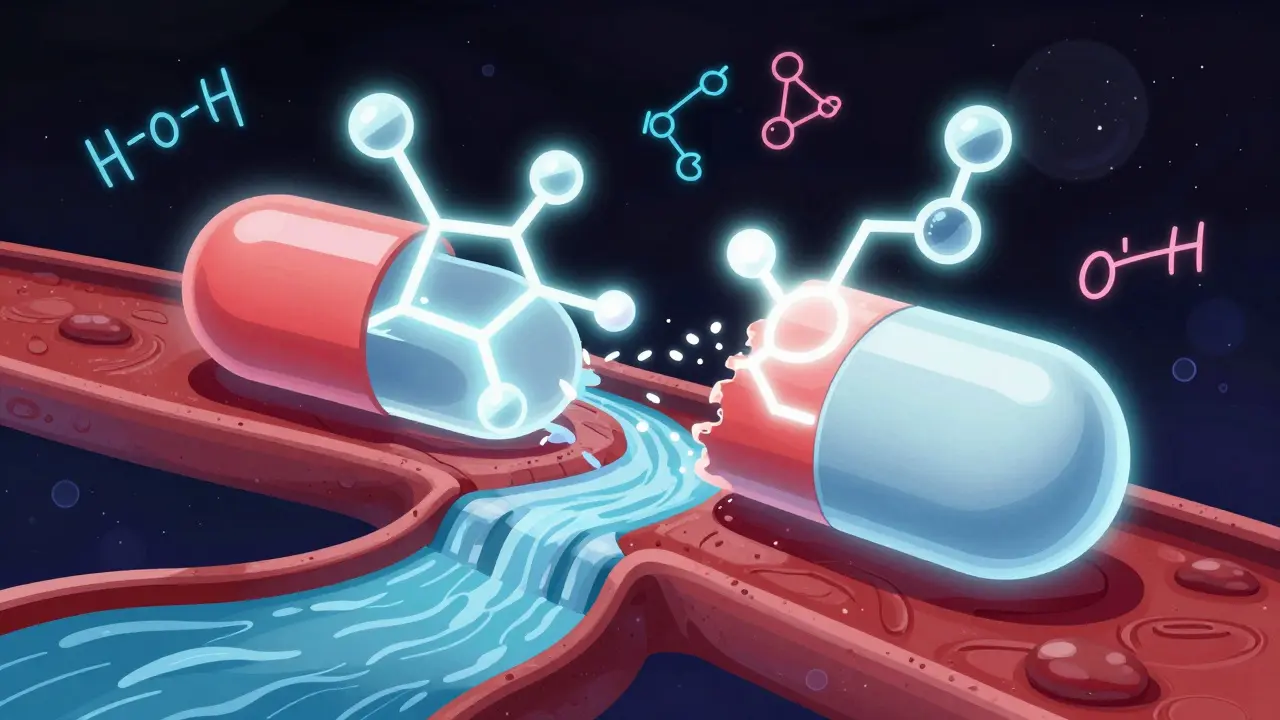
When a drug combines two or more active ingredients into one pill, patch, or inhaler, it’s no longer just about whether the medicine works. It’s about whether the bioequivalence of that combination matches the original product exactly. This isn’t a simple question of dose size. It’s a complex puzzle involving how each component behaves on its own, how they interact with each other, and how the body absorbs them together. For generic manufacturers trying to bring affordable versions to market, proving this equivalence is one of the toughest hurdles in modern drug development.
Why Bioequivalence Matters for Combination Products
Bioequivalence means two products deliver the same active ingredients at the same rate and to the same extent in the body. For single-drug pills, this is relatively straightforward: measure blood levels of one compound over time, compare the peak concentration (Cmax) and total exposure (AUC), and ensure they fall within 80-125% of the brand-name version. But when you combine two or more drugs-like a blood pressure pill with an ACE inhibitor and a diuretic-the interactions change everything. One drug might slow down how fast the other is absorbed. One might bind to the other in the gut, reducing its availability. These aren’t hypothetical risks; they’re documented realities. The FDA’s data shows that 73% of new chemical entities approved between 2010 and 2019 were complex products, including fixed-dose combinations (FDCs), topical creams, and drug-device systems. These aren’t niche products. They’re used daily by millions for conditions like diabetes, asthma, HIV, and eczema. Without generic versions, patients pay hundreds of dollars a month. Generic drugs saved the U.S. healthcare system $373 billion in 2020 alone. But if bioequivalence can’t be proven reliably, those savings vanish.The Three Big Challenges: FDCs, Topical Products, and Drug-Device Systems
There are three main categories of combination products, each with its own set of testing nightmares.Fixed-Dose Combinations (FDCs) are the most common. Think of a single pill containing metformin and sitagliptin for type 2 diabetes. The challenge isn’t just proving that both drugs reach the bloodstream-it’s proving they do so in the same way as when taken separately. The FDA now requires manufacturers to demonstrate bioequivalence to both the individual components and the co-administered reference products. That means running three-way crossover studies: one where patients take the generic combo, another where they take the brand combo, and a third where they take each drug separately. These studies need 40-60 healthy volunteers, not the usual 24-36. And even then, failure rates are 25-30% higher than for single-entity drugs. Why? Because formulation chemistry gets messy. One ingredient can change the solubility, dissolution, or even the pH of the stomach environment around the other. A 2022 study found that combining two poorly soluble drugs in one tablet reduced absorption of both by up to 40% in some cases.
Topical products like creams, ointments, and foams are even harder. You can’t just draw blood and measure concentration. The drug needs to penetrate the skin’s outer layer-the stratum corneum-to work. The FDA’s current method uses tape-stripping: peeling off 15-20 layers of skin with adhesive tape and analyzing how much drug is in each layer. But here’s the problem: there’s no standard for how deep the tape should go, how much material to collect, or how to account for natural skin variation between people. One lab’s results might differ from another’s by 30%. A generic version of calcipotriene/betamethasone dipropionate foam failed three consecutive bioequivalence studies because the measurements were inconsistent. That’s not a manufacturing flaw-it’s a method flaw.
Drug-device combinations-like inhalers, auto-injectors, or nasal sprays-are a different beast entirely. It’s not enough to show the drug reaches the bloodstream. You have to prove the device delivers it the same way. For an inhaler, that means matching the aerodynamic particle size distribution. If the aerosol particles are too large, they hit the throat instead of reaching the lungs. Too small, and they’re exhaled before they can act. The FDA requires aerosol performance to stay within 80-120% of the reference product. But minor changes in the propellant, valve design, or even the shape of the mouthpiece can throw this off. In 2024, 65% of complete response letters from the FDA on generic inhalers cited deficiencies in user interface testing. That’s not about chemistry. It’s about ergonomics, pressure, timing, and how the patient actually uses the device.
Why Traditional Bioequivalence Methods Fail
The standard two-way crossover design with 24-36 volunteers works fine for simple oral drugs. But for combination products, it’s like trying to measure wind speed with a single thermometer. You need more subjects, more measurements, and more complex statistics. The FDA’s population bioequivalence approach is sometimes used-it looks at variability across the whole population rather than just average values-but there’s no agreed-upon statistical model. Different companies use different methods, and regulators often reject submissions because the approach wasn’t “well-justified.” Modified-release formulations add another layer of difficulty. If a drug is designed to release slowly over 12 hours, you can’t just measure peak levels. You need to track the entire release profile. For drugs with a narrow therapeutic index-like warfarin or levothyroxine-the acceptable range tightens to 90-111%. That leaves almost no room for error. In 2023, FDA data showed 35-40% of initial ANDA submissions for modified-release FDCs failed bioequivalence testing on the first try.
The Real Cost of Failure
Developing a generic combination product isn’t cheap. It typically costs $15-25 million and takes 3-5 years. Bioequivalence studies alone account for 30-40% of that cost. Companies need specialized labs with LC-MS/MS instruments costing $300,000-$500,000 each, and technicians with 2-3 years of training just to run them. For small and mid-sized manufacturers, this is a wall. Teva reported that 42% of their complex product failures were due to bioequivalence issues. Mylan (now Viatris) said development timelines for topical products increased by 18-24 months because of repeated testing failures. In the FDA’s public docket, 78 industry submissions between 2021 and 2023 cited “lack of clear bioequivalence pathways” as the top barrier. Eighty-nine percent of surveyed generic companies called current requirements “unreasonably challenging.”How the Industry Is Adapting
There’s hope, though. The FDA’s Complex Product Consortium, launched in 2021, has already issued 12 product-specific bioequivalence recommendations. Companies that follow them see development timelines cut by 8-12 months. Early engagement through Type II meetings has increased by 220% since 2020-meaning manufacturers are asking regulators for feedback before spending millions. One of the biggest breakthroughs has been the use of physiologically-based pharmacokinetic (PBPK) modeling. This computer simulation predicts how a drug moves through the body based on physiology, chemistry, and absorption data. It’s been accepted in 17 approved ANDAs for complex products as of mid-2024. In some cases, it reduced the need for clinical studies by 30-50%. For topical products, in vitro-in vivo correlation (IVIVC) modeling is showing promise too. Pilot studies found that in vitro tape-stripping data could predict in vivo performance with 85% accuracy. If this holds, it could replace costly and inconsistent human trials. The FDA is also working with NIST to develop reference standards for complex products. The first batch-targeting inhalation devices-is expected by Q4 2024. These won’t be just guidelines. They’ll be physical, certified samples that labs can use to calibrate their equipment. That’s huge. Right now, two labs testing the same product can get different results because their instruments aren’t calibrated the same way.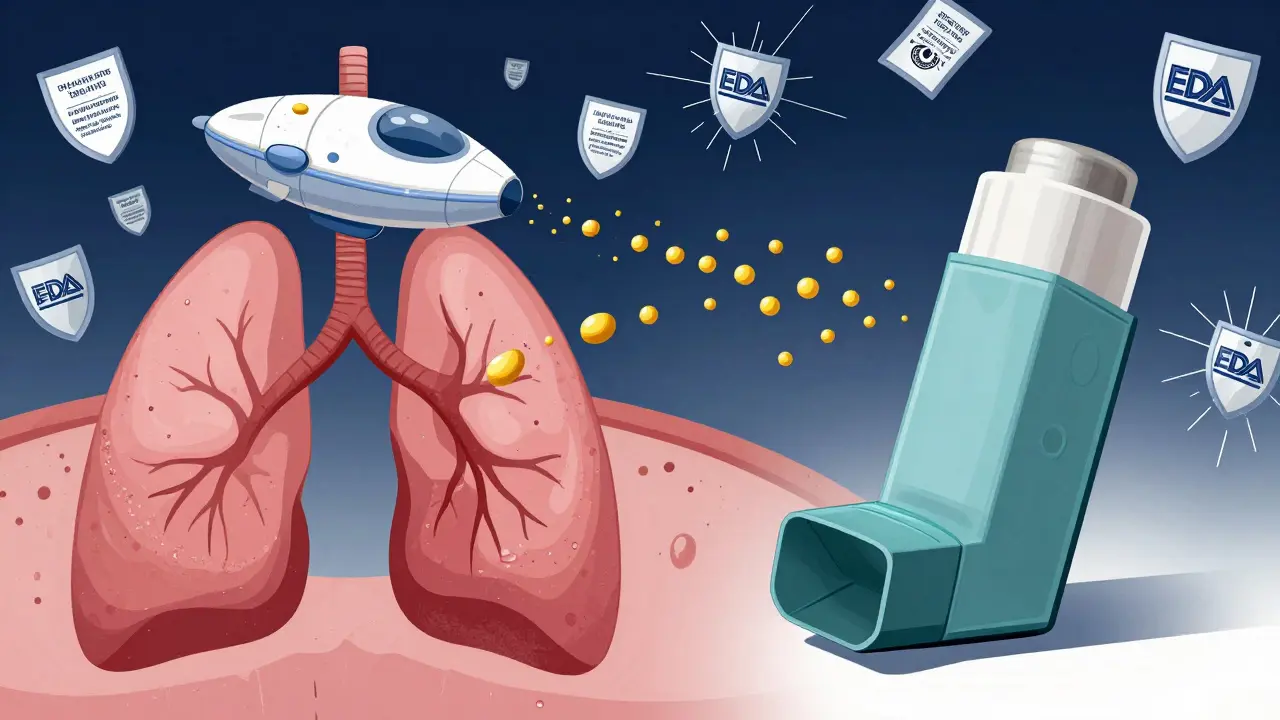
Global Inconsistencies and Patent Barriers
Europe’s EMA often requires additional clinical trials for complex products that the FDA accepts with modeling. This duplication adds 15-20% to development costs. And while the U.S. has made progress, Europe lags behind, creating a fragmented approval process. Then there are patents. Drug companies stack patents around combination products-covering formulations, delivery methods, even packaging. Between 2019 and 2023, litigation around drug-device combinations rose 300%. The average delay in generic entry? 2.3 years. That’s not just legal games. It’s real money lost to patients who can’t afford the brand.What’s Next?
The FDA’s 2024 draft guidance includes 15 new product-specific recommendations, including for HIV drug combos like dolutegravir/lamivudine. The agency has pledged to create 50 new product-specific guidances by 2027, starting with respiratory products, where 78% of submissions currently face bioequivalence issues. The goal isn’t to make testing harder. It’s to make it smarter. To move away from one-size-fits-all rules and toward tailored, science-based pathways. If this happens, generic versions of $78 billion in complex products could reach the market by 2028. If it doesn’t, 45% of these products will have no generic competition by 2030.For patients, this isn’t abstract science. It’s whether they can afford their daily inhaler. For manufacturers, it’s whether they can stay in business. For regulators, it’s whether the system can keep up with modern medicine.
What exactly is a combination product?
A combination product is a medical product that combines two or more different types of components-such as a drug and a device, a drug and a biological product, or two drugs in one formulation. Examples include inhalers (drug + device), insulin pens, and fixed-dose pills with two active ingredients like metformin and sitagliptin.
Why can’t we just test one active ingredient in a combination product?
Because the ingredients interact. One drug can change how the other is absorbed, metabolized, or distributed in the body. For example, a drug that slows stomach emptying might delay the absorption of another ingredient. That means bioequivalence must be proven for each component individually and together-not just one.
Are bioequivalence requirements the same in the U.S. and Europe?
No. The FDA often accepts modeling and in vitro data to demonstrate equivalence. The EMA frequently requires additional clinical trials for complex products, even when the FDA has approved a similar product. This forces manufacturers to run duplicate studies, increasing costs by 15-20%.
What’s the biggest hurdle for generic inhalers?
The delivery device. Even if the drug chemistry matches perfectly, a small change in valve design, propellant pressure, or mouthpiece shape can alter how much of the drug reaches the lungs. The FDA requires aerosol particle size to stay within 80-120% of the brand product. In 2024, 65% of rejection letters cited issues in this area.
Can computer modeling replace human bioequivalence studies?
In some cases, yes. Physiologically-based pharmacokinetic (PBPK) modeling has been accepted in 17 approved generic applications as of mid-2024. It can reduce the need for clinical studies by 30-50%, especially for oral and inhalation products. But it’s not a universal replacement-it still requires strong supporting data and regulatory agreement.
How much does it cost to develop a generic combination product?
Typically $15-25 million over 3-5 years. Bioequivalence testing alone can cost $5-10 million for topical products and $3-7 million for complex oral or inhalation products. That’s 30-40% of the total development cost.
Why are failure rates higher for FDCs than single-drug generics?
Formulation interactions. Two drugs in one pill can affect each other’s solubility, dissolution rate, or stability. One ingredient might bind to the other, reducing absorption. These interactions are hard to predict and often only become clear during testing. Studies show FDC bioequivalence failures are 25-30% more common than for single-drug products.
What role do regulatory agencies play in improving this process?
They’re creating product-specific guidances instead of one-size-fits-all rules. The FDA’s Complex Product Consortium has issued 12 such guidances since 2021. They’re also developing reference standards with NIST to reduce lab variability. And they’re pushing for early dialogue with manufacturers to prevent costly missteps.



Aaron Pace
March 7, 2026 AT 08:55Joey Pearson
March 8, 2026 AT 01:27Roland Silber
March 9, 2026 AT 19:06Andrew Poulin
March 11, 2026 AT 06:40Sean Callahan
March 11, 2026 AT 18:19Ferdinand Aton
March 13, 2026 AT 14:14Amina Aminkhuslen
March 14, 2026 AT 00:51amber carrillo
March 15, 2026 AT 21:05Tim Hnatko
March 16, 2026 AT 08:26Adebayo Muhammad
March 18, 2026 AT 02:29Joe Prism
March 18, 2026 AT 13:43Bridget Verwey
March 20, 2026 AT 07:16Weston Potgieter
March 22, 2026 AT 04:09Vikas Verma
March 22, 2026 AT 23:02