
Choosing the right over-the-counter (OTC) eye drops isn’t as simple as picking the brightest bottle on the shelf. Your eyes aren’t just dry - they might be allergic, irritated, or both. And using the wrong kind can make things worse. If you’ve ever reached for Visine after a long day at the computer, only to wake up with even redder eyes the next morning, you’re not alone. Millions of people do this every year. The good news? There’s a better way. Knowing exactly what’s in your eye drops - and what your eyes actually need - can turn daily discomfort into lasting relief.
Understand the Three Main Types of OTC Eye Drops
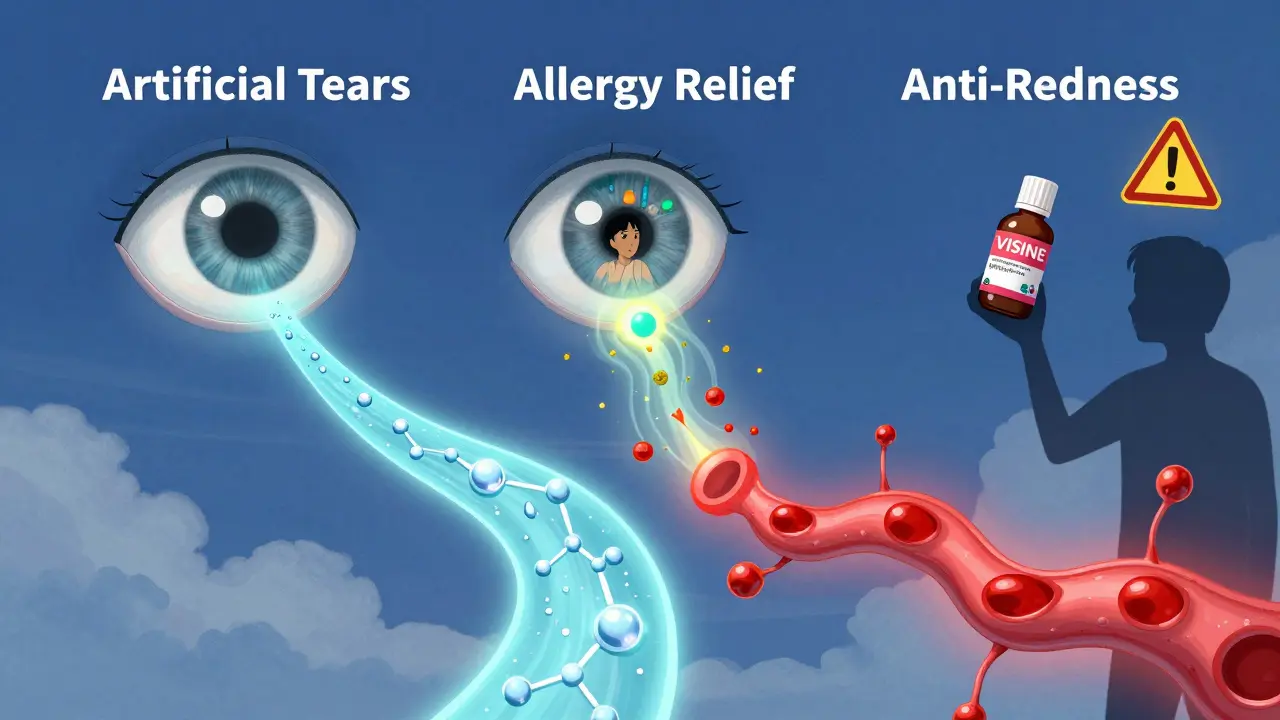
Not all eye drops are made the same. They fall into three clear categories, each targeting a different problem. Mixing them up is like using hand sanitizer to treat a sunburn - it won’t help, and it might hurt.- Artificial tears - These mimic natural tears. They don’t treat the root cause of dryness, but they replace what your eyes are missing. Look for ingredients like polyethylene glycol, a lubricant that helps retain moisture on the eye’s surface, or hyaluronic acid, a molecule that holds up to 1,000 times its weight in water. Brands like Systane Ultra and Refresh Optive use these to keep eyes moist for hours.
- Allergy relief drops - These fight itching, swelling, and watery eyes caused by pollen, dust, or pet dander. They contain antihistamines like ketotifen, found in Zaditor, which blocks histamine release, or olopatadine, the active ingredient in Pataday that provides up to 24 hours of relief. These are not for daily use unless you’re in allergy season.
- Anti-redness drops - These shrink blood vessels to make eyes look whiter. The active ingredient is usually tetrahydrozoline, as in Visine, or brimonidine in Lumify. They work fast - within minutes - but they don’t fix the cause of redness. Worse, if you use them too often, your eyes get dependent. When the effect wears off, the blood vessels dilate even more than before. This is called rebound redness, and it affects 68% of frequent users within two weeks.
If you’re unsure which type you need, ask yourself: Does it feel like sand is in your eyes? That’s dryness. Does it itch like crazy when you go outside? That’s allergies. Does it look bloodshot but feel fine otherwise? That’s redness - but be careful.
Match the Drop to Your Dry Eye Type
Dry eye isn’t one condition. There are two main types, and they need totally different treatments.Aqueous-deficient dry eye means your tear glands don’t make enough fluid. This is common in older adults and people who spend hours staring at screens. If your eyes feel gritty, especially in air-conditioned rooms or after reading, you likely have this. The best choice? Drops with electrolytes. TheraTears, which contains sodium, potassium, and chloride in concentrations matching natural tears, has been shown to outperform standard artificial tears by 37% in symptom relief. It’s also hypotonic - meaning it’s slightly less salty than your tears - which helps draw moisture into the eye.
Evaporative dry eye happens when your tears evaporate too fast. This is usually caused by blocked oil glands in your eyelids (called Meibomian Gland Dysfunction). If your eyes burn more at the end of the day, or if you notice oily residue on your eyelashes, this is probably your issue. You need drops that replace the oil layer. Systane Complete PF, with mineral oil and castor oil, is designed for this. It rebuilds the tear film’s protective barrier. Clinical data shows it reduces symptoms 52% better than regular lubricants.
And then there’s Thealoz Duo, a newer option with trehalose 3% and sodium hyaluronate 0.15%. It’s not just a lubricant - it helps repair damaged eye surface cells. In trials, it improved corneal staining scores by 40% compared to standard drops. It’s pricier, but for severe dryness, it’s worth considering.
Preservative-Free vs. Preserved: The Hidden Risk
Most eye drops come in multi-dose bottles with preservatives like polyquaternium-1, a chemical added to keep bacteria out after opening. Sounds smart - until you realize these preservatives can irritate your eyes over time.If you use drops more than four times a day, you’re at risk. Studies show that 22% of chronic users develop tiny corneal scratches called punctate keratitis. That’s not just discomfort - it’s damage. The fix? Switch to preservative-free drops. These come in single-use vials. You open one, use it, and throw it away. No preservatives. No buildup. No irritation.
They cost more - $12.50 to $22.26 for 30 vials - but if you’re using drops daily, it’s cheaper than treating the damage they cause. Brands like Refresh Optive Preservative-Free, and Soothe XP are popular choices. And if you wear contacts, look for ones labeled “compatible” - they’re tested to not dry out your lenses.
Forget the Redness Relief - Unless You Know Why
Redness drops are the most misused OTC eye products. People use them because their eyes look bad - not because they feel bad. But here’s the truth: redness is often a symptom, not the problem.The American Optometric Association warns that 83% of people who use vasoconstrictors like tetrahydrozoline (Visine) for dry eye end up making it worse. Why? Because these drops cut off blood flow to the eye surface. That blood flow delivers oxygen and nutrients needed to make tears. No blood flow? No tear production. You’re trading short-term whitening for long-term dryness.
There’s one exception: Lumify, with brimonidine tartrate 0.025%. It works differently. It reduces redness without causing rebound in most users. In clinical trials, only 5.2% of users experienced rebound redness - far better than Visine’s 68%. But even Lumify isn’t meant for daily use. Use it only for occasional redness - like after a long flight or a night out.
How to Apply Eye Drops Correctly
Even the best drop won’t work if you use it wrong. Most people mess up the basics.Here’s how to do it right:
- Wash your hands.
- Tilt your head back slightly, looking up.
- With one finger, gently pull down your lower eyelid to create a small pocket.
- Hold the bottle above your eye - don’t touch the tip to your eye or lashes. A single drop is enough.
- Close your eye gently for 30 seconds. Don’t blink hard. Just rest it.
- Press lightly on the inner corner of your eye (near your nose) for 10 seconds. This stops the drop from draining into your throat.
Why does this matter? If you blink right after, you lose half the drop. If you touch the bottle to your eye, you risk contamination. If you don’t press your inner eyelid, the drop drains into your nose and can cause side effects like headaches (a common complaint with Lumify users).
What Real Users Say - And What They Wish They Knew
On Amazon, Systane Ultra has over 18,000 reviews. 78% of 5-star reviews say: “Instant relief from screen fatigue.” But 63% of 1-star reviews say: “It stings like crazy.” That sting? Often from preservatives. Switching to the preservative-free version fixes it.On Reddit’s r/dryeye community, users swear by Refresh Relieva PF. One top post says: “This is the only drop that doesn’t blur my vision for work - lasts 5 hours.” Gel drops like Systane Gel Drops can blur vision for 2-3 minutes. If you’re driving or working on a computer, avoid them during the day.
And then there’s the story of u/RedEyeSufferer: “Visine made my eyes twice as red after 3 days. I thought I needed more. I didn’t know I was making it worse.” That’s the trap. Redness drops are addictive. You don’t need them. You need the right lubricant.
When to See a Doctor
OTC drops help - but they’re not a cure. If after 14 days of using the right type of drop, your eyes still feel gritty, burn, or blur your vision, it’s time to see an eye doctor. You might have an underlying condition like meibomian gland dysfunction, Sjögren’s syndrome, or an autoimmune disorder. Also, if you’re using drops more than six times a day for over a month, you’re masking a deeper problem.And if you’re using redness drops daily? Stop. Immediately. Switch to a preservative-free artificial tear. Your eyes will thank you.
Can I use allergy eye drops for dry eyes?
No. Allergy drops like Zaditor or Pataday are designed to block histamine, not to lubricate. They won’t relieve dryness and may even irritate your eyes further. If you have both allergies and dryness, use an allergy drop once or twice a day, and a separate artificial tear for hydration. Don’t mix them in the same bottle.
Are preservative-free eye drops worth the extra cost?
Yes - if you use drops more than four times a day. Preservatives can damage the eye surface over time, leading to inflammation and reduced tear production. Single-use vials cost more per drop, but they prevent long-term damage. For frequent users, they’re cheaper than doctor visits for corneal irritation.
Why do my eyes blur after using gel drops?
Gel drops contain thicker ingredients like hydroxypropyl guar, which coat the eye and last longer - but they also temporarily blur vision. This lasts 2-3 minutes. Use them before bed or when you’re not driving or working on screens. For daytime relief, stick to liquid artificial tears.
Can I use eye drops with contact lenses?
Only if they’re labeled “compatible with contact lenses.” These are tested to not dry out or warp your lenses. Regular drops can stick to lenses, cause discomfort, or reduce oxygen flow. Blink Contacts and Refresh Optive for Contacts are designed for this. Always wait 15 minutes after inserting lenses before applying drops.
Is it safe to use expired eye drops?
No. Even if they look fine, preservatives break down over time. Bacteria can grow. Using expired drops risks infection. Most multi-dose drops expire 30 days after opening. Single-use vials are good until the printed date - but discard immediately if the seal is broken or the liquid looks cloudy.

John Haberstroh
February 16, 2026 AT 20:23Man, I used to be that guy who reached for Visine like it was candy after a long Zoom call. Then one day my eyes looked like I’d been stabbed with a rusty needle. Turns out, rebound redness is real - and it’s brutal. Switched to Refresh Optive PF, and wow. No more stinging, no more bloodshot mornings. Just… chill eyes. Like my lids finally remembered how to relax. Also, never thought about the inner corner press trick - that’s a game-changer. I’m gonna start doing that like it’s a morning ritual. Thanks for the clarity, this post saved my eyeballs.
Agnes Miller
February 16, 2026 AT 23:17i just found out my drops have preservatives and i use them 6x a day 😳 i thought they were all the same… switched to preservative free last week and my eyes dont feel like sandpaper anymore. also i didnt know about the 30 sec close thing - game changer. thanks for the info!!
Jonathan Ruth
February 18, 2026 AT 11:48Philip Blankenship
February 19, 2026 AT 22:00So I’ve been using Systane Ultra for like 5 years, never thought twice about it. Then I read this and realized I was basically pouring chemicals into my eyes every day. I switched to the preservative-free version and honestly? My vision feels clearer. Not just less irritated - actually clearer. Like the fog lifted. Also, the part about evaporative dry eye? Yeah, that’s me. I’ve got oily residue on my lashes like a greasy little lizard. Systane Complete PF is a miracle. I’m not even kidding. I bought three boxes. I’m officially a convert. And now I’m telling everyone I know. This post is a public service.
Oliver Calvert
February 20, 2026 AT 09:54Kancharla Pavan
February 21, 2026 AT 00:19You think you’re helping people but you’re just feeding the consumerist machine. Why are you trusting corporations that sell eye drops? Who made these studies? Who funded them? The same companies that profit from your dependence. You’re being manipulated into buying expensive vials because you’ve been conditioned to fear preservatives. Real solution? Wash your eyes with clean water. Blink more. Look away from screens. Stop treating symptoms and fix the cause. Your eyes don’t need chemicals. They need rest. You’re all being sold a lie wrapped in clinical data.
PRITAM BIJAPUR
February 21, 2026 AT 20:03Wow. This post hit me like a sunrise after a long night 🌅. I’ve been using Lumify like it was my emotional support eye drop - and now I realize I was just numbing the pain. Trehalose? Sodium hyaluronate? These aren’t just ingredients - they’re tiny healers. I’m getting Thealoz Duo tomorrow. I’m not just fixing my eyes… I’m honoring them. Every blink matters. Every drop is a conversation. And now? I’m listening. Thank you for this. 🙏✨
Dennis Santarinala
February 22, 2026 AT 06:09I love how this post doesn’t just give you a list - it gives you a mindset shift. I used to think eye drops were like painkillers: pop one, feel better, done. But now I see it’s more like tending a garden. You gotta understand the soil, the sun, the season. And oh my gosh - the inner corner press?! Why didn’t anyone tell me this?! I’ve been wasting 70% of every drop! I’m gonna start a little ritual: wash hands, tilt back, press, rest, breathe. It’s not just medicine - it’s mindfulness. I’m so glad I read this. 🌿👁️
Tony Shuman
February 24, 2026 AT 00:33Haley DeWitt
February 25, 2026 AT 03:36OMG I JUST REALIZED I’VE BEEN USING VISINE FOR 8 YEARS 😭 I’M SO SORRY MY EYES. I switched to Refresh Optive PF today and it’s like my eyes gave me a hug. Also, the inner corner thing? I did it and my drop didn’t drain into my throat - I didn’t even know that was happening!! I’m crying (in a good way) and I’m telling all my friends. THANK YOUUUUUUU 🥹💖