
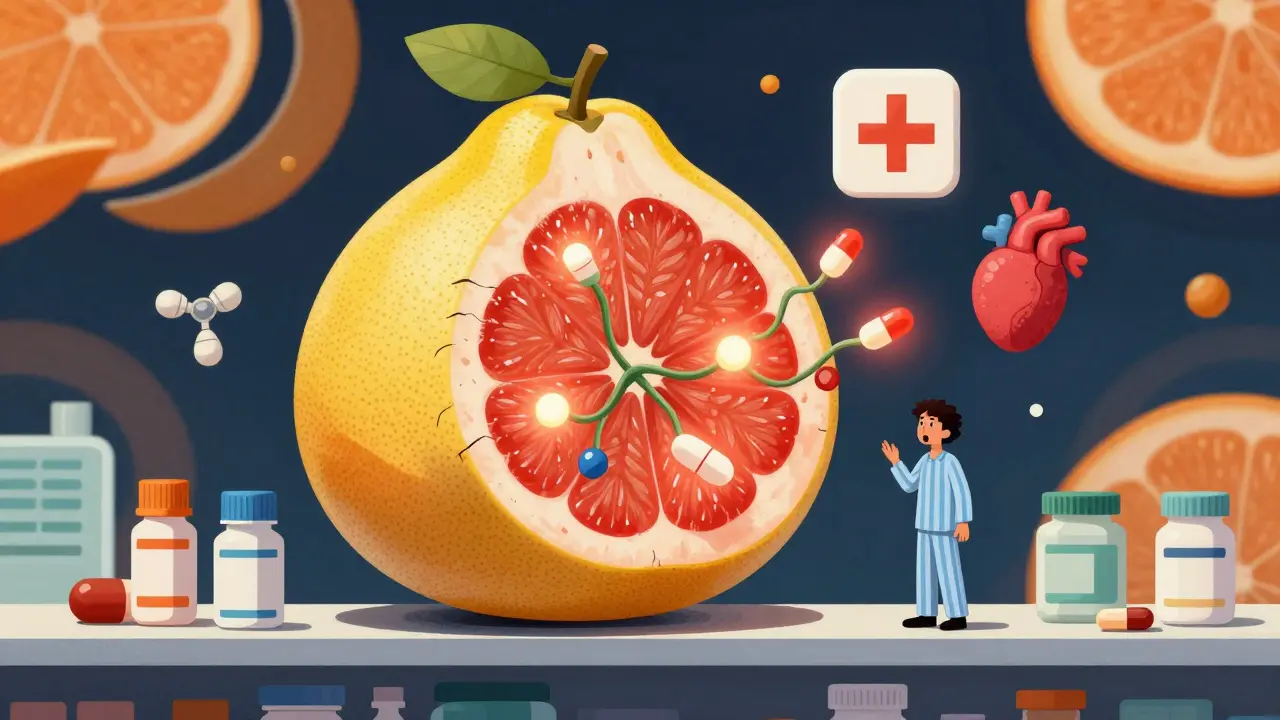
Drug Interaction Checker for Pomelo & Seville Orange
Check Your Medication
Enter your medication name to see if it interacts with pomelo or Seville orange
Safety Note
Always consult your doctor or pharmacist before changing your diet when taking medications. This tool is for informational purposes only and doesn't replace professional medical advice.
Most people know grapefruit can mess with their meds. But what about pomelo or Seville orange? These fruits aren’t just exotic snacks-they’re silent troublemakers when you’re on certain prescriptions. If you’re taking statins, blood pressure pills, or immunosuppressants, eating one of these without knowing the risk could land you in the hospital.
Why These Fruits Are Just as Dangerous as Grapefruit
Pomelo and Seville orange aren’t just similar to grapefruit-they’re often worse. Both contain high levels of furanocoumarins, especially bergamottin and 6',7'-dihydroxybergamottin. These chemicals shut down a key enzyme in your gut called CYP3A4. That enzyme normally breaks down drugs before they enter your bloodstream. When it’s blocked, the drug builds up to dangerous levels. A 2014 study in the Journal of Agricultural and Food Chemistry found pomelo has 1.5-2.5 μM of bergamottin, while grapefruit has 1.0-2.0 μM. Seville orange? Some varieties hit 3.0-4.0 μM. That’s up to 30% more than grapefruit. And it’s not just juice. Marmalade made from Seville orange peel packs even more punch because the peel is where furanocoumarins concentrate. The effect doesn’t vanish after one bite. These compounds bind permanently to the enzyme. Even if you eat the fruit in the morning and take your pill at night, the damage is already done. The enzyme stays blocked for up to 72 hours. That means if you eat pomelo on Monday, you’re still at risk on Thursday.Which Medications Are at Risk?
Not all drugs are affected. But the ones that are? They’re serious.- Statins like simvastatin and atorvastatin: Eating pomelo can spike simvastatin levels by 350%, raising the risk of rhabdomyolysis-a condition where muscle tissue breaks down and can cause kidney failure.
- Calcium channel blockers like amlodipine and felodipine: Blood pressure can drop dangerously low.
- Immunosuppressants like tacrolimus and cyclosporine: Transplant patients who ate Seville orange marmalade have been hospitalized with toxic drug levels.
- Anti-anxiety drugs like buspirone and some benzodiazepines: Can cause extreme drowsiness or breathing trouble.
- Some anti-arrhythmics like amiodarone: Risk of irregular heartbeat increases.
Why Nobody Talks About This
Grapefruit gets all the attention. That’s because it’s been studied since the 1980s. Pomelo and Seville orange? Not so much. Only 37% of products containing these fruits carry warning labels, compared to 78% for grapefruit. A 2022 FDA review found most pomelo sold in U.S. markets is mislabeled as “Chinese grapefruit,” so people assume it’s safe if they’ve heard grapefruit is bad. It’s not. Even worse, only 42% of community pharmacists routinely ask patients about pomelo or Seville orange use. Most still only check for grapefruit. A Reddit post from October 2022 tells the story: a patient developed rhabdomyolysis after eating pomelo daily for two weeks. No one warned them. They thought grapefruit was the only one to avoid.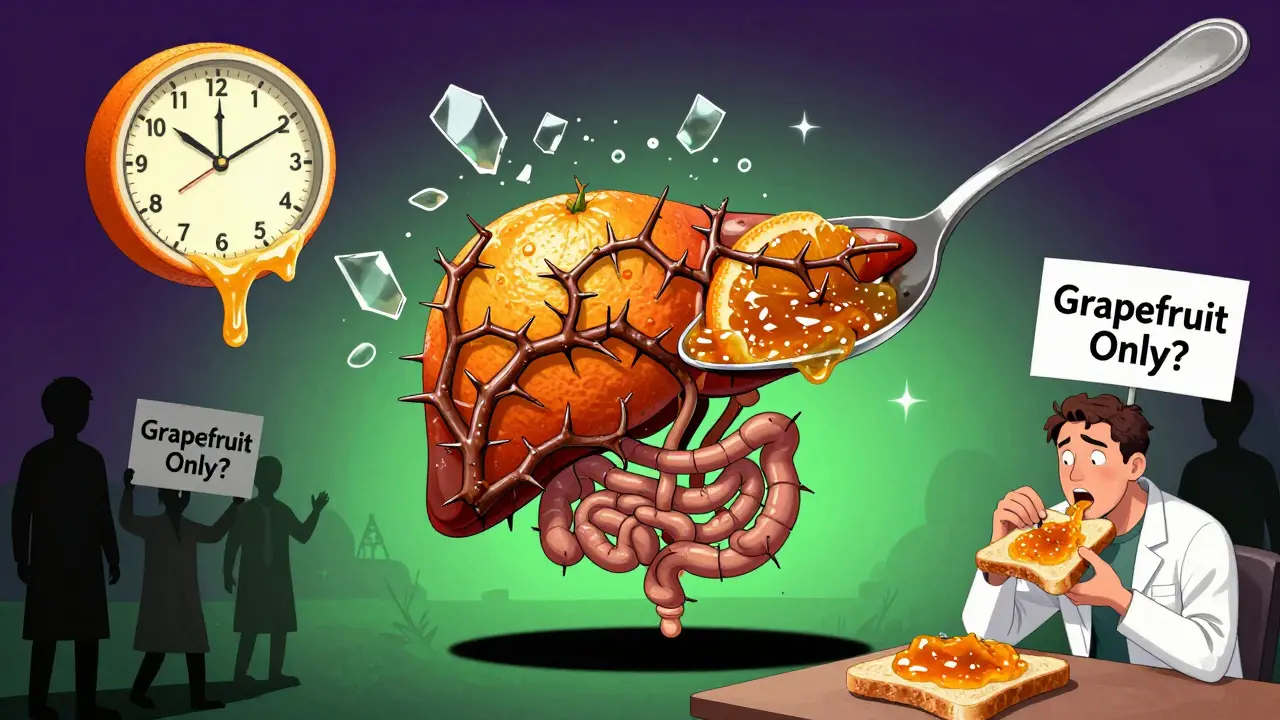
What You Should Do
If you’re on any of the medications listed above, here’s what to do:- Check your prescription label. If it warns about grapefruit, assume it warns about pomelo and Seville orange too.
- Ask your pharmacist. Don’t assume they know. Say: “Does this interact with pomelo or bitter orange?”
- Read labels on marmalade. If it says “Seville orange” or “bitter orange,” avoid it. Sweet orange marmalade is fine.
- Know what pomelo looks like. It’s huge-sometimes as big as a soccer ball-with thick, pale yellow or green rind and pink or white flesh. If you’re unsure, ask the produce clerk.
- Avoid all three fruits for at least 3 days before and during treatment. Even a small amount can trigger an interaction.
What’s Being Done About It
The science is clear. The FDA, European Medicines Agency, and Mayo Clinic all say: treat pomelo and Seville orange like grapefruit. But policy hasn’t caught up. The FDA received 217 adverse event reports linked to pomelo-drug interactions between 2018 and 2022-a 43% increase from the prior five years. In response, they proposed new labeling rules in 2023 that will require warnings on all furanocoumarin-containing citrus fruits. Implementation is expected by mid-2025. The University of Washington just launched a $2.1 million NIH-funded study to map exactly how pomelo affects drug levels. Meanwhile, 17 EU countries now require warning labels on pomelo and Seville orange products. But until those rules are in place, the burden is on you.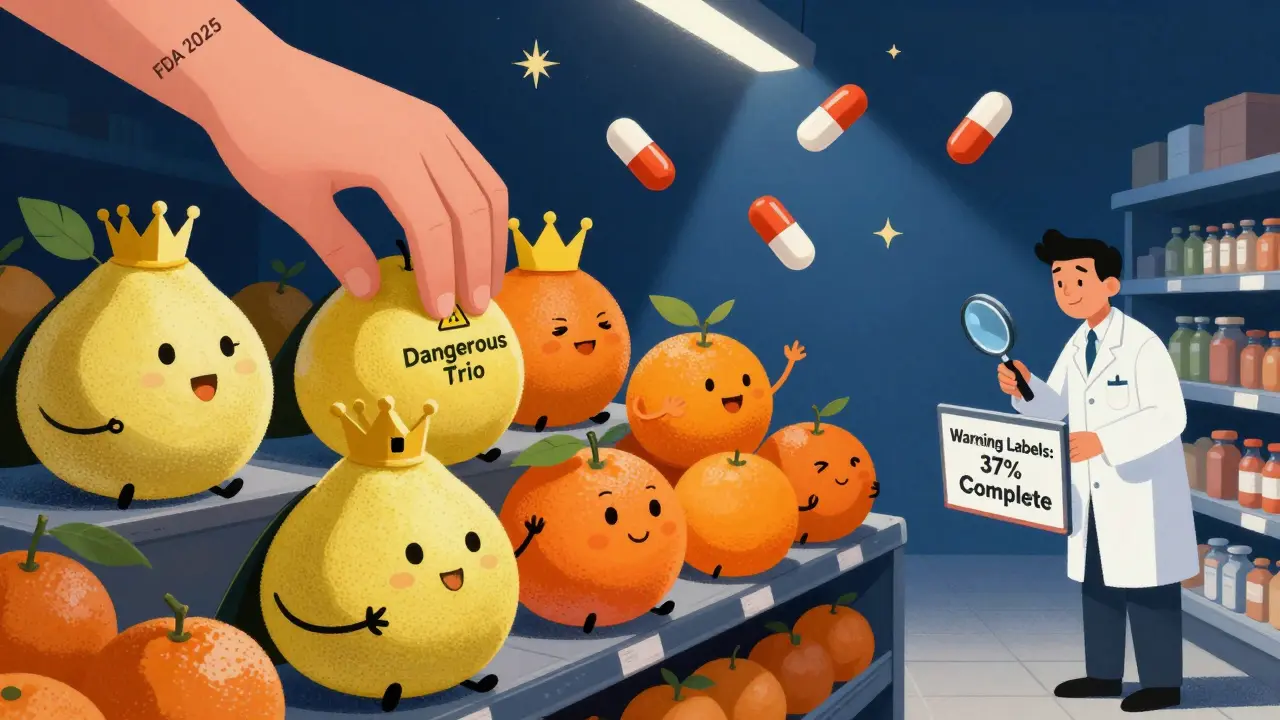
What About Other Citrus?
Sweet oranges (like navel or Valencia), tangerines, clementines, and mandarins are safe. They don’t contain enough furanocoumarins to cause interactions. Same goes for limes and lemons-unless they’re processed into juice with peel included (which is rare). The only other citrus to watch is bitter orange extract in supplements. It’s sometimes used for weight loss or energy, but it’s packed with the same compounds as Seville orange. Avoid it if you’re on meds.Bottom Line
You don’t need to give up citrus. Just know which ones are dangerous. Grapefruit, pomelo, and Seville orange are a dangerous trio. If your medication warns about grapefruit, treat the other two the same way. It’s not about fear. It’s about awareness. A single slice of pomelo can be enough to overload your system. A spoonful of marmalade can send a transplant patient to the ICU. Talk to your doctor. Read labels. Ask questions. Your life might depend on it.Can I eat pomelo if I’m not on any medication?
Yes. Pomelo is perfectly safe if you’re not taking medications that interact with furanocoumarins. It’s a nutritious fruit high in vitamin C and antioxidants. The risk only exists when you’re on certain drugs. If you’re unsure, check with your doctor or pharmacist before adding it to your diet.
Is Seville orange the same as regular orange?
No. Seville orange, also called bitter orange, is a different species from sweet oranges like navel or Valencia. It’s sour, bitter, and used mainly for marmalade and traditional medicines. Regular sweet oranges don’t contain enough furanocoumarins to cause drug interactions. If a product says “Seville orange” or “bitter orange,” avoid it if you’re on meds.
How long do the effects last after eating pomelo or Seville orange?
The enzyme inhibition lasts up to 72 hours. That’s because furanocoumarins permanently damage the CYP3A4 enzyme in your gut. Your body needs time to make new enzymes. Even if you eat the fruit one day and take your pill the next, the interaction can still happen. That’s why experts recommend avoiding these fruits for at least three days before and during treatment.
Can I just eat less pomelo to avoid the interaction?
No. Even small amounts-like 200 mL of juice or one segment of fruit-can trigger the interaction. The effect is not dose-dependent in a linear way; it’s all-or-nothing. Once the enzyme is inhibited, even a tiny bit of furanocoumarin can block enough of it to raise drug levels dangerously. There’s no safe threshold.
What should I do if I accidentally ate pomelo and took my medication?
If you took your medication within 72 hours of eating pomelo or Seville orange, contact your doctor or pharmacist immediately. Watch for signs like muscle pain or weakness (especially with statins), dizziness or fainting (with blood pressure meds), or confusion and nausea (with immunosuppressants). Don’t wait for symptoms. Early intervention can prevent serious harm.


Susan Arlene
January 5, 2026 AT 14:20So i just ate a whole pomelo for breakfast and took my statin at noon... hope i dont turn into a pile of mush by tomorrow lol
Joann Absi
January 5, 2026 AT 19:42THIS IS WHY AMERICA IS FALLING APART 😭 No one reads labels anymore. We got people eating exotic fruits like they’re candy while their meds turn into poison. 🇺🇸 We need to ban this nonsense. Also why is the FDA so slow?? 🤬
Mukesh Pareek
January 6, 2026 AT 05:23The pharmacokinetic implications are non-trivial. Furanocoumarins act as irreversible CYP3A4 inhibitors, leading to first-pass metabolism suppression. The AUC increase for simvastatin exceeds the therapeutic window by 3.5x. This is not anecdotal-it’s biochemically deterministic.
Ashley S
January 6, 2026 AT 12:36Ugh. I hate when people make everything sound like a death sentence. I eat grapefruit all the time and I’m fine. Stop scaring people.
Jeane Hendrix
January 7, 2026 AT 23:27Wait so if i’m on cyclosporine and i had a slice of pomelo on monday… does that mean i can’t take my pill until thursday? That’s wild. I never realized it lasted that long. My pharmacist never mentioned this. 😅
Tom Swinton
January 8, 2026 AT 06:18Look, I’ve been on blood pressure meds for 12 years, and I just found out about this yesterday. I used to love Seville orange marmalade on my toast. I thought it was just ‘bitter orange’ and figured it was fine. I’m so grateful for this post. I’m switching to sweet orange jam today. Seriously, thank you for sharing this. I feel like I just dodged a bullet.
Katelyn Slack
January 8, 2026 AT 22:34just read this and my heart stopped… i eat pomelo every week. i take atorvastatin. i’m gonna call my doctor tomorrow. thanks for the warning.
Melanie Clark
January 8, 2026 AT 23:38This is all part of the pharmaceutical-industrial complex’s plan to make you dependent. They don’t want you to know that natural foods like pomelo can heal you… but they profit from your broken liver. The FDA is in their pocket. And don’t get me started on how they mislabel pomelo as ‘Chinese grapefruit’… it’s mind control. I stopped taking all meds after this.
Harshit Kansal
January 10, 2026 AT 00:53Bro this is legit. My cousin in Mumbai got hospitalized after eating bitter orange marmalade with his transplant meds. He thought it was just ‘orange jam’. We all need to spread this info. Seriously.
Brian Anaz
January 10, 2026 AT 21:57Why are we letting foreigners import dangerous fruit without warnings? This is a border security issue. If we had real leadership, this wouldn’t be happening.
Venkataramanan Viswanathan
January 12, 2026 AT 14:02In India, we call Seville orange ‘kagzi nimbu’ and use it in Ayurveda. But we also know its potency. My grandmother always warned: ‘Never mix with heart pills.’ The science is old, but the world forgot. Good to see it’s being recognized now.
Vinayak Naik
January 14, 2026 AT 09:32Yo this is wild-my aunt used to make this crazy sour marmalade from these bitter oranges she got from her cousin in Kerala. She swore it cured her arthritis. Turns out she was on a blood thinner. I’m so glad she’s okay. But now I’m telling everyone: if it tastes like regret, don’t eat it with your pills 😅