
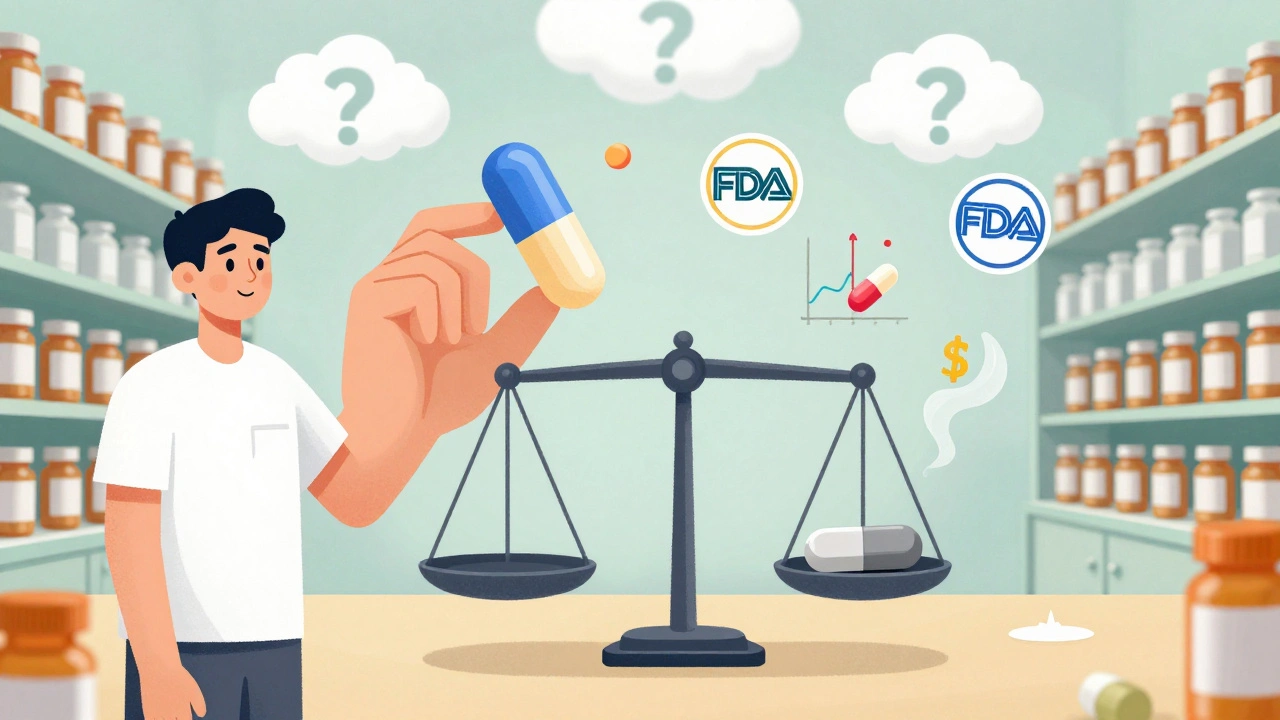
Most people don’t realize that generic medications are just as safe and effective as their brand-name cousins - yet many still refuse them. Why? Because they think cheaper means worse. If you’ve ever looked at your prescription and wondered, "Will this generic really work the same?" - you’re not alone. But here’s the truth: the FDA requires generics to match brand-name drugs in every way that matters - active ingredient, strength, dosage, and how your body absorbs it. The only differences? Color, shape, and inactive ingredients like fillers or dyes - none of which affect how the medicine works.
Why Your Doctor Might Suggest a Generic
Your doctor isn’t trying to save money on your behalf - they’re trying to help you stay healthy. Generics make it possible for people to afford their medications long-term. In the U.S., 90% of all prescriptions filled are generics. That’s not because they’re cheap - it’s because they work. A 2020 study in JAMA Internal Medicine looked at 47 clinical trials comparing generics and brand-name heart medications. The results? No meaningful difference in how well they worked. Not even a tiny one. And the cost difference? Huge. A brand-name statin might cost $675 per prescription. The generic version? Around $16. That’s not a small savings - it’s the difference between taking your medicine every day or skipping doses because you can’t afford it. Studies show patients on generics are 8-12% more likely to stick with their treatment plan. That’s not just about money - it’s about staying out of the hospital.What You’re Probably Worried About (And Why It’s Wrong)
You’ve heard the stories: "My cousin took a generic and felt awful." "The pills look different." "They’re made in another country." These fears are common - and understandable. But they’re not based on facts. Let’s break them down:- "Generics aren’t as strong." False. The FDA requires generics to deliver the same amount of active ingredient into your bloodstream as the brand name. The tolerance? Within 80-125% of the original. That’s tighter than the variation you’d see between two batches of the same brand-name drug.
- "The fillers cause side effects." Inactive ingredients (like dyes or binders) can rarely cause reactions - but this happens in less than 1% of cases. If you’ve had an allergic reaction to a brand-name drug, your doctor can check if the generic has a different filler. But for most people? No difference.
- "They’re made overseas, so they’re unsafe." The FDA inspects every manufacturing facility - whether it’s in the U.S., India, or Germany. In 2023, 98.7% of generic drug plants passed inspection. Same standards as brand-name factories.
- "My blood pressure med worked better before." If you’re on a drug with a narrow therapeutic index - like warfarin, levothyroxine, or some seizure meds - your doctor might stick with a brand or specific generic. But even then, the FDA requires stricter testing. Switching between generics of the same drug is still safe for nearly everyone.
How to Start the Conversation Without Feeling Awkward
You don’t need to be a medical expert to ask smart questions. Here’s how to bring it up naturally:- Ask: "I’ve heard about generics. Are there generic versions of this medicine?"
- Tell: "I’m worried about whether they’ll work the same. Can you explain how they’re tested?"
- Ask again: "Can you help me understand what’s the same and what’s different?"
What to Look for on the Label
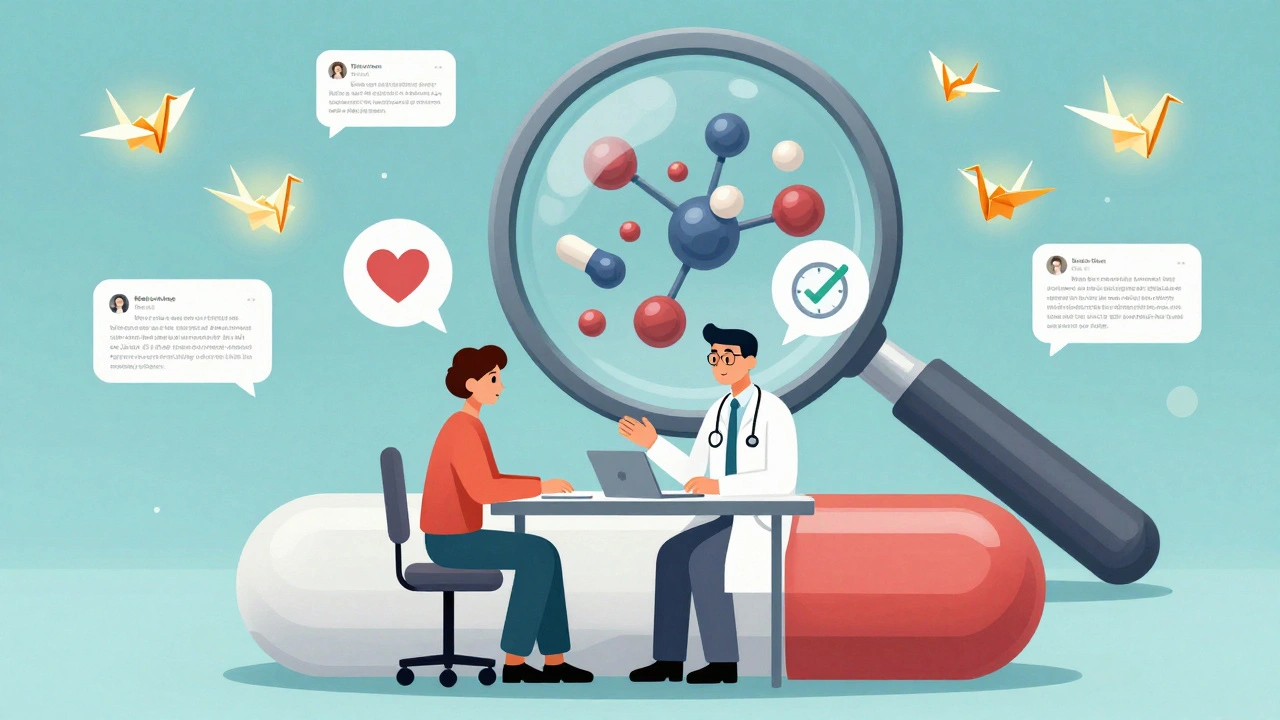
When you get your prescription, check the bottle. The generic name will be listed first - like "levothyroxine sodium" instead of "Synthroid." The brand name might be printed in smaller text, or not at all. That’s normal. The pill might look different - smaller, yellow instead of white, with a different imprint. That’s because of the inactive ingredients. It doesn’t mean it’s weaker. If you’re ever unsure, ask your pharmacist. They’re trained to explain this stuff. In fact, 83% of patient concerns about generics are resolved when a pharmacist takes 3 minutes to walk through the facts.When Generics Might Not Be the Best Choice
There are rare cases where your doctor might recommend sticking with a brand. These usually involve drugs where tiny differences in absorption can matter:- Thyroid meds (like levothyroxine)
- Seizure drugs (like phenytoin)
- Blood thinners (like warfarin)
- Inhalers and complex topical creams
What’s Changing Right Now
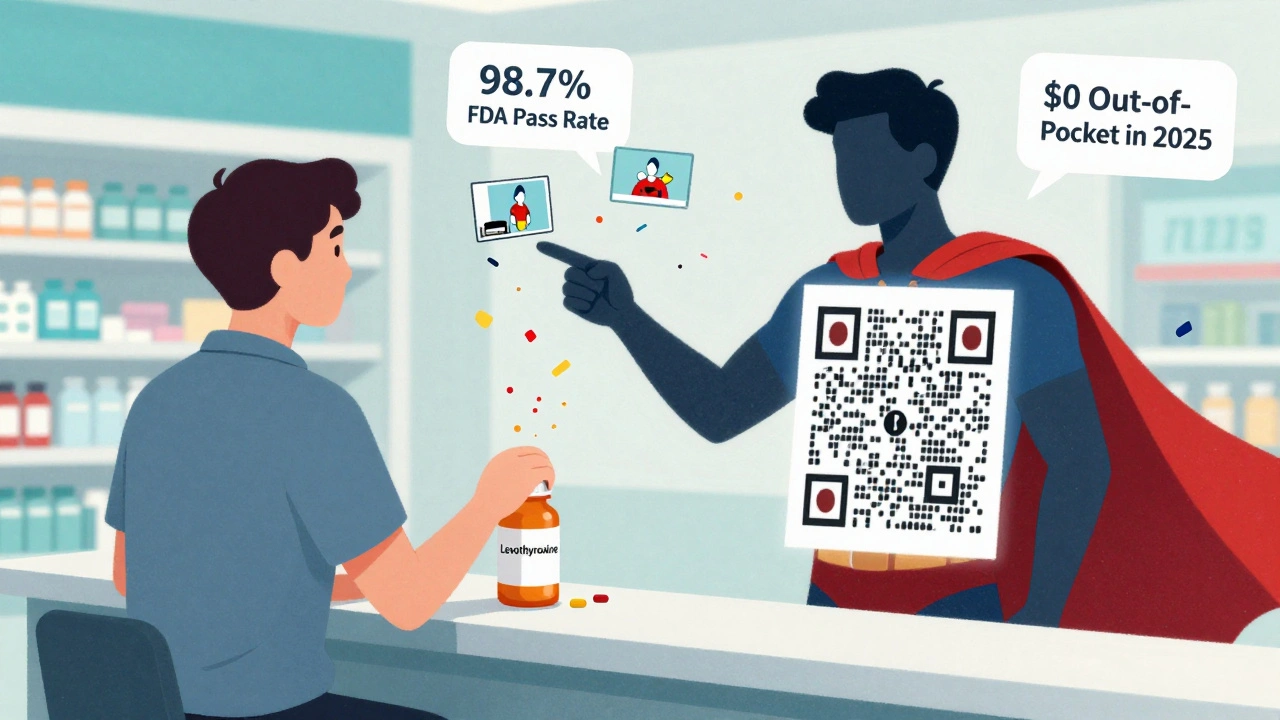
In 2025, Medicare Part D will start covering many generics with $0 out-of-pocket cost. That’s a big deal. It means more people will be able to afford their meds - and stick with them. The FDA is also rolling out new tools: QR codes on pill bottles that link to short videos explaining how the drug works, and a pilot chatbot that answers common questions about generics in plain language. Pharmacists are now required to document that they’ve talked to you about your generic medication. That means more consistency - and less guesswork.Real Talk: What Patients Say After Switching
A 2023 survey of 12,500 people who switched to generics found:- 79% said they noticed no difference in how the drug worked.
- 68% said cost was the main reason they chose the generic.
- Only 4.3% reported any side effects they thought were linked to the switch - and most of those were minor, like a headache or upset stomach that went away.
Your Next Step
Don’t wait until your next appointment to ask. If you’re on a chronic medication - especially one you’ve been taking for years - ask your doctor or pharmacist this week: "Is there a generic version of this? And if so, can we switch?" You’re not being cheap. You’re being smart. You’re choosing health over fear. And you’re helping to keep your own care affordable - not just for you, but for everyone who needs these medicines.Are generic medications really as effective as brand-name drugs?
Yes. The FDA requires generic drugs to have the same active ingredient, strength, dosage form, and route of administration as the brand-name version. They must also prove bioequivalence - meaning they deliver the same amount of medicine into your bloodstream at the same rate. A 2020 JAMA study of 47 clinical trials found no meaningful difference in effectiveness between generics and brand-name cardiovascular drugs.
Why do generic pills look different from brand-name ones?
The difference in color, shape, or size comes from inactive ingredients - like dyes, fillers, or coatings - that don’t affect how the drug works. By law, generic manufacturers can’t copy the exact appearance of a brand-name pill to avoid trademark issues. But the active ingredient is identical. If you’re concerned about a change in appearance, ask your pharmacist - they can confirm it’s the same medication.
Can generic medications cause more side effects?
For most people, no. The active ingredient - the part that treats your condition - is the same. Rarely, someone might react to an inactive ingredient in a generic version (like a dye or preservative), but this happens in less than 1% of cases. If you’ve had a reaction to a brand-name drug, your doctor can check if the generic uses different fillers. Most side effects people blame on generics are actually due to the condition itself, changes in routine, or the nocebo effect - where expecting a problem causes you to feel it.
Are generic drugs made in unsafe facilities?
No. The FDA inspects all drug manufacturing facilities - whether they make brand-name or generic drugs - using the same strict standards. In 2023, 98.7% of generic drug plants passed FDA inspections. Many generic drugs are made in the U.S., Canada, or Europe. Even those made overseas follow the same quality rules. The FDA has inspectors stationed in India, China, and other countries to ensure compliance.
Should I avoid generics if I’m on a narrow therapeutic index drug?
Not necessarily. Drugs like levothyroxine, warfarin, and phenytoin have tight safety margins, so the FDA requires stricter bioequivalence testing for generics of these drugs (within 90-110% instead of 80-125%). Most patients switch safely. But if you’ve been stable on one version - brand or generic - your doctor may recommend staying on it to avoid any small fluctuations. Never switch without talking to your provider first.
Will my insurance cover generics?
Almost always - and usually at a much lower cost. Most insurance plans have lower copays for generics. By 2025, Medicare Part D will cover many generics with $0 out-of-pocket cost. Even without insurance, generics typically cost 80-85% less than brand-name drugs. In 2023, the average retail price for a generic prescription was $15.78, compared to $674.89 for a brand-name drug.
Can I ask my pharmacist about generics instead of my doctor?
Absolutely. Pharmacists are trained to explain generics and answer questions about safety, cost, and differences in appearance. In fact, they handle 47% of all patient questions about generics. If your doctor didn’t explain it well, or if you’re unsure after your visit, call your pharmacy. They can review your meds, check for interactions, and help you understand what you’re taking.
Why do some doctors still push brand-name drugs?
Most doctors support generics - but sometimes they don’t mention them because they assume you’ll ask. Other times, they’re following a specific guideline for your condition, or they’ve seen a rare reaction in a patient before. If you’re curious, ask: "Is there a generic option?" Don’t assume they’re pushing brand-name because they’re being paid to. Drug companies pay doctors to promote brands - but that’s illegal in the U.S. for most prescriptions. Your doctor’s main goal is your health and affordability.
What if I switch to a generic and feel worse?
If you feel different after switching - whether it’s new side effects, reduced effectiveness, or just unease - contact your doctor. Don’t stop taking the medication. Most of the time, the issue isn’t the drug itself - it’s your body adjusting, stress, or unrelated changes. But if the problem persists, your doctor can switch you back or try a different generic. Keep a note of when symptoms started and what you were taking before and after.
How do I know if a generic is FDA-approved?
All legally sold generic drugs in the U.S. must be FDA-approved. You can verify this by checking the label - it should list the generic name and manufacturer. You can also look up the drug in the FDA’s Orange Book (available online) or ask your pharmacist. If a pharmacy sells a "generic" that doesn’t appear in the FDA database, it’s not legal. Stick with licensed pharmacies - online or in-person - to avoid counterfeit drugs.


Billy Schimmel
December 8, 2025 AT 05:16Wow. So generics are just as good. Who knew.
Ibrahim Yakubu
December 9, 2025 AT 10:21You people are still debating this? The FDA doesn't lie. Generics have the same active ingredient, same absorption rate, same everything except the logo on the pill. I worked in pharma logistics for 12 years - I've seen the labs. The only difference is the marketing budget. You're paying for the color, not the chemistry.
My cousin switched from Lipitor to atorvastatin and saved $500/month. No side effects. No drop in efficacy. Just cheaper. And now he's not bankrupt.
And don't get me started on the 'made overseas' myth. 70% of all generic pills - brand or generic - are made in India or China. The FDA inspects those factories harder than your mom inspects your room. If they found a single violation, the whole batch gets torched.
People think they're getting scammed because the pill looks different. But if you swapped your iPhone charger for a non-Apple one that works the same, you wouldn't cry. Why is medicine different?
It's not about cost. It's about control. People feel safer with a name they recognize. But that's branding, not biology. Your body doesn't care if it's Synthroid or levothyroxine. It only cares if the T4 levels are stable.
And yes, there are edge cases - warfarin, phenytoin, thyroid meds - but even then, switching between generics is fine. The FDA requires tighter bioequivalence for those. You're not risking your life. You're saving your wallet.
Stop letting Big Pharma make you feel guilty for wanting to live without going into debt.
Karen Mitchell
December 10, 2025 AT 16:17It is imperative to note that the assertion that generics are universally equivalent is not only scientifically oversimplified but also ethically negligent. The bioequivalence standards of 80-125% are not indicative of therapeutic equivalence. Variability within this range may, in fact, lead to subtherapeutic or toxic concentrations in sensitive populations. This is not mere semantics - it is a matter of pharmacokinetic integrity.
Furthermore, the FDA's inspection regime, while ostensibly rigorous, is underfunded and overstretched. In 2023, over 1,200 warning letters were issued to foreign manufacturing facilities - many of which produce generics. To claim that 98.7% passed is misleading when the definition of 'pass' includes minor deviations that still compromise quality.
One must also consider the psychological impact of switching. The nocebo effect is real, yes - but so is the physiological impact of inconsistent excipients in patients with autoimmune conditions, allergies, or compromised metabolism. To dismiss these concerns as 'fear' is condescending.
Until the FDA mandates identical excipient profiles across all generic manufacturers - and until all labeling includes full disclosure of all inactive ingredients - the blanket endorsement of generics is irresponsible.
Shayne Smith
December 12, 2025 AT 15:26My grandma switched to generic blood pressure meds last year. She was terrified. Now she says she feels better because she’s not stressed about the bill. I think we forget that medicine isn’t just about chemistry - it’s about peace of mind. And sometimes, peace of mind costs $16 instead of $675.
Geraldine Trainer-Cooper
December 14, 2025 AT 07:32we live in a world where people pay $20 for a latte but cry about $16 for a pill that saves their life
the real drug is fear
Nava Jothy
December 14, 2025 AT 16:38OMG I literally had a friend who switched to generic levothyroxine and her TSH went from 2.1 to 7.8 in two weeks 😭
and now she’s on disability and her hair is falling out 💔
how can you even recommend this???
also the pills are made in China and I heard the factory has rats in the walls 🐀
and the FDA? pfft they’re owned by Pfizer 😂
olive ashley
December 15, 2025 AT 19:32Let me guess - you’re one of those people who thinks the government is ‘helping’ you by forcing you to take ‘cheap’ medicine.
Here’s the truth: generics are the gateway drug to corporate healthcare. First they get you to switch, then they phase out the brand, then they raise the price of the generic, then they stop making it entirely and force you to buy the new ‘premium’ version.
And don’t even get me started on the fact that the same company that makes the brand-name drug often makes the generic too - just under a different label. You’re not saving money. You’re just paying the same person less visibly.
And yes, I know the FDA says it’s safe. But who do you think wrote the FDA guidelines? Big Pharma lobbyists. The same ones who paid your doctor to prescribe the brand in the first place.
They want you to believe you’re being smart. You’re being manipulated.
Dan Cole
December 17, 2025 AT 14:54Let’s be crystal clear: the claim that generics are bioequivalent is statistically true, but biologically misleading. The 80-125% window is a regulatory loophole, not a medical guarantee. Bioequivalence does not equal therapeutic equivalence - a distinction that even medical students are taught on day one.
When you consider the pharmacokinetic variance across populations - elderly patients with reduced hepatic metabolism, pediatric patients with immature enzyme systems, or individuals with polymorphisms in CYP450 enzymes - the variability in absorption becomes clinically significant.
Moreover, the FDA’s inspection data is cherry-picked. The agency does not disclose which facilities failed, nor does it publish the severity of violations. A ‘pass’ can mean a single missing calibration record - not a contaminated batch.
And the ‘made overseas’ argument? The U.S. imports 80% of its active pharmaceutical ingredients. China controls 40% of the global supply. That is not a supply chain - it is a vulnerability.
Generics are not dangerous. But they are not risk-free. To treat them as interchangeable is to ignore the very foundation of personalized medicine.
Andrew Frazier
December 18, 2025 AT 08:33generic? more like generic american. we used to make real medicine here. now we import pills from china and call it progress. shame.
my grandpa took brand name aspirin his whole life. he lived to 94. you think he was takin some cheap knockoff? nah. he knew what was good.
if you want to live like a third world country, go ahead. but don't act like you're saving money when you're just getting scammed.
Mansi Bansal
December 19, 2025 AT 02:17One must interrogate the epistemological underpinnings of the so-called 'generic equivalence' doctrine. The very notion that a pill's efficacy can be reduced to pharmacokinetic parameters - while ignoring the phenomenological experience of the patient - is a triumph of reductionist scientism over humanistic care.
The color of the pill, the texture, the imprint - these are not arbitrary. They are semiotic markers of identity, of trust, of ritual. To replace Synthroid with levothyroxine is not merely to substitute a compound - it is to dismantle a therapeutic narrative.
And let us not overlook the colonial dimensions: the Global South manufactures, the Global North consumes. The FDA's inspections are performative theater - a mask of oversight while the real power resides in patent law and global capital.
Thus, the question is not whether generics work - but whether we should be allowed to choose what we ingest, when we are denied the right to know the full composition of our medicine.
pallavi khushwani
December 20, 2025 AT 01:15i switched my cholesterol med to generic last year and honestly? i didn’t notice a thing. saved like $400 a year. my doctor was like 'you sure you wanna do this?' and i was like 'bro i’m not dying, i’m budgeting'
also my pharmacist gave me a sticker that said 'i’m a smart patient' and i put it on my fridge. now my mom thinks i’m a genius.
Katie O'Connell
December 20, 2025 AT 23:16It is regrettable that the discourse surrounding generic medications has been reduced to a utilitarian calculus of cost-efficiency, thereby obfuscating the profound ethical and epistemic implications of pharmaceutical commodification. The FDA’s regulatory framework, while ostensibly science-based, operates within a neoliberal paradigm that prioritizes market penetration over patient autonomy.
Moreover, the normalization of generic substitution as a default practice implicitly devalues the physician-patient relationship, transforming clinical decision-making into a bureaucratic checkbox.
One must ask: if a patient's psychological attachment to a branded medication serves as a placebo-enhancing ritual - a component of therapeutic adherence - then is it not ethically incumbent upon providers to honor that preference?
The answer, of course, is yes. And yet, the system incentivizes the opposite.
Clare Fox
December 21, 2025 AT 23:49my friend took generic adderall and said she felt like a zombie
i said 'maybe you just don't like the color'
she said 'but the pill is blue now and it used to be orange'
i said 'so... you're mad because the pill changed its outfit?'
she hasn't talked to me since
Akash Takyar
December 22, 2025 AT 22:13Dear friends, I commend this thoughtful and well-researched article. It is my sincere belief that access to affordable medication is not a privilege - it is a human right. Generics are a vital tool in the fight against health inequity. Many patients in rural communities, low-income families, and elderly populations rely on generics to survive. To dismiss them is to dismiss their dignity.
As a pharmacist, I have counseled over 5,000 patients on generic substitutions. In 98% of cases, the transition was seamless. The remaining 2%? We worked with their doctors to find the right fit. It’s not about the pill - it’s about the person.
Please, let’s stop stigmatizing cost-conscious choices. You’re not being cheap. You’re being wise. And you’re helping others do the same.
Arjun Deva
December 23, 2025 AT 13:40you know what’s really scary? the fact that they’re putting fluoride in the water and generics in your pills… same company… same control…
they want you dependent… they want you docile… they want you to think it’s all fine because the pill looks different but still works…
but what if the fillers are nanobots? what if the dye is tracking you? what if the ‘bioequivalence’ is just a lie to keep you from suing them?
my cousin’s dog took a generic flea pill… it turned into a cat.
don’t trust the system.
Billy Schimmel
December 24, 2025 AT 07:17lol at the guy who said the dog turned into a cat. that’s the most honest comment here.