
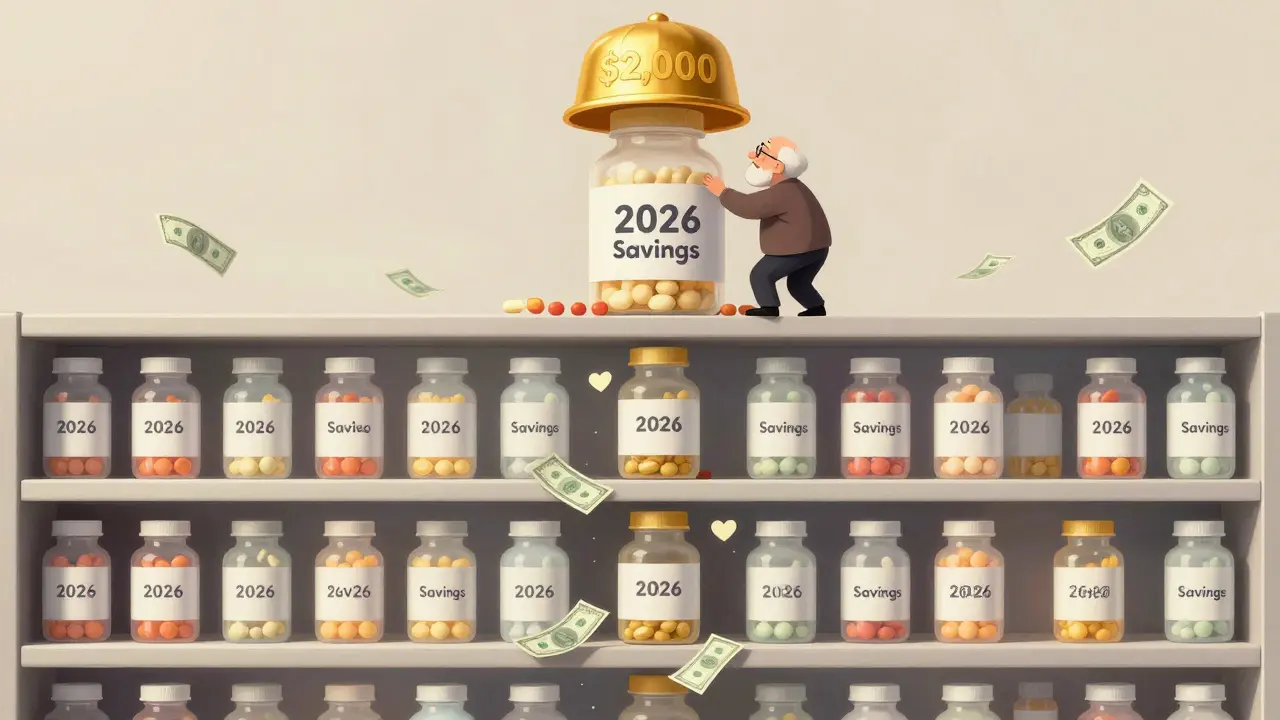
By 2026, if you're on Medicare and take generic drugs, your out-of-pocket costs could be 75% lower than they were just two years ago. That’s not a guess-it’s the result of major changes to Medicare Part D that took full effect in 2025. The biggest win? A hard cap of $2,000 on what you pay annually for all your prescriptions, including generics. After that, your copays drop to $0 for the rest of the year. For millions of seniors, this isn’t just a policy tweak-it’s life-changing savings.
What Changed in Medicare Part D in 2025?
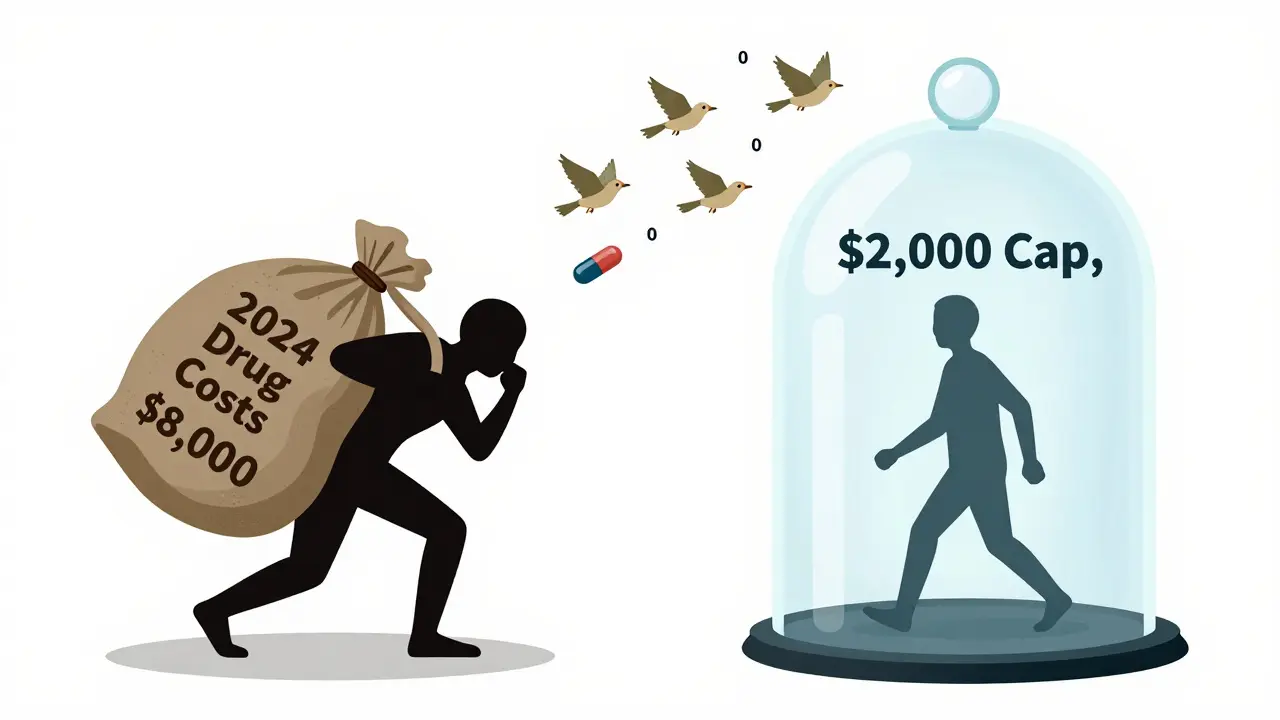
Before 2025, if you took multiple generic medications, you could easily spend $7,000 to $8,000 out of pocket before hitting catastrophic coverage. Many people gave up on filling prescriptions because they couldn’t afford the monthly bills. Now, that ceiling is $2,000. That’s a massive shift. And it’s not just about the cap. The way costs are calculated has also gotten simpler and fairer.
Under the new rules, every dollar you pay for covered drugs-whether it’s a deductible, copay, or coinsurance-counts toward your $2,000 limit. That includes what you pay for generics. Monthly premiums don’t count, but everything else does. Even manufacturer discounts, which used to vanish into a black hole, now count toward your cap. That means if you’re on a $50-a-month generic blood pressure pill, you’re getting credit for every dime you spend.
For people on low incomes, the savings are even bigger. If you qualify for Extra Help (Low-Income Subsidy), you pay $0 deductible and $0 to $4.50 for each 30-day supply of a generic. No coverage gap. No surprise bills. Just steady, affordable access.
How Much Do Generics Actually Cost Now?
Most Medicare Part D plans put generics in the lowest tier-Tier 1. In 2025, the median copay for a preferred generic is $10 for a 30-day supply. That’s the same whether you’re in a stand-alone Prescription Drug Plan (PDP) or a Medicare Advantage plan with drug coverage (MA-PD). But here’s where things get tricky: premiums are wildly different.
On average, PDPs cost $39 a month in premiums. MA-PDs? Just $7. That’s more than five times the difference. So even if your copays are the same, choosing an MA-PD can save you hundreds a year in premiums alone. And since most MA-PDs bundle medical and drug coverage, you’re often getting better overall value.
Some plans still have deductibles-about 85% of PDPs and 60% of MA-PDs still require you to pay $590 before coverage kicks in. But once you hit that, you’re only paying 25% coinsurance on generics until you hit the $2,000 cap. After that? Nothing. Not a cent.
Why Generics Are the Secret Weapon in Part D
Generics make up 84% of all prescriptions filled under Part D, but they only account for 27% of total drug spending. That’s because they cost a fraction of brand-name drugs. A generic version of a $400 brand-name drug might cost $12. That’s why the 2025 reforms focused so heavily on generics-they’re the most powerful tool for cutting costs.
The Inflation Reduction Act made sure plans had to cover at least two generic options in every drug category. That gives you choices. And because manufacturers now have to pay rebates if they raise prices faster than inflation, generic makers are incentivized to keep prices low. In fact, the Congressional Budget Office expects generic use to climb to 87% of prescriptions by 2028.
But here’s the catch: not all generics are treated the same. Some plans use “therapeutic substitution,” which means they might switch you to a different generic version of your drug-even if it’s chemically identical-because it has a lower copay. That’s legal, but it can cause confusion. One user on Reddit said their plan switched their generic thyroid med to a different brand, and suddenly their copay jumped from $4 to $15. They didn’t realize it was the same drug, just a different manufacturer.
What You Need to Do to Maximize Your Savings
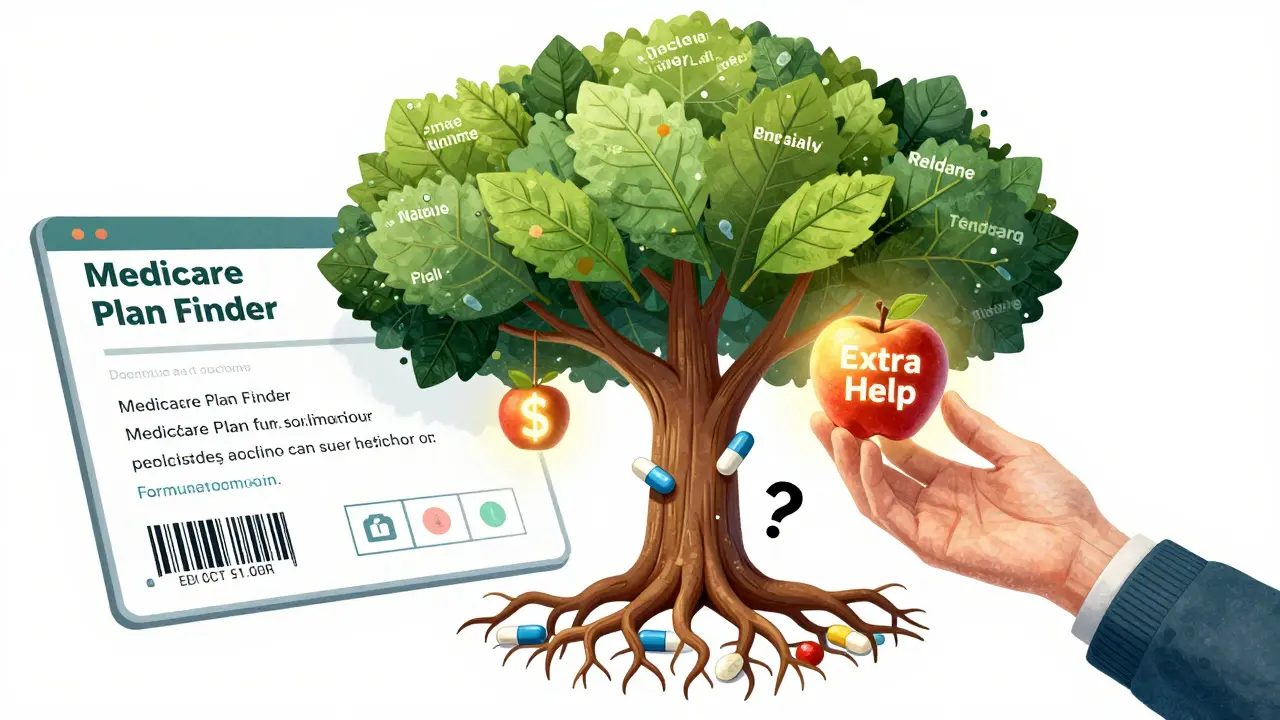
Don’t assume your plan from last year is still the best. Plans change their formularies every year. A drug that was $10 last year might now be $15-or worse, moved to a higher tier. That’s why you need to use the Medicare Plan Finder every fall, starting in October. Type in your exact medications, dosages, and pharmacy. The tool will show you which plans have the lowest total cost for your specific drugs.
Many people don’t know how to use it. A 2024 government report found that 32% of users needed help navigating the tool. If you’re not tech-savvy, call Medicare at 1-800-MEDICARE or ask your local State Health Insurance Assistance Program (SHIP) for free help. They’ll walk you through it.
Also, check if you qualify for Extra Help. Many seniors think they earn too much, but the income limits are higher than people realize. In 2025, a single person can earn up to $21,590 a year and still qualify. Even if you don’t think you’re eligible, apply. It’s free, and the savings are huge.
What’s Still Broken?
It’s not all perfect. Some plans are pushing back against the new reinsurance rules. Because Medicare now pays less to cover high-cost claims, some insurers are responding by restricting access to certain generics-even ones that are clinically identical. A 2024 report from the Accessible Medicines Foundation found Part D plans use more prior authorization for generics than commercial insurers do. That means you might need your doctor to jump through hoops just to get a $10 pill.
Another problem? Confusion over what counts toward your $2,000 cap. A KFF survey found 41% of beneficiaries didn’t understand that manufacturer coupons and discounts count. Some thought only what they paid out of pocket counted. That led to people thinking they were far from the cap when they were actually close. Always ask your plan: “Does this discount count toward my out-of-pocket maximum?”
And while the $2,000 cap is a win, it doesn’t help if your drugs aren’t covered at all. If your doctor prescribes a brand-name drug that has no generic, you’re still stuck with high costs. That’s why it’s worth asking if there’s a generic alternative-even if your doctor says “no.” Sometimes, a different generic version is available that your plan covers better.
Real Stories, Real Savings
One retired nurse in Ohio told Medicare Rights that her three daily generics-blood pressure, cholesterol, and diabetes meds-cost her $1,200 more in 2024 than in 2025. After hitting the $2,000 cap in July, her copays dropped to $0. She said she started refilling prescriptions she’d skipped for months.
A veteran in Florida said his $80-a-month generic for gout used to cost him $960 a year before the cap. Now, after hitting the cap, it’s free. He used to ration pills. Now he takes them as prescribed. “I feel like I got my health back,” he said.
But not everyone’s happy. Some people on complex regimens-like those taking multiple generics for autoimmune conditions-still face formulary restrictions. One user on Reddit said her plan dropped her generic arthritis med from Tier 1 to Tier 3, raising her copay from $10 to $50. She had to appeal and get her doctor to prove the substitution wouldn’t work. It took six weeks.
What’s Coming Next?
In 2026, a new program called the Selected Drug Subsidy Program will give plans a 10% subsidy to cover certain high-cost generics. That could mean even lower copays for complex medications. Also, biosimilars-generic versions of biologic drugs-are starting to appear in Part D formularies. These could bring savings similar to traditional generics, but for drugs that used to cost $10,000 a year.
Long-term, the system is sustainable-Medicare’s drug fund is projected to last until 2040. But if drug prices keep rising faster than inflation, the government might need to step in again. For now, the $2,000 cap is the biggest thing to happen to Medicare drug coverage in 20 years.
Final Checklist: Are You Getting All Your Savings?
- ✅ Did you use the Medicare Plan Finder this fall to compare plans for 2026?
- ✅ Do you know your exact copay for each generic drug on your plan?
- ✅ Have you checked if you qualify for Extra Help-even if you think you earn too much?
- ✅ Are you tracking your out-of-pocket spending? Keep receipts or use your plan’s online portal.
- ✅ Have you asked your pharmacist or doctor if there’s a cheaper generic alternative?
- ✅ Do you understand that manufacturer discounts count toward your $2,000 cap?
If you answered yes to all of these, you’re doing everything right. If not, start with one. Just one change-like switching plans or applying for Extra Help-could save you hundreds or even thousands this year.
Do generic drugs work as well as brand-name drugs under Medicare Part D?
Yes. Generic drugs contain the same active ingredients as brand-name drugs and are required by the FDA to meet the same standards for safety, strength, and effectiveness. The only differences are in inactive ingredients, like fillers or coatings, which don’t affect how the drug works. Medicare Part D plans encourage generics because they’re cheaper, not because they’re less effective.
What if my generic drug is suddenly not covered anymore?
Your plan can change its formulary, but they must give you 60 days’ notice. If your drug is removed or moved to a higher tier, you can request an exception. Your doctor can submit a form saying the generic is medically necessary for you. Most exceptions are approved if you’ve been stable on the drug. Don’t stop taking it-call your plan first.
Does the $2,000 cap include my monthly premium?
No. Only what you pay for the drugs themselves counts toward the $2,000 out-of-pocket cap. That includes deductibles, copays, and coinsurance. Your monthly premium is separate and doesn’t help you reach the cap. But you still have to pay it, even after you hit the cap.
Can I switch Medicare Part D plans anytime?
You can only switch during the Annual Enrollment Period (October 15 to December 7) unless you qualify for a Special Enrollment Period. Examples include moving out of your plan’s service area, losing Extra Help, or entering a nursing home. Outside these windows, you’re locked in until next year.
How do I know if I’m getting the lowest price for my generics?
Always ask your pharmacist if they can offer a cash price instead of using your insurance. Sometimes, the cash price for a generic is lower than your copay. For example, Walmart’s $4 list for generics is often cheaper than a $10 copay. Also, use GoodRx or SingleCare to compare prices across pharmacies. You can even use these coupons alongside your Medicare plan if they’re cheaper.

Carolyn Rose Meszaros
January 20, 2026 AT 03:03Greg Robertson
January 21, 2026 AT 05:19Renee Stringer
January 22, 2026 AT 20:30Crystal August
January 24, 2026 AT 00:43Nadia Watson
January 25, 2026 AT 15:59Courtney Carra
January 26, 2026 AT 14:00Shane McGriff
January 28, 2026 AT 01:58Jacob Cathro
January 28, 2026 AT 04:30pragya mishra
January 29, 2026 AT 20:14Manoj Kumar Billigunta
January 30, 2026 AT 18:01Arlene Mathison
January 31, 2026 AT 10:46Emily Leigh
February 1, 2026 AT 19:25thomas wall
February 1, 2026 AT 22:47