
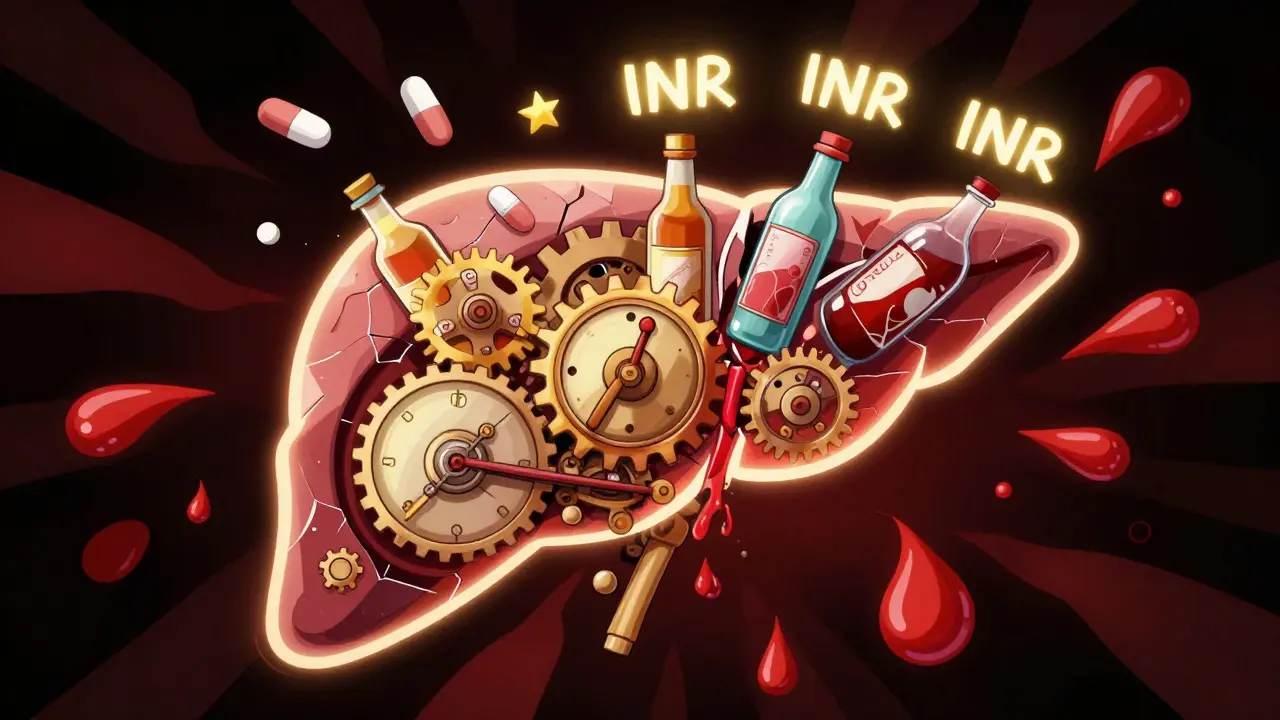
Warfarin Binge Drinking Risk Calculator
If you're on warfarin, drinking too much alcohol in one sitting isn't just a bad idea-it can land you in the hospital. The risk isn't theoretical. It's measured in INR spikes, emergency room visits, and life-threatening bleeds. This isn't about having a glass of wine with dinner. This is about what happens when you drink five or more drinks in a couple of hours-and how that single choice can throw your blood thinner into chaos.
What Warfarin Does, and Why It's So Sensitive
Warfarin, sold under the brand name Coumadin, is a blood thinner used to prevent clots in people with atrial fibrillation, deep vein thrombosis, or pulmonary embolism. It works by blocking vitamin K, which your liver needs to make clotting factors. Too little clotting? You bleed. Too much? You form clots. The goal is to keep your INR-International Normalized Ratio-between 2.0 and 3.0. That’s the sweet spot. Outside that range, danger rises.
Warfarin’s narrow window makes it finicky. It reacts to food, other medications, and yes-alcohol. Even small changes in your routine can send your INR flying. And binge drinking? That’s like slamming the gas pedal on a car with no brakes.
What Counts as Binge Drinking?
The National Institute on Alcohol Abuse and Alcoholism defines binge drinking as:
- 5 or more standard drinks for men in about 2 hours
- 4 or more standard drinks for women in about 2 hours
A standard drink is one 12-ounce beer, 5 ounces of wine, or 1.5 ounces of hard liquor. That’s not a night out. That’s one heavy session. And if you’re on warfarin, even one of these sessions can spike your INR by 1.5 points or more within 24 hours.
How Alcohol Messes With Your INR
Alcohol doesn’t just make you feel drunk-it messes with your liver, your enzymes, and your clotting system. Here’s how:
- Acute effect: When you drink heavily in one sitting, alcohol blocks the liver enzymes (CYP2C9 and CYP3A4) that break down warfarin. This means warfarin builds up in your blood, making it stronger. Your INR rises. Your bleeding risk shoots up.
- Chronic effect: If you drink heavily often, your liver starts producing more of those same enzymes to cope. Now warfarin gets broken down too fast. Your INR drops. You’re at risk of clots.
- Liver damage: Long-term heavy drinking harms your liver’s ability to make clotting factors. Even if your INR looks okay, your body can’t stop bleeding properly.
This back-and-forth makes dosing a nightmare. Your doctor can’t predict how your INR will react. One week it’s stable. The next, after a weekend of drinking, it’s 5.0-way above the safe range.
The Real Risk: Bleeding
People on warfarin already have a 3% to 6% chance of a major bleed each year. Binge drinking doubles-or triples-that risk.
A 2015 study from the University of Michigan tracked over 1,200 patients on warfarin. Those who binge drank had a 2.3 times higher risk of major bleeding. For those who’d been on warfarin for over a year? The risk jumped to 3.1 times higher.
Major bleeding means:
- Bleeding that won’t stop
- Hemoglobin drop of 2 g/dL or more
- Need for 2 or more units of blood transfusion
Signs you might be bleeding internally:
- Unexplained bruising, especially large or dark patches
- Nosebleeds that won’t stop
- Bleeding gums when brushing teeth
- Brown or red urine
- Black, tar-like stools or bright red blood in stool
- Vomiting blood or coffee-ground-looking material
- Coughing up blood
- Severe headache, dizziness, or weakness
- Excessive menstrual bleeding
If you notice any of these after drinking, get medical help immediately. Don’t wait.
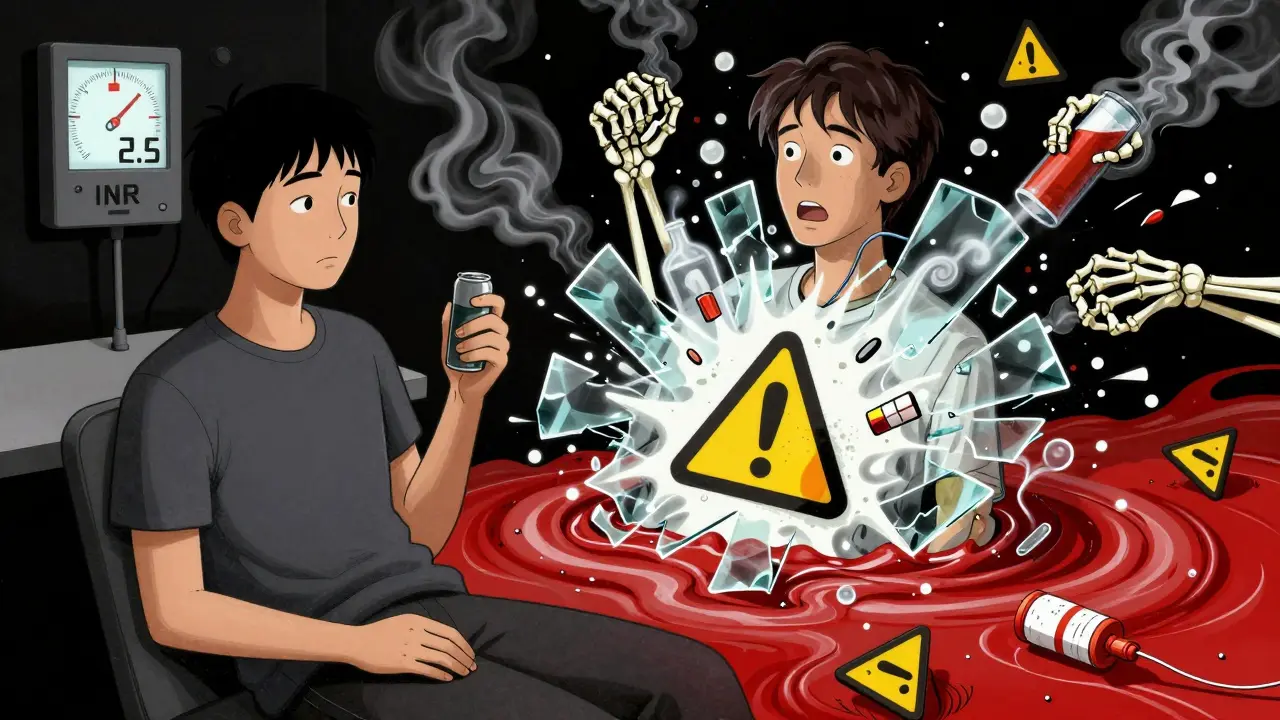
Genetics Make It Worse
Some people are more vulnerable because of their genes. If you carry the CYP2C9*2 or CYP2C9*3 variant, your body breaks down warfarin much slower. That means even small amounts of alcohol can cause dangerous INR spikes.
One study found these patients had a 4.2 times higher risk of major bleeding after binge drinking. That’s not a small increase. That’s a red flag.
Doctors don’t routinely test for these variants-but if you’ve had unexplained INR swings or bleeds before, ask if genetic testing might help.
What Do the Experts Say?
The British Heart Foundation says: You can drink alcohol on warfarin-but only if you stick to the limits. No more than 14 units a week. And never save them all for one night.
The University of Iowa is even clearer: No more than 2 drinks a day for men, 1 for women. And binge drinking? Not safe.
The European Society of Cardiology recommends no more than 8-10 units per week for warfarin users. That’s about 4-5 standard drinks total-not per day, per week.
The NHS says it plainly: “Drinking heavily, especially binge drinking lots of alcohol in one go, is dangerous while taking warfarin. The alcohol can increase the risk of bleeding.”
What About Newer Blood Thinners?
Many people switch from warfarin to DOACs-drugs like apixaban, rivaroxaban, or dabigatran. They don’t need regular INR checks. They have fewer food interactions.
But here’s the catch: Alcohol still raises bleeding risk with DOACs too. The FDA’s own database shows a 1.8 times higher risk of stomach bleeding with rivaroxaban in people who drink heavily.
So switching isn’t a free pass. It just removes one layer of risk. The other-alcohol’s direct effect on bleeding-remains.
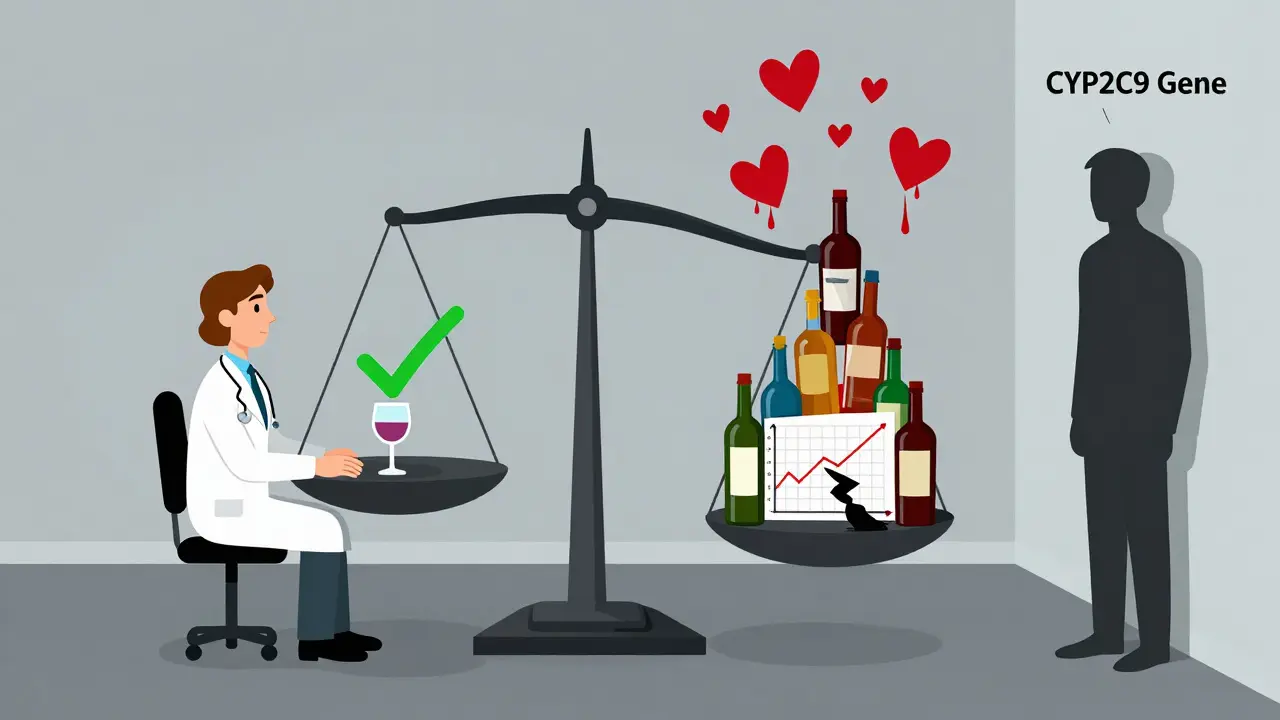
What Should You Do?
If you’re on warfarin, here’s what actually works:
- Avoid binge drinking entirely. Even one episode can be dangerous.
- Stick to low-risk limits. No more than 1-2 drinks on any day. Spread them out. Don’t save up for the weekend.
- Get your INR checked sooner after drinking. If you had a few drinks, ask your anticoagulation clinic to test your INR within 72 hours.
- Be honest with your doctor. If you’ve been drinking more than you say, tell them. They can’t help if they don’t know.
- Consider switching to a DOAC. If you struggle to cut back on alcohol, talk to your doctor about whether a DOAC might be safer for you.
- Know the signs of bleeding. Don’t ignore unusual bruising, bleeding gums, or dark stools.
Why This Isn’t Just Common Sense
Here’s the scary part: In 2010, the FDA removed warfarin’s official warning about alcohol because they didn’t have enough evidence at the time. But since then, multiple studies have proven the risk is real.
In 2022, the American College of Physicians formally asked the FDA to put the warning back. They’re not alone. Anticoagulation clinics across the U.S. and UK are now training staff to screen for alcohol misuse. Electronic health records now flag patients with high AUDIT-C scores and recommend extra INR checks.
But only 15% of primary care doctors routinely screen for alcohol use in patients on blood thinners. That’s a gap. And it’s costing lives.
Real Change Is Possible
A 2022 study called the WAVE trial showed something powerful: When patients got regular, structured counseling about alcohol and warfarin, their major bleeding events dropped by 37%.
It wasn’t just a pamphlet. It was repeated conversations-with pharmacists, nurses, and doctors-that reminded them why this matters.
For people with alcohol use disorder and atrial fibrillation, integrated care-where addiction specialists and anticoagulation teams work together-cut bleeding events by 52% over a year.
This isn’t about guilt. It’s about safety. You don’t have to quit alcohol forever. But if you’re on warfarin, you need to treat it like a controlled substance. Because it is.
Final Thought: Your INR Doesn’t Lie
Warfarin isn’t like a painkiller you can take when you need it. It’s a daily balancing act. One night of binge drinking can undo weeks of careful dosing. And the consequences? They’re not just inconvenient-they’re deadly.
If you’re reading this, you care enough to ask the question. That’s the first step. Now take the next one: Talk to your doctor. Get your INR checked after any drinking. Cut back. Or stop. Your body will thank you.
William Liu
December 19, 2025 AT 09:33Warfarin and alcohol is one of those things doctors don't emphasize enough until someone ends up in the ER. I've seen it firsthand-my uncle thought one weekend binge was fine. Turned out his INR hit 6.8. He spent a week in the hospital. Don't be him.
Dev Sawner
December 20, 2025 AT 04:24It is imperative to underscore that the pharmacokinetic interaction between ethanol and warfarin is mediated primarily through cytochrome P450 enzyme inhibition, specifically CYP2C9. The clinical implications are not merely theoretical but are substantiated by multiple peer-reviewed studies, including those published in the Journal of Thrombosis and Haemostasis. Failure to adhere to abstinence protocols constitutes a significant deviation from evidence-based anticoagulation management.
Moses Odumbe
December 20, 2025 AT 08:59Bro, I get it. You want to chill with a beer. But if you're on warfarin? That’s not a beer. That’s a loaded gun. I switched to apixaban after my INR went nuts post-birthday party. No more weekly blood draws. No more panic when I drink a glass of wine. DOACs are the future. And yes, alcohol still risks bleeding-but it’s way less of a rollercoaster. 🤓
Meenakshi Jaiswal
December 21, 2025 AT 03:10If you're reading this and you're on warfarin, please don't feel ashamed. This isn't about being perfect-it's about being safe. Talk to your pharmacist. Ask for a referral to an anticoagulation clinic. Many offer free counseling. You don't have to quit alcohol forever. Just learn how to manage it. Small steps matter. You're not alone.
bhushan telavane
December 21, 2025 AT 09:16In India, we drink a lot, but we also have a culture of not talking about health risks. My cousin was on warfarin after a stroke. He drank during Diwali. He bled into his stomach. No one told him it could happen. This post should be shared in every village clinic.
Mahammad Muradov
December 21, 2025 AT 11:09It is unconscionable that primary care physicians do not routinely screen for alcohol misuse in patients on anticoagulants. This is not negligence-it is malpractice. The data is unequivocal. The guidelines are clear. The fact that 85% of clinicians ignore this is a systemic failure of medical education and accountability.
Connie Zehner
December 22, 2025 AT 18:18I’m on warfarin and I drink. Every. Single. Weekend. I’ve had 5 INR checks in the last year. All fine. So why is everyone acting like I’m going to die? You’re scaring people for no reason. My doctor says I’m fine. So I’m fine. 🙄
holly Sinclair
December 23, 2025 AT 09:31It’s fascinating how we treat warfarin as a binary issue-either you’re completely sober or you’re a danger to yourself. But what if the real problem isn’t alcohol itself, but the way our medical system treats anticoagulation as a static, predictable process? Human biology is dynamic. Our liver metabolizes differently day to day. Our stress levels shift enzyme activity. Our sleep alters absorption. Maybe the issue isn’t just alcohol-it’s our refusal to accept that warfarin therapy requires constant adaptation, not rigid rules. We need personalized, adaptive monitoring, not one-size-fits-all warnings.
Monte Pareek
December 25, 2025 AT 07:52Let’s cut the crap. If you’re on warfarin and you binge drink, you’re playing Russian roulette with your organs. The data doesn’t lie. The bleeding risk doubles. The hospital bills skyrocket. The family trauma lasts for years. I’ve worked in ERs for 18 years. I’ve seen the bodies. I’ve signed the death certificates. Stop rationalizing. Stop hoping. Do the right thing. Your liver, your kidneys, your brain-they’re not replaceable. And no, switching to a DOAC doesn’t make you invincible. It just changes the odds. So stop drinking like a college kid and start acting like an adult who values their life.
Kelly Mulder
December 25, 2025 AT 14:01As a physician, I find it deeply troubling that this post is presented in such a ‘casual’ tone. The clinical gravity of INR fluctuations due to ethanol consumption demands precision, not colloquialisms. Furthermore, the suggestion to ‘switch to a DOAC’ is not a panacea-it introduces its own set of renal and hemorrhagic risks. This article, while well-intentioned, lacks the rigor expected in medical communication.
Lynsey Tyson
December 26, 2025 AT 12:20I get that some people are scared of this topic. But I think we can talk about it without making people feel guilty. I used to drink a lot and was on warfarin. I didn’t know it was dangerous until my mom had a bleed. Now I just have one glass of wine on special nights. It’s not about perfection. It’s about awareness. And if you’re reading this, you’re already on the right path.
Edington Renwick
December 27, 2025 AT 07:45They don’t want you to know this, but the FDA removed the alcohol warning because Big Pharma didn’t want DOACs to look bad. Warfarin is cheaper. They want you stuck with it. And now they’re scaring you into staying on it by making alcohol sound like poison. Meanwhile, the DOACs? They’re just as dangerous. They just don’t have the INR test to catch it. Wake up.
anthony funes gomez
December 27, 2025 AT 18:06Considering the pharmacodynamic modulation of coagulation cascades under the influence of ethanol, particularly through CYP2C9-mediated warfarin metabolism inhibition, coupled with the hepatic suppression of vitamin K-dependent clotting factor synthesis, it becomes evident that the temporal dynamics of INR elevation are non-linear and dose-dependent. Moreover, the presence of CYP2C9 polymorphisms introduces a genotypic variable that exponentially increases the risk of supratherapeutic INR states-thereby rendering population-wide guidelines insufficient for individualized risk stratification. Hence, the imperative for pharmacogenomic-guided anticoagulation therapy is not merely advantageous-it is ethically obligatory.
Laura Hamill
December 28, 2025 AT 20:21They’re lying. Warfarin is a weapon. The government knows alcohol makes it worse. But they let you drink because they want you to die so they can charge you more for the hospital. They don’t care. I’ve seen the reports. They’re hiding the truth. Your INR is being tracked. Your drinking is being logged. They’re waiting for you to slip up. Don’t trust them. Don’t drink. Don’t trust your doctor. Stay safe.