

You just picked up your meds. You toss the bag in your pocket, head home, pop a pill, and move on with your day. But did you actually check the bottle? It sounds like a no-brainer, but skipping that ten-second scan of the label is one of the most common ways people end up taking the wrong dose-or worse, the wrong drug entirely.
According to the Institute for Safe Medication Practices (ISMP), medication errors affect about 1.5 million Americans every year. A quarter of those preventable mistakes come down to labeling discrepancies. That’s not just a statistic; it’s your neighbor, your parent, or potentially you, grabbing the wrong blood thinner because the strength looked similar at a glance. Checking your Prescription Label isn’t just bureaucratic fussing-it’s the final safety net between the pharmacy counter and your body.
Why This Quick Check Matters More Than You Think
Think of the prescription process as a relay race. The doctor writes the script, the pharmacist fills it, and then... they hand it to you. If you don’t verify what’s in that vial, you’re trusting the last runner didn’t drop the baton. And sometimes, they do.
A study published in the Journal of the American Pharmacists Association found that patients who actively verified their labels reduced the likelihood of taking incorrect medications by 67%. That’s huge. It means if you spend thirty seconds reading the sticker, you are three times more likely to stay safe than if you just trust the system blindly.
Dr. Beth Kollisch, Director of Patient Safety at Johns Hopkins Medicine, puts it bluntly: patient verification is the "single most underutilized safety measure" in outpatient pharmacies. She estimates that if everyone checked their labels properly, we could prevent around 150,000 adverse drug events annually. So, why do so many of us skip it? Probably because we assume the pharmacy got it right. They usually do, but "usually" isn't good enough when it comes to drugs that can stop your heart or thin your blood.
The Five Things You Must Verify Every Time
Don’t try to read the whole label at once. Focus on these five critical elements. If any of them look off, stop. Don’t walk away until you’ve clarified it with the pharmacist.
- Your Full Legal Name: It needs to match exactly what you gave the pharmacy. Not just your first name. If you go by "Mike" but your ID says "Michael," make sure the label says "Michael." Why? Because if two people named Mike Smith pick up prescriptions at the same time, a mix-up is easy. Including a middle initial helps distinguish you from other patients with similar names.
- Medication Name (Brand vs. Generic): Doctors often prescribe by brand name (like Lipitor), but pharmacies dispense generics (like atorvastatin). Both should ideally be listed, or at least you need to know they are equivalent. If the label says a generic name you don’t recognize, ask the pharmacist to confirm it matches what your doctor discussed.
- Strength and Dosage Form: This is where the dangerous stuff happens. Is it 5 mg or 50 mg? Is it a tablet or a capsule? A decimal point out of place can turn a standard dose into an overdose. Always double-check the number followed by the unit (mg, mcg, mL).
- Directions for Use: Does it say "Take twice daily" when your doctor said "Take once daily at bedtime"? Sometimes instructions get auto-populated incorrectly. Read the directions aloud to yourself and compare them mentally with what you remember from your appointment.
- Pharmacy Contact Info: Sounds minor, but if something goes wrong later, you need to know who filled it. Ensure the phone number is legible. Also, check the expiration date. If the bottle expired last month, don’t take it-go back and swap it.
Decoding the Jargon: What Those Codes Actually Mean
Labels are cluttered with codes. Here’s how to cut through the noise without needing a medical degree.
| Label Element | What It Means | Why You Should Care |
|---|---|---|
| NDC Number | A unique 10- or 11-digit identifier assigned by the FDA to specific drug products. | If you ever suspect a recall or need to look up the exact manufacturer online, this code pinpoints the exact version of the drug you have. |
| Rx Number | A unique tracking number assigned by the pharmacy to your specific transaction. | Keep this handy. If you lose the bottle or need a refill before the next appointment, this number lets the pharmacy pull up your history instantly. |
| Lot Number | Identifies the specific batch of medication manufactured together. | Critical during recalls. If a specific batch is contaminated, knowing the lot number tells you if your pills are affected. |
| Refills Left | How many times you can get more of this med without a new doctor's order. | Don’t run out unexpectedly. If it says "0," call your doctor now, not when you’re down to your last pill. |
One thing to watch out for: abbreviations. Old-school doctors love using "QD" (once daily) or "BID" (twice daily). While the Joint Commission has banned some confusing abbreviations, they still slip through. If you see something like "HS" (at bedtime) and aren’t sure, ask. Never guess.
Troubleshooting Common Verification Failures
Even careful people miss things. Visual impairment affects 12.7% of adults over 40, and health literacy challenges impact millions more. If you struggle to read small print, you’re not alone, and there are workarounds.
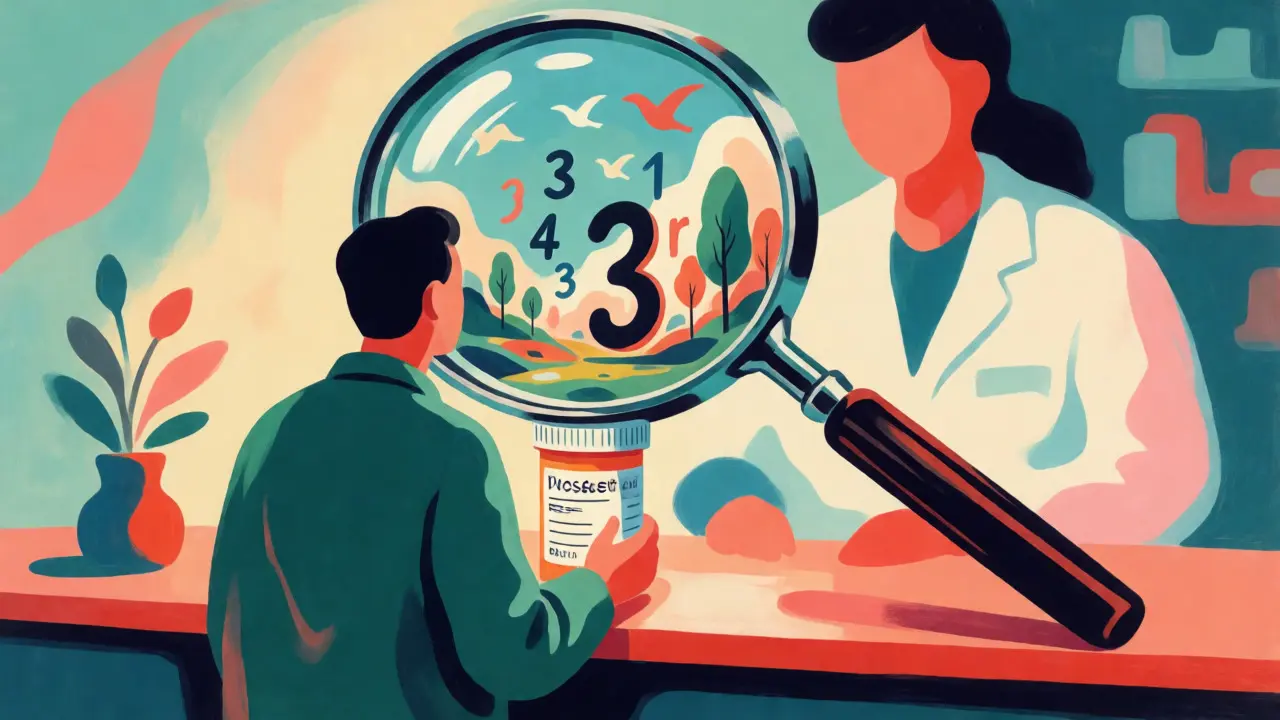
The Small Print Problem: Many pharmacies use tiny fonts. If you find yourself squinting, don’t hesitate to ask the pharmacist to print a large-print label. Most major chains like CVS and Walgreens offer this service for free. You can also use your smartphone camera zoom feature to magnify the text while standing at the counter.
The Look-Alike Sound-Alike Trap: Some drugs sound nearly identical. For example, Hydralazine (for high blood pressure) and Hydroxyzine (an antihistamine) look different but sound similar. If you have multiple conditions, ensure the indication (what it treats) matches the drug name. If you’re being treated for anxiety but receive a heart medication, flag it immediately.
The Wrong Patient Scenario: Rarely, the label will have your name but the wrong medication-perhaps another patient’s drug was accidentally printed with your name. This happened to a user on Drugs.com who almost took the wrong blood pressure med because the pill color changed, even though the name matched. Trust your eyes. If the pill looks different from what you’ve taken before, stop and ask.

When Technology Helps (and When It Doesn’t)
We live in a digital age, so why rely on paper? Apps like Medisafe or GoodRx allow you to scan barcodes on the bottle. These tools are great supplements, especially for managing complex regimens with more than five medications. However, they are not replacements for manual verification.
Here’s why: technology fails. Batteries die, apps crash, and barcode scanners misread smudged codes. Furthermore, 42% of prescription users are over 65, and only 28% of that group uses smartphones for health management regularly. Manual verification is immediate, requires no setup, and works everywhere. Use the app to track your schedule, but use your eyes to verify the actual product in your hand.
Making Verification a Habit
It takes practice to make this automatic. Start by treating the pharmacy counter as a consultation room, not just a checkout line. Stand there for thirty seconds. Read the label. If anything feels off, speak up. Pharmacists are trained to expect these questions and won’t mind helping.
For parents managing kids' meds or caregivers handling elderly relatives’ prescriptions, this habit is non-negotiable. A simple mismatch in weight-based dosing for a child can lead to significant issues. Keep a photo of the correct label on your phone for reference. If you pick up refills frequently, snap a picture of the first correct bottle so you can compare future ones against it.
Remember, the pharmacy system is robust, but it’s run by humans. Humans make typos. Humans mishear names. By confirming your name and medication details, you add a crucial layer of defense that costs nothing but a few seconds of attention.
What if my name is spelled differently on the label?
If the spelling is a minor typo (e.g., "Jon" instead of "John") but clearly refers to you, it’s usually fine. However, if it’s a completely different person’s name, do not leave the pharmacy. Ask the pharmacist to reprint the label with the correct name to avoid confusion with insurance claims or future refills.
The medication looks different than usual. Is that okay?
Yes, often. Generic manufacturers change the shape, color, or size of pills based on supply chain availability. As long as the active ingredient and strength on the label match your previous prescription, the appearance change is typically harmless. Still, ask the pharmacist to confirm it’s the same drug.
Can I return a prescription if I notice an error after leaving?
Most pharmacies will exchange a medication if you bring it back unopened and within a reasonable timeframe (often 30 days). However, policies vary by state and chain. Always keep your receipt and the original label to prove which drug was dispensed.
What does "Sig" mean on a prescription label?
"Sig" is short for the Latin word "signa," meaning "write." On modern labels, it precedes the directions for use (e.g., "Sig: Take one tablet by mouth daily"). It tells you how to take the medication. If the Sig seems contradictory to your doctor’s advice, clarify it with the pharmacist.
Should I verify the label for over-the-counter meds too?
OTC drugs don’t have custom prescription labels, but you should always check the Drug Facts panel. Ensure the active ingredient matches what you intend to take and that there are no interactions with your current prescriptions. This is especially important for pain relievers and cold medicines that contain acetaminophen or ibuprofen.

Marc-David Mayer
August 31, 2026 AT 14:25Oh my goodness, this is such a vital reminder! 🌟 I used to just grab the bag and run without thinking twice. Now I make it a point to stand there for those thirty seconds and really look at everything. It’s not about distrust; it’s about empowerment! 💪 You are the final gatekeeper of your own health. Don’t be shy, ask questions, and double-check that name and dosage. You’ve got this! 😊👍
Stuart Lorne
September 2, 2026 AT 12:16Look if you cant read a label you probably shouldnt be handling meds anyway its basic literacy dont overcomplicate it with all these stats and studies just use your eyes and brain simple enough or do we need a manual for breathing too next
Morgan Law
September 4, 2026 AT 05:37Hey man, totally get where you're coming from on wanting things to be simple, but honestly? Pharmacy labels are notoriously tiny and confusing even for people with perfect vision. I've seen pharmacists themselves misread their own screens sometimes because they're rushed. So yeah, maybe it's not just "basic literacy," maybe it's also system design failing us. But hey, checking is always better than guessing, right? Just trying to keep everyone safe here. 😎
Anderson Miller
September 6, 2026 AT 02:04Is it truly... trust? Or is it... hope? Hope that the human element didn't fail. We build these massive systems, relay races as the article calls them, yet we remain fragile links in the chain. If you don't check, you aren't just trusting the pharmacist; you're trusting the entire industrial complex of healthcare logistics. And let's be real... that complex is often understaffed and overworked. So yes, check the label. Not because you're paranoid, but because you're awake. The alternative is sleeping through your own survival.
Kimberly Thomas
September 6, 2026 AT 10:45I find the suggestion to "ask the pharmacist" naive at best. Have you actually been to a CVS during lunch rush? They are barely acknowledging your existence while scanning items. Expecting a consultation room vibe at a checkout line is setting yourself up for disappointment and looking like the difficult customer. Just take the bottle home, verify it in good light, and call back if it's wrong. Stop romanticizing the retail pharmacy experience.
kishhore kumar
September 8, 2026 AT 05:31Interesting points!! :D I never thought about the NDC number before. Is that the same across all pharmacies or does it change? Also what about when the generic looks different every month? My mom gets confused by this all the time :( Does the lot number help track that? Asking for a friend who worries too much lol :) Would love to know more about how to handle the visual changes safely!! :)
Aaron Gragg
September 9, 2026 AT 06:26To address the inquiry regarding National Drug Codes (NDCs), it is imperative to understand that the NDC is a unique identifier assigned by the FDA to specific drug products, distinguishing them by labeler, product, and package size. Consequently, while the active ingredient remains constant, the NDC may vary depending on the manufacturer supplying the pharmacy at that moment. Regarding the visual discrepancy issue, this phenomenon is known as "look-alike sound-alike" (LASA) errors, which are exacerbated by supply chain fluctuations forcing manufacturers to alter pill imprints, shapes, or colors. The Lot Number serves primarily for recall tracking rather than identifying the specific formulation variant, so relying solely on visual memory is indeed precarious. One must cross-reference the Rx Number and the Strength/Dosage Form explicitly stated on the label, rather than depending on the physical appearance of the tablet itself, to ensure therapeutic equivalence.
Adam Cox
September 9, 2026 AT 22:02You guys are missing the point. The problem isn't reading the label, the problem is that the system relies on patients to catch errors made by professionals. That's backwards. If I have to verify my own prescription, why am I paying for a service? It's liability shifting. They want us to be the safety net because they can't afford enough staff to be careful. It's not about being smart or literate, it's about corporate cost-cutting disguised as patient empowerment. Read the fine print: you're working for free now.
Sarah Leitschuh
September 10, 2026 AT 12:28That’s a really valid perspective, Adam. It definitely feels like the burden is shifted onto us sometimes.
But I try to look at it differently-like wearing a seatbelt. The car has airbags and crumple zones, but you still buckle up because you’re the one driving. Checking the label is just taking ownership of your body. It doesn’t mean the system is broken, just that humans are involved, and humans err. It’s less about blame and more about adding that extra layer of care for ourselves. Let’s try to meet in the middle on this one. 🙂
Curtis Surpless
September 12, 2026 AT 04:25contrarian view: most errors happen upstream at the prescribing stage not the dispensing stage so checking the label only catches transcription errors not clinical judgment errors if the doc prescribed the wrong thing based on bad data no amount of label checking saves you stop obsessing over the bottle and start questioning the diagnosis
Rose Boerner
September 13, 2026 AT 04:35I find it absolutely appalling that we have normalized the idea that patients must audit their own medical care due to systemic incompetence. It is a moral failure of our healthcare infrastructure when a citizen cannot trust the professional entrusted with their life-saving medication. To suggest that we simply "check the label" is to dismiss the profound anxiety and responsibility placed upon the vulnerable. We deserve a system that functions correctly without requiring the patient to act as a quality control inspector. This is not merely an inconvenience; it is an insult to the dignity of the patient.
Akeem Feiton
September 15, 2026 AT 04:31Yall are whining too much. In America we built the best hospitals in the world and yall cant even read a lable?? Get off your phones and pay attention. If you mess up its on YOU. Stop blaming big pharma or the pharmacist. Take responsibility for your own stupid mistakes. God bless USA and common sense!!
Marshall Stephens
September 17, 2026 AT 04:18I think there's a balance to be struck here. While personal responsibility is key, the environment matters too. Maybe instead of arguing about who is to blame, we could focus on practical tips? Like using a magnifying glass app or asking for large print labels proactively. It seems like small adjustments can help bridge the gap between the ideal system and reality. Everyone wants to be safe, after all.
Kristina Rhodes
September 18, 2026 AT 13:46It’s funny, isn’t it? How something so small-a sticker on a plastic bottle-holds so much power over our lives. We go through the motions of modern medicine, handing over money and autonomy, expecting certainty. But certainty is an illusion. The act of checking becomes a ritual of mindfulness, a brief pause in the chaos. Perhaps the error isn’t in the label, but in our assumption that we are passive recipients of care rather than active participants in our own existence. A gentle nudge to wake up, really wake up, before swallowing the next dose. 🌿
Harry Falk
September 19, 2026 AT 19:32Agreed with the practical advice. Large print labels are underutilized. Ask for them. Simple.