

When a new drug hits the market, the clock starts ticking on its profitability. The standard 20-year patent clock begins the day the patent is filed-often years before the drug even reaches human trials. By the time the FDA gives final approval, it’s not uncommon for patent term restoration to have already lost 7 to 10 years of exclusivity. That’s where patent term restoration comes in: a legal tool designed to give innovators back some of the time they lost waiting for regulators to approve their product.
How Patent Term Restoration Works
Patent term restoration (PTR), also called patent term extension (PTE), isn’t a loophole. It’s a congressionally mandated compensation system created by the Hatch-Waxman Act of 1984. The law was a compromise: let generic drugs enter the market faster, but make sure innovators aren’t punished for delays outside their control. The process starts after the FDA approves a drug. The patent holder has just 60 days to file an application for restoration with the FDA. That deadline is strict. Miss it, and you lose your chance forever. The FDA then calculates how much time was lost during regulatory review. That includes two phases: the testing phase (from when the investigational new drug application, or IND, was submitted to when the new drug application, or NDA, was filed) and the approval phase (from NDA submission to FDA approval). The formula is simple on paper: half the testing phase plus the entire approval phase. But in practice, it’s messy. If the patent holder didn’t act with “due diligence” during clinical trials-say, they delayed patient enrollment for months-the FDA can knock off that time. One biotech company lost 12 months of extension because their trial recruitment took twice as long as planned. The FDA published the calculation in the Federal Register, giving competitors 60 days to challenge it. The maximum extension allowed is 5 years. But there’s another cap: the total patent life after restoration can’t exceed 14 years from the date of FDA approval. So even if you lost 7 years to regulation, you’re still capped at a 5-year extension. And if your patent was filed before 1984, the max extension drops to 2 years.What You Can Extend-and What You Can’t
PTR doesn’t extend the whole patent. It only extends protection for the specific product approved by the FDA. If your patent covers 10 different uses of a compound, but only one use got FDA approval, you only get extension for that one use. That’s a key limitation. Also, only one patent per product can be extended. If a drug is covered by five patents, the company must pick the best one. Companies usually choose the patent with the broadest claims or the one that expires last. Pick wrong, and you’re stuck with a shorter monopoly. Pfizer, Merck, and Johnson & Johnson all have teams dedicated to this decision. One mistake can cost hundreds of millions in lost revenue. The extension only applies to the approved product. If you later get approval for a new dosage form or a new patient group, you don’t get more time. The extension is locked in at approval.Patent Term Restoration vs. Other Exclusivity Tools
PTR isn’t the only way drugmakers extend exclusivity. There are other tools built into the same law:- Data exclusivity: 5 years for new chemical entities, 3 years for new clinical data. This blocks generics from using your clinical trial data to get approval, but doesn’t stop them from making their own version.
- Orphan drug exclusivity: 7 years for drugs treating rare diseases (under 200,000 patients in the U.S.).
- Patent Term Adjustment (PTA): This is different. PTA makes up for delays at the USPTO during patent examination-not FDA delays. You can get both PTA and PTR on the same patent.

Who Uses It-and Why
The biggest users are big pharma and biotech firms. Evaluate Pharma found that 87% of the top 100 selling drugs in 2022 used PTR. On average, they gained 3.2 years of extra exclusivity. For a blockbuster drug like Stelara®, Johnson & Johnson secured a 4.8-year extension by meticulously documenting every FDA interaction and proving they acted with due diligence. Small companies rely on it even more. Without PTR, many drugs wouldn’t be profitable. The average time from IND to approval is 8.2 years. That eats up over 40% of a 20-year patent. Dr. Robert Grabowski of Duke University found PTR increases the net present value of drug development by 11-15%. That’s the difference between a viable project and a financial loss. But it’s not just about money. Without PTR, investors would have less incentive to fund risky drug development. The Pharmaceutical Research and Manufacturers of America (PhRMA) says without PTR, the return on investment for new drugs would drop by 18%. That could slow innovation.Common Mistakes and How to Avoid Them
Most PTR applications get approved-but many don’t make it past the first try. According to FDA data, 42% of first-time applicants make errors. Here are the top three reasons applications get rejected:- Missing the 60-day deadline: This is the #1 killer. If you don’t file within 60 days of FDA approval, you’re out. No exceptions.
- Wrong patent selected: You can only extend one patent per product. Pick the wrong one, and you’re stuck with a weak extension-or none at all.
- Lack of due diligence: If the FDA thinks you dragged your feet during trials, they’ll cut your extension. Keeping detailed logs of clinical trial timelines, communications with regulators, and internal decision-making is critical.
Controversies and Criticisms
PTR isn’t without controversy. Critics say it’s been abused. The FTC found that 12% of PTR applications between 2015 and 2019 involved “product hopping”-making a minor change to a drug (like switching from a pill to a liquid) just to reset the clock. This delays generics without adding real benefit to patients. There’s also the cost to taxpayers. The Congressional Budget Office estimated PTR extensions cost Medicare $5.2 billion a year by keeping prices high. Some lawmakers have tried to cap extensions at 3 years, but those bills haven’t passed. Still, the system works as designed. It was never meant to be a tool for perpetual monopoly-it was meant to balance innovation and access. The fact that 95% of new drugs get at least one extension shows it’s being used as intended, not abused.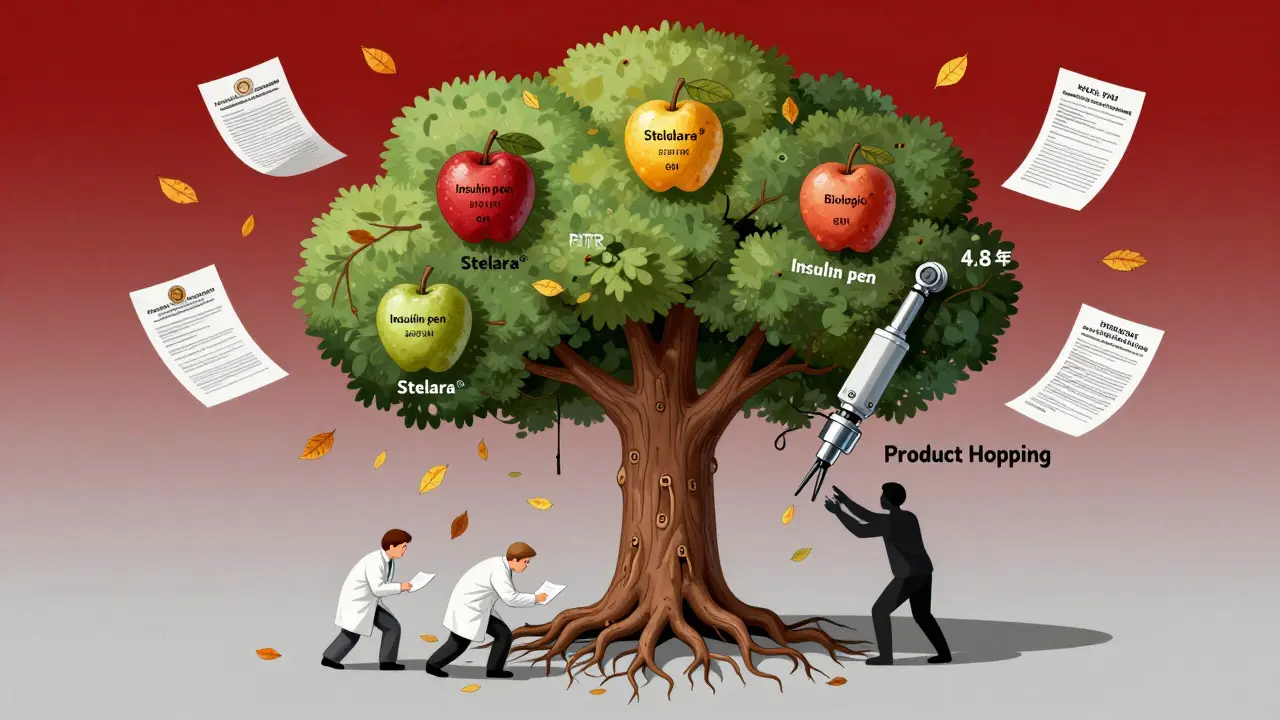
What’s Changing in 2025
As of January 2023, all PTR applications must be filed electronically. This cut processing time from 90 days to 60. The USPTO also updated its guidelines in 2022 after the Amgen v. Sanofi Supreme Court case, clarifying how to interpret patent claims in extension applications. The biggest trend? More applications for combination products-drugs paired with devices, like insulin pens or inhalers with sensors. Between 2015 and 2022, applications for these products jumped 300%. As drug development gets more complex, PTR will become even more important.Is Patent Term Restoration Right for Your Drug?
If you’re developing a new drug, PTR isn’t optional-it’s essential. But you need to plan for it from day one. Don’t wait until approval to think about which patent to extend. Start tracking your IND-to-NDA timeline. Document every delay. Keep records of all communications with the FDA. Work with legal counsel who specializes in PTR before you even file your NDA. The goal isn’t just to get an extension. It’s to get the right extension-on the right patent-for the maximum time possible. That’s the difference between a profitable drug and a financial flop.Can you get patent term restoration for a medical device?
Yes. The Hatch-Waxman Act originally covered human drugs, but was expanded in 1988 to include medical devices, food additives, and color additives. The same rules apply: you must file within 60 days of FDA approval, and the extension is capped at 5 years or 14 years post-approval, whichever comes first. Medical device manufacturers use PTR less often than drugmakers, but it’s still a critical tool for complex devices that take years to get approved.
Can you extend a patent after it expires?
No. You must file for patent term restoration before the patent expires. The application must be submitted to the FDA within 60 days of FDA approval, which usually happens years before the patent expires. If you miss that window, you cannot retroactively extend the patent. Once the patent expires, the protection ends permanently.
How long does the FDA take to approve a patent term restoration request?
As of 2023, the FDA processes PTR applications in an average of 60 days, down from 90 days before electronic filing was required. After the FDA makes its determination, the USPTO reviews and grants the actual patent extension. The entire process typically takes 3 to 6 months from the date the application is submitted.
Can generic drugmakers challenge a patent term restoration?
Yes. Once the FDA publishes its calculation of the extension period in the Federal Register, third parties have 60 days to request a revision. They can also file a due diligence petition if they believe the patent holder didn’t act promptly during clinical trials or regulatory review. Between 2018 and 2022, 73% of approved PTR applications faced at least one challenge from generics or competitors.
Does patent term restoration apply to biologics?
Yes, but less frequently. Biologics are covered under the same law, but they’re often protected by different types of patents and face more complex regulatory pathways. Between 2015 and 2022, 82% of biologics received a patent term extension, compared to 98% of small-molecule drugs. The average extension for biologics is slightly shorter, around 2.8 years, due to longer development timelines and more frequent regulatory delays.


Erika Putri Aldana
December 20, 2025 AT 21:00Southern NH Pagan Pride
December 21, 2025 AT 08:52Jay lawch
December 22, 2025 AT 13:01Christina Weber
December 23, 2025 AT 10:47Cara C
December 24, 2025 AT 08:43Michael Ochieng
December 25, 2025 AT 17:36Dan Adkins
December 25, 2025 AT 23:54Grace Rehman
December 27, 2025 AT 09:08Jerry Peterson
December 27, 2025 AT 20:01Meina Taiwo
December 29, 2025 AT 10:44