

After a heart attack, life doesn’t stop-it changes. And that change isn’t just about rest or fear. It’s about rebuilding your body, one step at a time, with the right meds, the right food, and the right movement. You’re not alone in this. Thousands in the UK and around the world walk this path every year. The key? Cardiac rehabilitation isn’t optional. It’s the backbone of everything that comes next.
Medications: Your Daily Lifeline
You’ll leave the hospital with a handful of new pills. Maybe more than you’ve ever taken before. It’s overwhelming. But each one has a job: to protect your heart, lower your risk, and help you feel better.
Statins are almost always part of the mix. They don’t just lower cholesterol-they stabilize the fatty build-up in your arteries so it doesn’t rupture again. Beta-blockers slow your heart rate, reduce blood pressure, and ease the strain on your heart muscle. Aspirin or another antiplatelet drug keeps your blood from clotting in the wrong places. ACE inhibitors or ARBs help your heart pump more efficiently, especially if it’s been damaged. And if you had an irregular heartbeat or weak heart function, you might get an aldosterone antagonist or an antiarrhythmic.
Don’t guess what these pills do. Write them down. Keep a list in your wallet or phone. If you’re unsure why you’re taking something, call your pharmacist. In the UK, the NHS Medicines Line offers free advice. Missing a dose isn’t just a slip-it can raise your chance of another heart attack. Your pharmacist is part of your recovery team. They’ll check for interactions, explain side effects, and help you stay on track.
Diet: What You Eat Heals You
Forget fad diets. What matters now is consistency. A heart-healthy diet isn’t about deprivation-it’s about choosing foods that give your heart a fighting chance.
Fill half your plate with vegetables and fruits. They’re packed with fiber, antioxidants, and potassium-everything your heart needs to recover. Swap white bread and pasta for whole grains like oats, brown rice, and quinoa. These help control blood sugar and keep cholesterol low.
Choose lean proteins: skinless chicken, fish (especially oily fish like salmon, mackerel, and sardines), beans, lentils, and tofu. Eat fish at least twice a week. Omega-3s in oily fish reduce inflammation and lower triglycerides. Avoid processed meats like bacon, sausages, and deli meats-they’re loaded with salt and preservatives that raise blood pressure.
Salt is the silent saboteur. The NHS recommends no more than 6g a day. That’s less than a teaspoon. Read labels. Many soups, sauces, and even breads are salt bombs. Cook at home when you can. Use herbs, garlic, lemon, and spices instead of salt to add flavor.
Fats matter too. Ditch butter, cream, and fried foods. Swap them for olive oil, avocado, nuts, and seeds. These are healthy fats that help lower bad cholesterol. Watch out for hidden trans fats in baked goods and margarine-they’re worse than saturated fat.
A dietitian will work with you in cardiac rehab. They’ll make a plan that fits your culture, your taste, your lifestyle. No one-size-fits-all. If you’re used to eating curry or roast dinners, they’ll help you make them heart-safe-not give up your traditions.
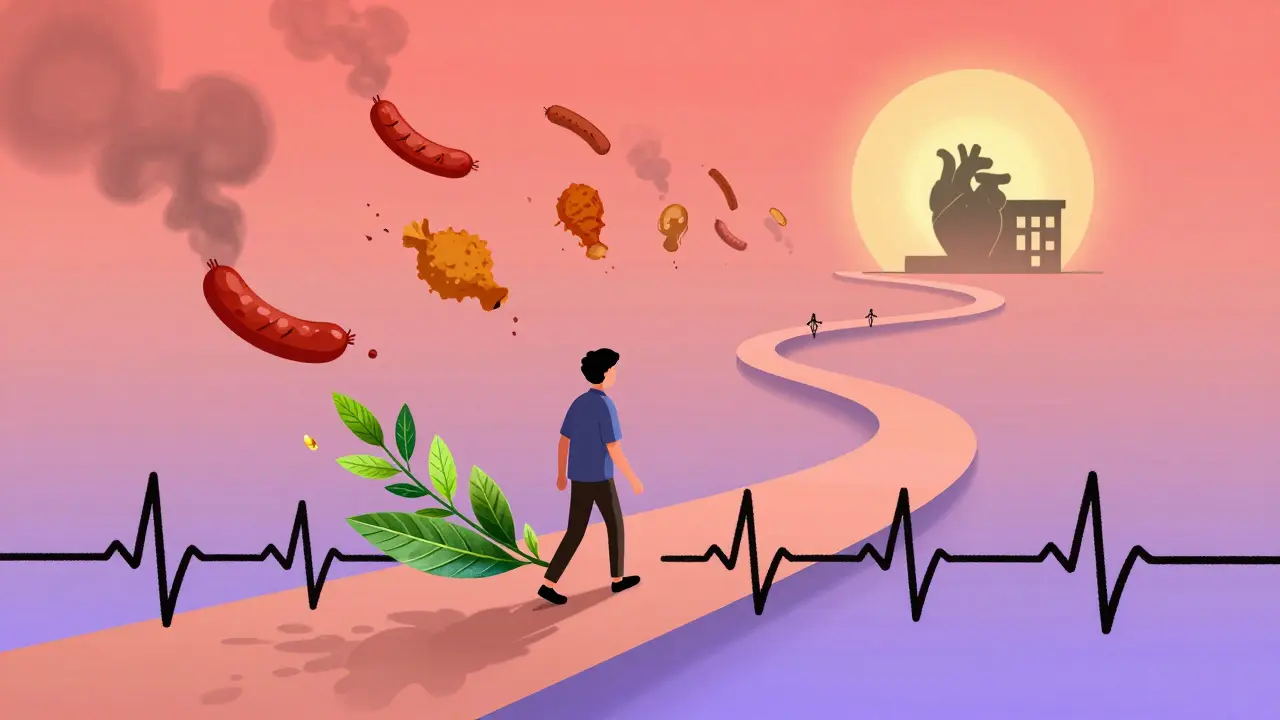
Activity: Move, But Wisely
You’ll feel tired. Weak. Even scared to walk to the end of the street. That’s normal. Your heart muscle was injured. It needs time to heal.
Day one after going home? Walk around the house. Go up and down the stairs once or twice. That’s it. No rushing. No pushing. The NHS says to build up slowly-over weeks, not days. If you’re dizzy, short of breath, or feel chest pain, stop. Rest. Call your doctor if it doesn’t go away.
By week two or three, you might start walking outside. Ten minutes. Then fifteen. Then twenty. Use a pedometer or your phone to track steps. Aim for 10,000 a day eventually, but don’t stress if you’re at 3,000. Progress is progress.
Cardiac rehab is where real change happens. It’s not a gym. It’s a supervised program with nurses, physiotherapists, and exercise specialists who know your heart’s limits. You’ll ride a stationary bike. Walk on a treadmill. Do light strength training. All while your heart rate and blood pressure are monitored. You’ll learn how hard you can push-without overdoing it.
Aerobic exercise is the star. It strengthens your heart, improves circulation, and lowers blood pressure. Swimming, cycling, brisk walking-they all count. Avoid heavy lifting or sudden bursts of effort until your team says it’s safe. If you’re 70 and just got a stent, your rehab plan looks different than someone who’s 50 and active before the heart attack.
Don’t wait for energy to come back. Move even when you’re tired. Fatigue fades with activity. But only if you start slowly and stick with it.
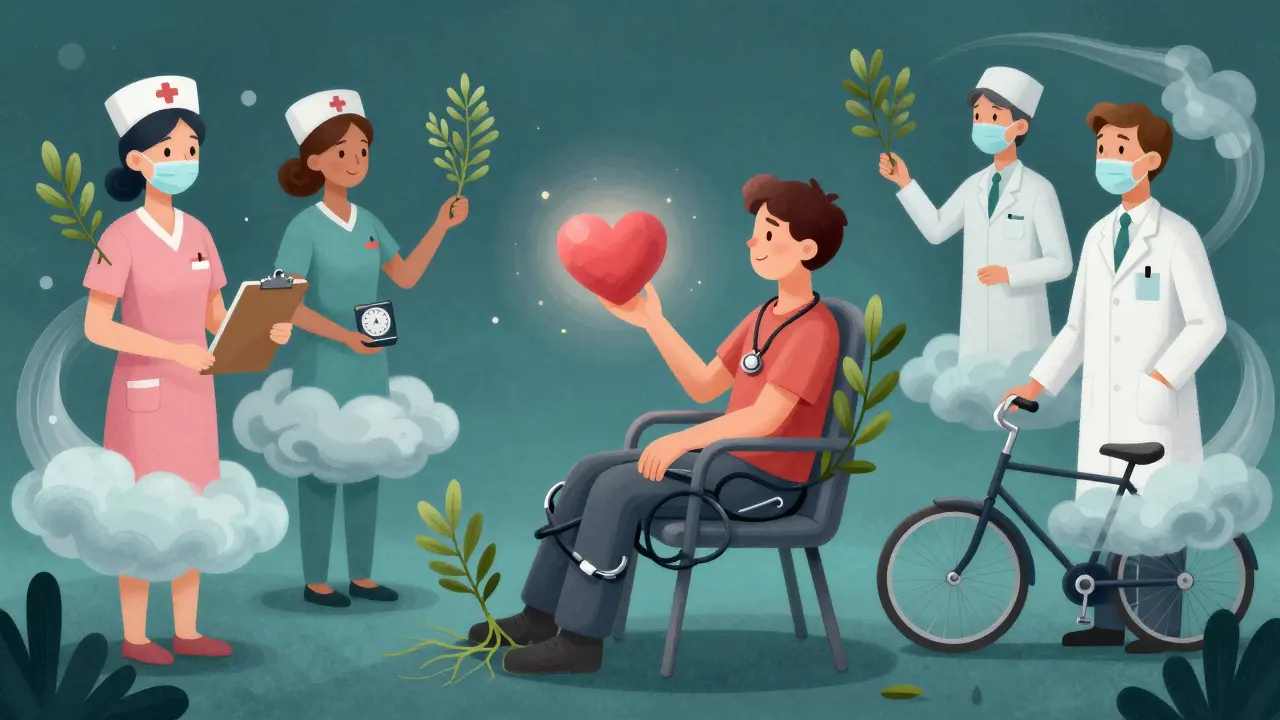
Cardiac Rehabilitation: Your Recovery Roadmap
This isn’t a luxury. It’s the single most effective thing you can do after a heart attack. Studies show people who complete cardiac rehab cut their risk of another heart attack by up to 30% and are more likely to live longer.
Programs usually start in hospital and continue for 6 to 12 weeks after you go home. Sessions are 2-3 times a week. You’ll get:
- Supervised exercise tailored to your heart’s condition
- Education on how your meds work
- Nutrition counseling from a dietitian
- Stress management and breathing techniques
- Support for anxiety or depression-yes, it’s common
Many people feel guilty for needing help. But this isn’t weakness. It’s smart. Your rehab team includes nurses, pharmacists, physios, and psychologists-all working together. They’ve seen hundreds of people like you. They know what works.
If you’re not offered rehab, ask. Not every hospital makes it easy, but it’s your right. The NHS recommends it for everyone after a heart attack. You can also find community-based programs through your GP or local heart charity.
Follow-Up and Long-Term Mindset
You’ll have a check-up 4 to 6 weeks after leaving hospital. Your doctor will check your heart function, review your meds, and see how you’re doing with diet and activity. Don’t skip it. This is when they adjust your plan.
Long-term, you’ll need ongoing care. Blood pressure checks. Cholesterol tests. Weight monitoring. Maybe an echocardiogram or stress test every year. Keep appointments. Even if you feel fine.
Some risks can’t be changed-age, family history. But the ones you can control? That’s your power. Quit smoking if you still do. Limit alcohol. Sleep well. Manage stress. Learn to say no. Your heart isn’t just a muscle-it’s your life’s engine. Treat it like one.
Recovery isn’t linear. Some days you’ll feel strong. Others, you’ll crash. That’s okay. What matters is showing up. Taking your pills. Eating your veggies. Walking when you can. Talking when you’re scared.
You’re not just surviving a heart attack. You’re rebuilding a life. And you can do it-with the right support, the right choices, and the right mindset.
How long does it take to recover from a heart attack?
Recovery varies. Most people start feeling better in 2 to 4 weeks, but full recovery can take 3 months or longer. It depends on how much damage the heart took, your age, other health conditions, and whether you join cardiac rehab. The NHS says not to rush-your body needs time to heal properly.
Can I drive after a heart attack?
You must stop driving for at least 1 week after a heart attack. If you drive a car or motorcycle, you can usually resume after 1 month if you’re feeling well and have no ongoing symptoms. For heavy goods vehicles or passenger-carrying vehicles, you need to notify the DVLA and may need medical clearance. Always check with your doctor and the DVLA before getting behind the wheel.
What foods should I avoid after a heart attack?
Avoid processed foods high in salt, sugar, and unhealthy fats. This includes bacon, sausages, ready meals, fried chicken, pastries, sugary drinks, and foods with hydrogenated oils. Check labels for hidden salt-many breads, soups, and sauces contain more than you think. Focus on whole, unprocessed foods instead.
Is it safe to have sex after a heart attack?
Yes, for most people. Sex is a moderate physical activity-similar to climbing two flights of stairs. If you can walk 10 minutes without chest pain or shortness of breath, you’re likely ready. Talk to your doctor if you’re unsure. Some medications can affect libido or performance, but that’s usually fixable. Don’t let fear stop you-emotional connection matters too.
What if I feel depressed after my heart attack?
Feeling down, anxious, or overwhelmed is very common-up to 1 in 3 people experience it. It’s not weakness. It’s a normal response to a life-changing event. Cardiac rehab includes psychological support. Talk to your GP or nurse. Therapy, support groups, or even short-term medication can help. Don’t ignore it-mental health affects physical recovery.
vishnu priyanka
January 13, 2026 AT 00:17Man, this hits different coming from the UK. Over here in India, we got our own version of cardiac rehab - mostly just grandmas yelling at you to eat less ghee and walk around the temple compound. But honestly? The meds and diet stuff? Spot on. My uncle did the whole statin + fish + no salt thing after his bypass, and now he’s biking to the market at 72. No drama. Just consistency.
Robin Williams
January 13, 2026 AT 07:09you dont need a phd to get this right. just eat real food. move a lil. take your pills. sleep. repeat. its not rocket science. its just hard because we live in a world that sells you lies in bright packaging. your heart dont care about your instagram. it just wants you to not be a dumbass.
Adam Rivera
January 15, 2026 AT 06:09I love how this post doesn’t sugarcoat it. My dad had his heart attack in ’21 and he’s still doing the 10-minute walks every morning. Rain or shine. Even on Christmas. He says, ‘If I stop, I’m letting the heart win.’ And honestly? That’s the real MVP mindset right there.
John Pope
January 16, 2026 AT 10:11Let’s deconstruct the epistemology of post-infarction rehabilitation, shall we? The biomedical model, as articulated by the NHS, is predicated on a Cartesian dichotomy between mind and body - yet the phenomenological experience of cardiac recovery is inherently embodied, intersubjective, and temporally contingent. Cardiac rehab, then, is not merely a protocol but a hermeneutic of resilience - a dialectical negotiation between institutional authority and autonomic vulnerability. The pharmacological regimen? A techno-biopolitical apparatus designed to normalize deviant physiology. And yet… the humble walk? That’s the ontological act of reclaiming agency. One step. One breath. One refusal to be reduced to a lipid panel.
Anny Kaettano
January 17, 2026 AT 09:20Cardiac rehab is the most underutilized intervention in modern medicine. We’re talking about a 30% reduction in mortality - and yet, 40% of patients never even enroll. Why? Shame. Fear. Lack of access. The system fails people at every turn. If you’re reading this and you’ve been told ‘you’ll be fine’ without a referral - demand it. You are not a statistic. You deserve a team. And if your doctor doesn’t get it? Find another one. Your life is not negotiable.
mike swinchoski
January 18, 2026 AT 11:29Why are we even talking about this? Just take your pills. Eat salad. Stop eating donuts. You’re not special. Everyone’s got a heart. You don’t get a trophy for surviving. Just do the work. Stop making it a lifestyle blog.
Acacia Hendrix
January 19, 2026 AT 13:17Let’s be clear: if you’re not following a Mediterranean-DASH-Ketogenic hybrid protocol under the supervision of a board-certified functional cardiologist with a PhD in nutrigenomics, you’re not doing cardiac rehab - you’re just winging it. And frankly, that’s statistically irresponsible. The NHS guidelines are antiquated. You need biomarker tracking, circadian rhythm alignment, and a personalized omega-3:omega-6 ratio. Otherwise, you’re just delaying the inevitable.
Alan Lin
January 21, 2026 AT 02:19To the person who said ‘just take your pills’ - you’re not helping. You’re part of the problem. This isn’t about discipline. It’s about systemic neglect. People don’t skip meds because they’re lazy - they skip them because they can’t afford them. Because they work two jobs. Because they don’t have a car to get to the pharmacy. Because their doctor won’t listen. This post is beautiful - but it’s a luxury for those who already have access. If you want to help? Advocate for policy. Fight for insurance. Demand community programs. Or stop pretending your moralizing changes anything.
Adam Vella
January 22, 2026 AT 18:18While the article provides a comprehensive overview of post-myocardial infarction management, it fails to address the critical role of mitochondrial biogenesis in cardiac remodeling, nor does it reference the 2023 AHA meta-analysis on time-restricted eating’s impact on cardiac troponin clearance. Furthermore, the recommendation to consume ‘oily fish twice weekly’ is statistically insufficient for achieving optimal EPA/DHA plasma concentrations (>4.5% of total fatty acids), which are correlated with 40% greater reduction in ventricular arrhythmias. I recommend supplementing with 2.5g of pharmaceutical-grade fish oil daily, alongside a low-glycemic, high-polyphenol diet, and continuous glucose monitoring to mitigate insulin resistance - a key driver of post-infarct fibrosis.