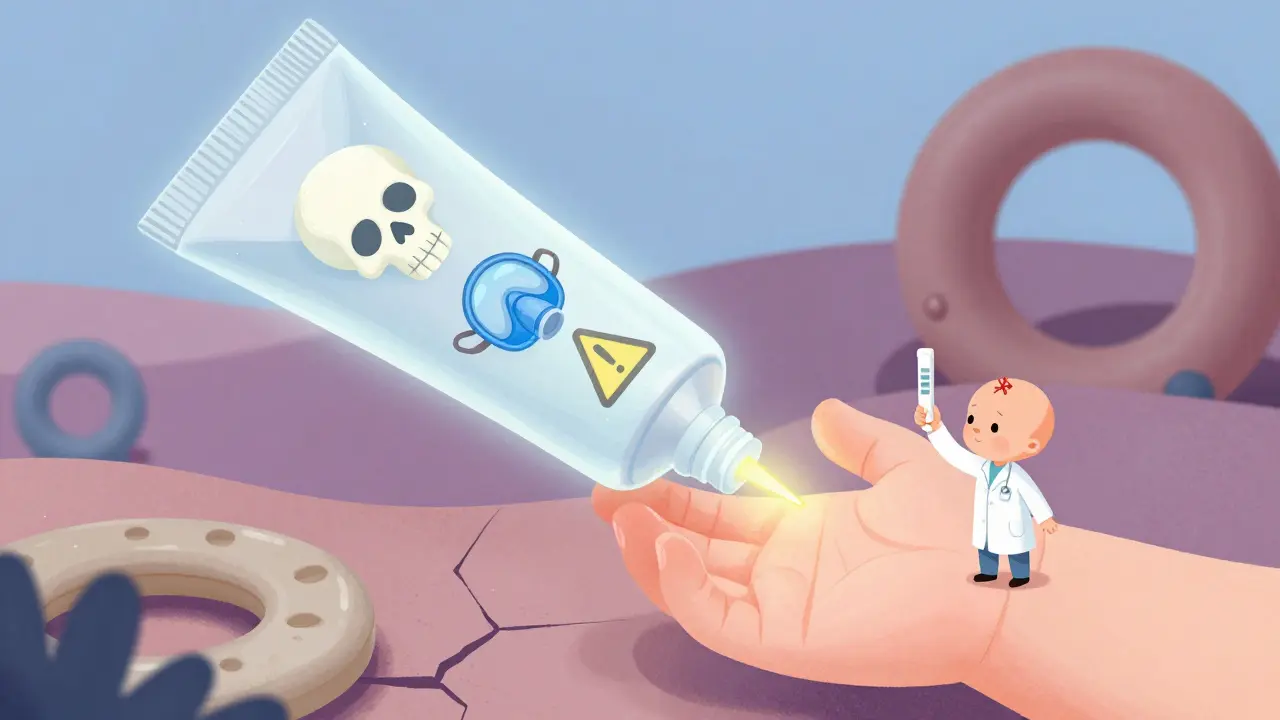
When your child has a rash, diaper irritation, or teething pain, it’s natural to reach for a cream or ointment to help. But what seems like a simple fix can turn dangerous if you don’t know the rules. Topical medications - creams, gels, and ointments applied to the skin - are not harmless. In children, especially babies under one year, the skin absorbs these products much more easily than in adults. A little too much, applied too often, or used on broken skin can lead to serious harm - even life-threatening reactions.
Why Children’s Skin Is Different
Children’s skin isn’t just smaller skin - it’s thinner, more porous, and less developed. A baby’s stratum corneum (the outermost protective layer) is up to 30% thinner than an adult’s. Their surface-area-to-body-weight ratio is higher, meaning a small amount of medicine can get absorbed into their bloodstream faster and in greater concentration. For infants under 12 months, this absorption can be 3 to 5 times higher than in adults. If the skin is inflamed - like in eczema - absorption can jump even higher, up to 10 to 15 times. This is why a pea-sized dab of hydrocortisone on a toddler’s face might be safe, but the same amount spread over half their body could shut down their stress hormone system.Medications to Avoid in Young Children
Some topical products have no place in a child’s medicine cabinet. The FDA has banned benzocaine-containing teething gels for children under 2 because they can cause methemoglobinemia - a condition where blood can’t carry oxygen properly. Symptoms appear fast: blue lips or skin, trouble breathing, dizziness. In severe cases, oxygen levels drop below 80% within minutes. Since 2006, over 400 cases have been reported in children, mostly from teething gels. Chilled rubber teethers work just as well - and without the risk. Topical anesthetics like lidocaine and dibucaine also carry serious risks. While sometimes used in hospitals for needle procedures, they’re unsafe for home use in babies. Even small amounts on broken skin can cause seizures. The U.S. Consumer Product Safety Commission (CPSC) requires child-resistant packaging for products with more than 0.5 mg of these ingredients, but many over-the-counter versions still don’t comply. A 2022 FDA check found 32% of retail lidocaine products lacked proper packaging. Potent corticosteroids - especially Class I and II - should never be used on children under 2. These include clobetasol, betamethasone, and halobetasol. Even short-term use can suppress the HPA axis, which controls cortisol production. This can lead to fatigue, low blood sugar, and even adrenal crisis. A 2022 review of 12,350 children showed that 15.8% of those using high-potency steroids developed HPA suppression, compared to just 2.3% with low-potency options.What’s Safe? Alternatives and Better Choices
For eczema and mild rashes, low-potency hydrocortisone (1%) is often the right choice - but only when used correctly. The American Academy of Pediatrics now recommends topical calcineurin inhibitors like tacrolimus (0.03%) or pimecrolimus for facial eczema in children as young as 3 months. These work just as well as mild steroids but don’t suppress hormones. They carry a black box warning about cancer risk, but after 15 years of use, there’s still no confirmed case linking them to cancer in children. For diaper rash, zinc oxide paste is the gold standard. It’s protective, non-absorbable, and safe even if swallowed. For itching, calamine lotion works well without systemic effects. For teething, cold (not frozen) teething rings or a clean, chilled washcloth are safer and just as effective.How to Apply Topical Medications Correctly
Never guess how much to use. The fingertip unit (FTU) method is the only reliable way. One FTU is the amount squeezed from a standard tube along the length of an adult’s index finger - about 0.5 grams. One FTU covers two adult palms. For a 10kg child, no more than 2g total of steroid cream per day should be used, and only on 10% of the body surface at once. That’s roughly four FTUs total. Apply only to intact skin. Never use creams on open sores, cuts, or severe eczema unless directed by a doctor. Damaged skin can absorb lidocaine up to 60 times more than healthy skin. Occlusion - covering the area with plastic wrap or Tegaderm - increases absorption by 300-500%. This technique is sometimes used under medical supervision for stubborn eczema, but never at home without explicit instructions.
Storage and Prevention of Accidental Poisoning
Most poisonings happen because the medicine was left out. The American Association of Poison Control Centers reports that 78% of pediatric exposures occur when products are left accessible after use. A parent applies cream, puts the tube on the bathroom counter, and turns away for five minutes - that’s all it takes. Keep all topical medications in child-resistant containers, locked away, and never in the same drawer as snacks or candy. Even if the product says “for kids,” it doesn’t mean it’s safe if ingested.When to Seek Emergency Help
Call 911 or go to the ER immediately if your child shows any of these signs after using a topical product:- Blue or gray skin, especially around lips or fingernails
- Difficulty breathing or rapid, shallow breathing
- Extreme drowsiness or unresponsiveness
- Seizures or twitching
- Vomiting or confusion
What to Look for on Labels
Prescription creams come with detailed pediatric warnings. Over-the-counter products? Often not. A 2021 study found only 37% of OTC topical pain relievers included age-specific dosing instructions. Always check:- Age restrictions (e.g., “not for use under 2 years”)
- Maximum daily dose or number of applications
- Warnings about skin damage or occlusion
- Active ingredient name and concentration
Common Misconceptions
Many parents believe:- “More cream = faster healing.” False. Thick layers don’t help - they increase absorption and risk.
- “It’s just a cream, it can’t hurt.” False. Topical meds are drugs. They enter the bloodstream.
- “My cousin used this on their baby - it was fine.” Anecdotes aren’t science. One child’s luck doesn’t mean it’s safe.
- “I’ll just use the leftover steroid from my eczema.” Dangerous. Sharing prescriptions is a leading cause of pediatric toxicity. One in five households do this.
What’s Changing in 2025
The FDA released draft guidelines in 2023 requiring all new topical medications to include clear pediatric labeling: maximum body surface area, age limits, and duration rules. New products launching in 2025 are starting to include child-safe dosing pumps and QR codes that link to safety videos. Research is also advancing: nanoparticle-based creams now in Phase III trials can reduce absorption by 70-80% while keeping effectiveness. These could be game-changers for eczema and psoriasis treatment in children.Final Rule: Less Is More
The guiding principle for every topical medication in children is simple: use the lowest strength for the shortest time possible. A mild hydrocortisone used for three days is safer than a strong steroid used for two weeks. A cold teether beats a numbing gel every time. When in doubt, skip it. Talk to your pediatrician or dermatologist. Don’t rely on internet advice, old prescriptions, or well-meaning relatives. Your child’s skin is delicate. Treat it like the sensitive, developing organ it is - not like a surface you can treat like an adult’s.Can I use hydrocortisone cream on my baby’s face?
Yes, but only 1% hydrocortisone, and only for a few days. Use no more than one fingertip unit (0.5g) total per day, applied thinly. Avoid using it on broken skin or under occlusion. For facial eczema, the American Academy of Pediatrics now recommends topical calcineurin inhibitors like tacrolimus 0.03% as a safer first-line option for babies over 3 months.
Is benzocaine really that dangerous for teething?
Yes. Benzocaine can cause methemoglobinemia - a rare but life-threatening condition that reduces oxygen in the blood. It happens fast, often within 15-30 minutes of application. Since 2006, over 400 cases have been reported in children under 2. The FDA banned benzocaine teething products for this age group for this exact reason. Cold teething rings or a clean, chilled washcloth are just as effective and carry zero risk.
How much cream should I use on my child?
Use the fingertip unit (FTU) method. One FTU is the amount of cream squeezed from a standard tube along the length of your index finger - about 0.5 grams. One FTU covers an area equal to two adult palms. For a 10kg child, no more than 2g total of steroid cream per day is safe. That’s four FTUs max. Never apply thick layers - it doesn’t work better, it just increases risk.
Can I use my own eczema cream on my child?
No. Adult creams often contain high-potency steroids like clobetasol or halobetasol, which can suppress your child’s adrenal system. Even low-potency creams may contain ingredients not approved for young children. Sharing prescriptions is one of the leading causes of pediatric topical medication poisoning. Always use products specifically labeled for children and prescribed for their age.
What should I do if my child swallows some cream?
Call Poison Control immediately at 1-800-222-1222. Do not wait for symptoms. If the cream contains lidocaine, dibucaine, or benzocaine, it can cause seizures, breathing problems, or methemoglobinemia. Keep the product container handy - the ingredients list will help them determine the risk. If your child is having trouble breathing, turning blue, or seizing, call 911 right away.