
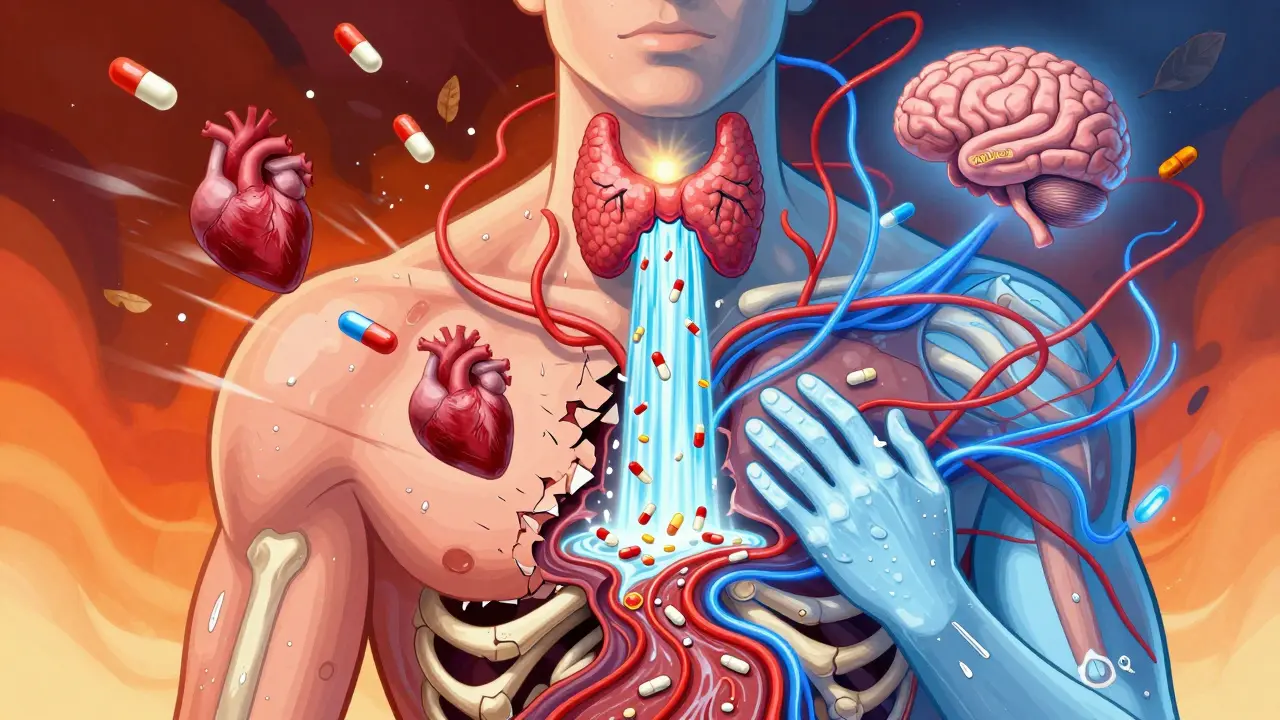
More than 120 million prescriptions for levothyroxine are filled every year in the U.S. Most people take it exactly as directed-to replace missing thyroid hormone after surgery or due to Hashimoto’s disease. But for others, it’s not medicine. It’s a shortcut. A way to lose weight fast. To feel more energetic. To push harder at the gym. And that’s where things go wrong.
What Happens When You Take Too Much Thyroid Medicine?
Thyroid hormone isn’t just about metabolism. It affects your heart, your bones, your brain, even your sleep. When you take too much-whether on purpose or by accident-you flood your system with T3 and T4. Your body doesn’t know how to handle it. Your heart starts racing. You can’t sleep. You sweat through your clothes even in a cool room. You lose weight, but not the healthy kind. Muscle melts. Your bones weaken. And your body starts to shut down.
This isn’t just theory. A 2021 study found that 12% of people showing up with symptoms of hyperthyroidism weren’t sick at all-they were abusing levothyroxine. The average age? 34.7. Most were women. Many were athletes, fitness influencers, or people struggling with body image. One Reddit user wrote: “I took 200mcg daily for three months to lose weight. Ended up in the ER with a heart rate of 142. Doctors said I was lucky to be alive.”
Doctors can spot this. In true autoimmune hyperthyroidism like Graves’ disease, the thyroid gland is overactive and so it soaks up radioactive iodine. But in medication-induced cases, the gland is quiet. The iodine uptake is low. Thyroglobulin levels drop. That’s the fingerprint of someone swallowing pills, not a gland gone rogue.
Signs You’re Taking Too Much
If you’re on levothyroxine and you start noticing these, it’s not normal:
- Weight loss that keeps going even when you’re eating normally
- Heart racing, chest pain, or fluttering in your chest
- Tremors in your hands-so bad you can’t hold a coffee cup
- Insomnia, even when you’re exhausted
- Diarrhea or frequent bowel movements
- Feeling hot all the time, even in winter
- Temporary hair thinning or shedding
- Anxiety that feels like panic, even when nothing’s wrong
These aren’t side effects. They’re red flags. In fact, 92% of people abusing levothyroxine report weight loss. 78% have tremors. 65% get nausea. And 15% end up with chest pain severe enough to require emergency care. In extreme cases, body temperature spikes above 104°F. That’s hyperthermia. It can be fatal.
What About Taking Too Little-or Skipping Doses?
It’s not just overdosing that’s dangerous. Skipping doses, taking pills at random times, or stopping cold turkey can trigger hypothyroidism-even if you were never diagnosed with it in the first place.
People do this for different reasons. Some forget. Some are scared of side effects. Others think they don’t need it anymore after they “feel better.” But thyroid hormone doesn’t work like caffeine. It doesn’t wear off. Your body needs a steady, daily supply.
When levels drop too low, symptoms creep in slowly:
- Constant fatigue-even after a full night’s sleep
- Feeling cold when others are comfortable
- Weight gain despite eating less
- Depression or brain fog
- Dry skin and brittle nails
- Constipation
A 2022 review found that 89% of people with drug-induced hypothyroidism feel tired. 76% are sensitive to cold. 68% gain weight. And 55% struggle with depression. These aren’t just “bad days.” They’re signs your body is running on empty.
One woman on HealthUnlocked said: “My doctor kept increasing my dose because I kept losing weight-but I was secretly taking extra pills. It took six months to stabilize after I confessed.”
Medications You Didn’t Know Could Mess With Your Thyroid
It’s not just levothyroxine. Other drugs can accidentally throw your thyroid off balance.
Amiodarone-a heart rhythm drug-contains more than 37% iodine by weight. That’s like dumping iodine crystals into your bloodstream. It can cause both hyperthyroidism and hypothyroidism. Two types exist: Type 1 (thyroid overproduces) and Type 2 (thyroid gets inflamed and leaks hormone). Both need different treatments.
Iodinated contrast dye-used in CT scans-can trigger thyrotoxicosis weeks after the scan. This is called the Jod-Basedow effect. People with underlying thyroid issues are especially at risk.
Immune checkpoint inhibitors-used in cancer treatment-can cause thyroid inflammation. In some cases, up to 8% of patients develop hyperthyroidism within weeks. Symptoms are subtle at first: fatigue, slight weight loss. But they can spike fast. Doctors now recommend thyroid tests every 4 to 6 weeks during treatment.
Lithium, used for bipolar disorder, causes hypothyroidism in 15-20% of long-term users. The good news? It often reverses when the drug is stopped.
Why Do People Abuse Thyroid Medication?
It’s not about ignorance. It’s about desperation.
Thyroid hormone speeds up metabolism. It burns calories. It suppresses appetite. And because it’s prescribed legally, it’s easy to get. Some patients get extra prescriptions by lying to doctors. Others buy it online from unregulated sites. The FDA found 217 websites selling thyroid hormones without a prescription in 2022-up 43% from 2020.
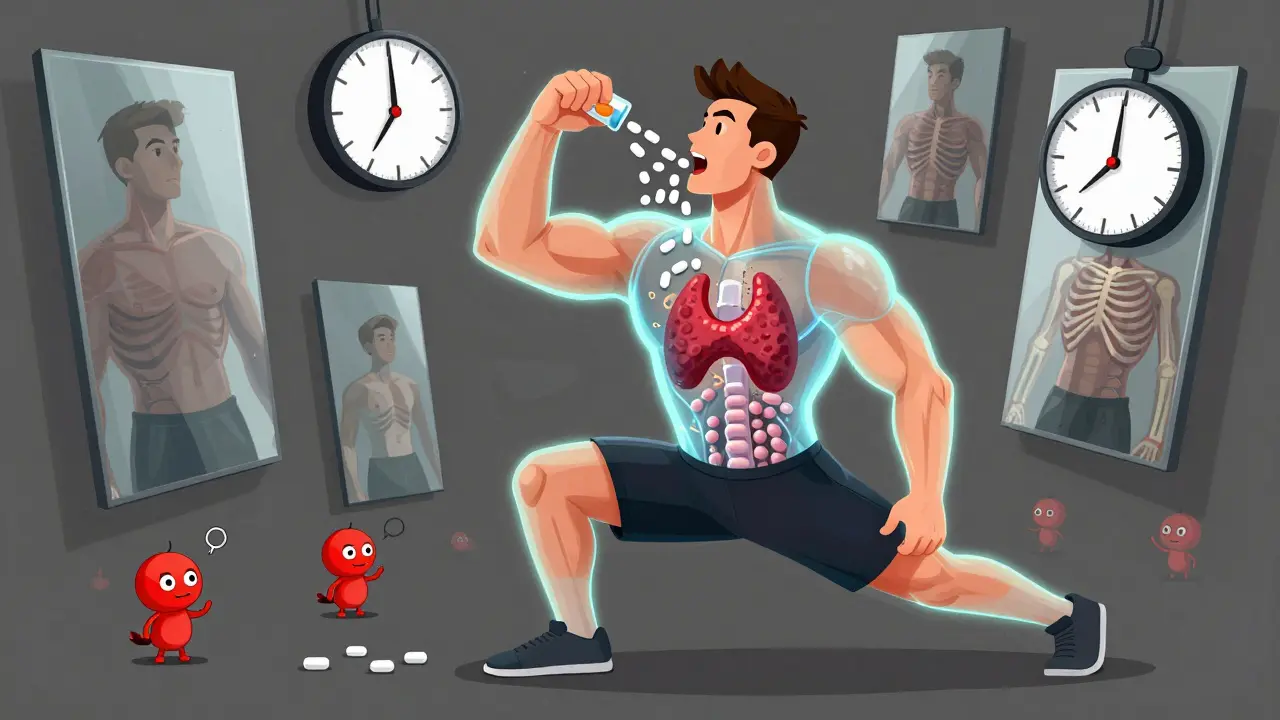
One study found 8.7% of gym-goers admitted to using thyroid meds for weight loss without medical supervision. On fitness forums, people brag about taking 100-200mcg daily. That’s 2 to 4 times the standard dose. Some combine it with stimulants like clenbuterol. That’s a recipe for cardiac arrest.
And here’s the cruel irony: people who abuse levothyroxine for weight loss often end up gaining weight later. Once they stop, their metabolism crashes. Their thyroid shuts down. They become hypothyroid. And now they need medication just to feel normal again.
How Doctors Diagnose Medication Misuse
It’s not always obvious. Many patients lie. They say they’ve been taking their pills “every day.” But thyroid tests don’t lie.
Here’s what doctors look for:
- High free T4, low TSH-classic for hyperthyroidism
- Low thyroglobulin-means the thyroid isn’t making hormone, so it’s coming from pills
- Low radioactive iodine uptake-rules out Graves’ disease
- TSH doesn’t drop after taking a missed dose-because the body’s already flooded
There’s also a “lag effect.” If someone takes a big dose right before a blood test, their T4 spikes-but TSH stays low because it takes 6 weeks to respond. That tricks doctors into thinking the dose is too low. In reality, it’s too high. This leads to misdiagnosis in 15-20% of noncompliant patients.
What Happens When You Stop?
Stopping levothyroxine abuse isn’t simple. Your body has adapted. Your heart is racing. Your bones are thinning. Your nervous system is on fire.
The Endocrine Society recommends a “washout period”-stopping the medication for 2-3 weeks under medical supervision. During this time, your heart rate, blood pressure, and body temperature are monitored. In 87% of mild cases, symptoms disappear on their own.
But it’s not always that easy. Some people develop permanent heart damage. Others lose so much bone density they’re at risk for fractures. One study showed chronic medication-induced hyperthyroidism increases osteoporosis risk by 3.2 times. Bone density drops 2-4% per year-faster than menopause.
And if you’ve been abusing it for weight loss, you might need to be treated for hypothyroidism afterward. Your thyroid gland, exhausted from being overstimulated, may stop working properly. You’ll need replacement therapy-not because you’re sick, but because you abused the medicine.
How to Avoid This
Thyroid medication is safe when used correctly. But it’s not harmless. Here’s how to stay safe:
- Get tested before starting. Never take thyroid hormone without a TSH and free T4 test.
- Take it on an empty stomach, 30-60 minutes before food or supplements. Calcium, iron, and even coffee can block absorption by 35-50%.
- Get blood tests every 6-8 weeks when starting or changing doses. Don’t skip them.
- Don’t take someone else’s pills. Even if they have the same diagnosis, your dose is unique.
- Ask your doctor about digital pills. The FDA approved a levothyroxine pill with a sensor in 2023. It tracks when you take it-and alerts your doctor if you miss doses.
- If you’re using it for weight loss, talk to someone. This isn’t a diet trick. It’s a medical emergency waiting to happen.
Patients who get proper counseling have a 63% lower chance of messing up their dosing. Education saves lives.
What’s Changing Now
Doctors are catching on. Point-of-care TSH tests are now available in some clinics-results in 15 minutes, not weeks. Telemedicine thyroid programs are cutting misuse by 28% by making follow-ups easier. And research is identifying genetic markers that predict who’s at risk for amiodarone-induced thyroid problems.
But the problem is growing. Hospitalizations for thyroid medication complications rose 18% since 2019. Costs in the U.S. hit $427 million a year. And the market for thyroid drugs is projected to hit $5.2 billion by 2027.
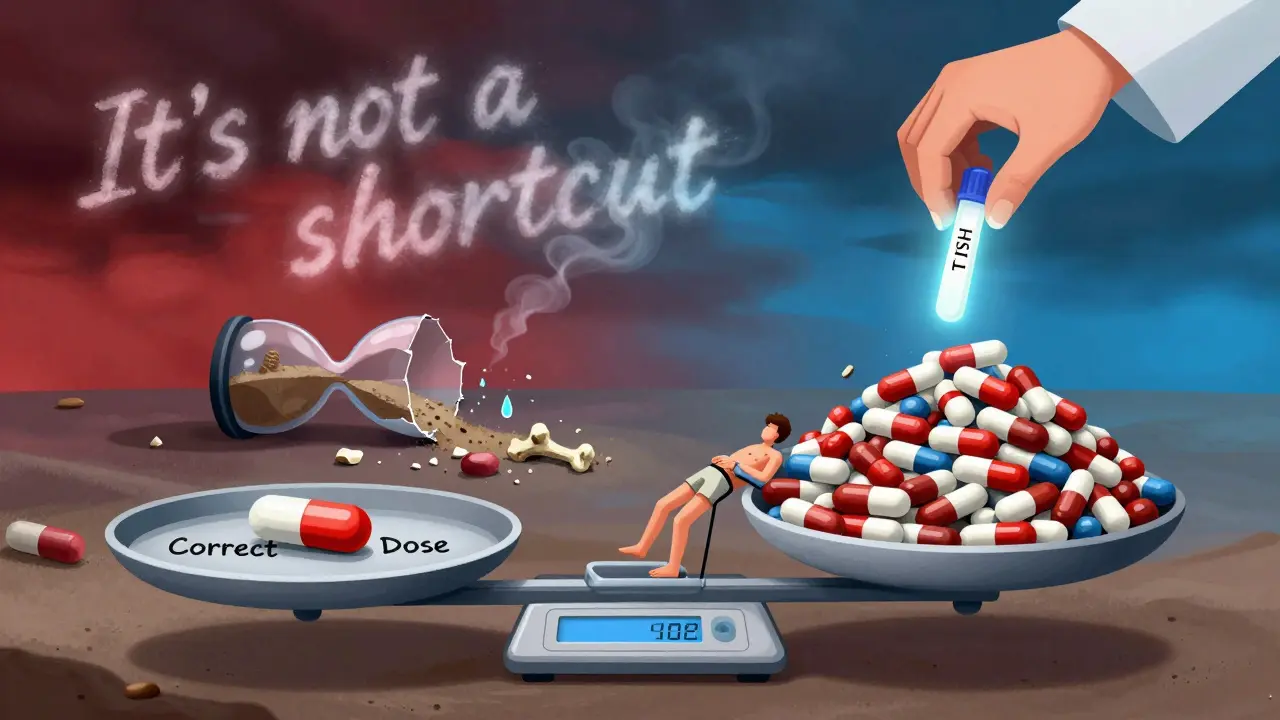
Thyroid medication isn’t the enemy. But treating it like a supplement, a shortcut, or a weight-loss hack? That’s where the danger lives.
It’s not about willpower. It’s about understanding that your thyroid isn’t a dial you can turn up for quick results. It’s a master regulator. Mess with it, and your whole body pays the price.
Can you really lose weight safely with levothyroxine?
No. Levothyroxine isn’t a weight-loss drug. Taking more than prescribed speeds up your metabolism-but it also puts your heart at risk, breaks down your muscle, and weakens your bones. Any weight lost this way is temporary, and you’ll likely gain it back worse than before. Safe weight loss comes from diet, exercise, and sleep-not hormone abuse.
How do I know if my thyroid symptoms are from my medication or something else?
Doctors use blood tests and imaging. A low radioactive iodine uptake and low thyroglobulin level mean your thyroid isn’t producing hormone-so the excess is from pills. High uptake means your gland is overactive, like in Graves’ disease. If your symptoms started after changing your dose or after a CT scan, that’s a clue. Always tell your doctor everything you’re taking.
Can thyroid medication cause permanent damage?
Yes. Chronic abuse can lead to atrial fibrillation, heart failure, osteoporosis, and even thyroid storm-a life-threatening surge of hormones. Bone loss from hyperthyroidism can be permanent, especially if you’re under 40. The longer you abuse it, the higher the risk. Stopping early can prevent most damage.
Why do some people need higher doses of levothyroxine?
Everyone’s needs are different. Factors like body weight, age, other medications, and even gut health affect absorption. After thyroid removal, most people need 1.6 mcg per kg of body weight. But if you have Hashimoto’s, your dose may change over time. That’s why regular testing is essential-never assume your dose is right forever.
Is it safe to take thyroid medication with other supplements?
Not if you take them together. Calcium, iron, magnesium, and even soy or fiber supplements can block absorption. Wait at least 4 hours after taking levothyroxine before taking anything else. Coffee, especially, reduces absorption by up to 50%. Take it with water on an empty stomach-no exceptions.
What should I do if I think I’ve been taking too much?
Don’t stop suddenly. Go to your doctor and get your thyroid levels checked. If you’re having chest pain, rapid heartbeat, or fever, go to the ER. Stopping abruptly can cause dangerous swings. Your doctor will likely recommend a gradual reduction with monitoring. Be honest-your life depends on it.


Mussin Machhour
December 23, 2025 AT 18:14Bro, I saw this post and immediately thought of my cousin. She was taking 150mcg because she wanted to ‘get shredded’ for her fitness competition. Ended up in the ER with atrial fibrillation. Doctors told her her heart was basically running on a treadmill at full blast for months. She’s on medication now just to keep her rhythm stable. Don’t be her.
Thyroid isn’t a cheat code. It’s a lifeline for some, a landmine for others.
Carlos Narvaez
December 24, 2025 AT 23:08Levothyroxine abuse is just another symptom of the American obsession with metabolic optimization. You don’t need to be a biohacker to know this is a catastrophic misunderstanding of endocrine physiology.
It’s not medicine. It’s performance-enhancing drug with a prescription label.
Harbans Singh
December 26, 2025 AT 07:05This is so important. I grew up in India where people buy thyroid meds from street pharmacies like candy. My aunt took 200mcg for ‘weight loss’ and ended up with permanent heart issues. No one told her it wasn’t a supplement.
Maybe we need public health campaigns in gyms, Instagram fitness pages, even beauty salons. People don’t know what they’re messing with. Education isn’t just helpful-it’s lifesaving.
Winni Victor
December 26, 2025 AT 19:50Oh my god I knew someone like this. She was posting ‘thyroid hack’ selfies on TikTok with a 100mcg pill in her hand and a caption like ‘burning fat like a furnace 🔥’. Then she vanished for six months. Came back looking like a ghost with brittle hair and zero energy. Now she’s on antidepressants and thyroid replacement. The irony is thicker than her goop.
Rick Kimberly
December 28, 2025 AT 19:40The data presented here is compelling and clinically significant. The distinction between endogenous and exogenous thyrotoxicosis via thyroglobulin and radioactive iodine uptake is a critical diagnostic criterion often overlooked in primary care settings. Further research into the long-term cardiac sequelae of iatrogenic hyperthyroidism is urgently warranted.
Terry Free
December 30, 2025 AT 02:34So people are dumb enough to take a hormone like it’s Adderall? Congrats, you just turned your body into a ticking time bomb. You think you’re getting lean? Nah. You’re just turning your muscles into protein soup and your bones into chalk. And now you’re gonna need a lifetime of meds just to stop feeling like death.
Stop being a lab rat. Get a job. Eat food. Sleep. That’s the real hack.
Lindsay Hensel
December 30, 2025 AT 13:55I’ve worked with patients who’ve done this-and the guilt they carry afterward is crushing. They didn’t think they were hurting themselves. They thought they were being disciplined. The tragedy isn’t just the physical damage-it’s the betrayal of their own bodies. Compassion, not judgment, is what’s needed here.
Katherine Blumhardt
January 1, 2026 AT 05:40omg i took thyroxine once bc my friend said it helped her lose 10lbs in a week and i thought it was magic but then i got so shaky and my heart felt like it was gonna pop out of my chest so i stopped. i still feel weird sometimes. pls tell me im not broken??
sagar patel
January 2, 2026 AT 15:52Abuse is rampant in urban India too. Pharmacies sell levothyroxine without prescription. Patients don't know difference between hypothyroidism and weight loss. Result: cardiac arrests in 30-year-olds. No awareness. No regulation. Just profit.
Bailey Adkison
January 4, 2026 AT 04:54People say this is about willpower but it’s not. It’s about a system that sells quick fixes and then abandons you when you break. No one told me thyroid meds could wreck my bones. No one warned me about the rebound weight gain. Now I’m 42 and need a hip replacement because I thought I was being smart.
Zabihullah Saleh
January 5, 2026 AT 23:53There’s something deeply human about this. We don’t want to accept that our bodies need time, rest, patience. We want a pill to fix what we think is broken. But the thyroid isn’t a broken machine-it’s a sacred rhythm. And we’re trying to tune it with a hammer.
Sophie Stallkind
January 6, 2026 AT 12:55This post represents a critical public health imperative. The normalization of endocrine manipulation for aesthetic or performance-based purposes underscores a profound disconnect between medical science and cultural values. Immediate intervention through physician education, pharmacy regulation, and media literacy initiatives is not merely advisable-it is ethically obligatory.