Imagine you are handed a prescription for a life-saving medication. You pay a fraction of the cost because it is a generic version. You trust it works exactly like the brand-name original. But what happens if new safety risks emerge months or years after you start taking it? For patients relying on generic drugs, understanding how the U.S. Food and Drug Administration (FDA) communicates these risks is not just academic-it can be a matter of health and safety.
The system for monitoring drug safety is complex, and generic medications occupy a unique, often confusing space within it. While brand-name manufacturers have certain powers to update warning labels quickly, generic manufacturers historically operate under stricter constraints. This article breaks down how FDA safety alerts work, why generic drug labeling lags behind, and what this means for your health in 2026.
How the FDA Monitors Drug Safety
The backbone of post-market drug surveillance in the United States is the MedWatch program. Established in 1993, MedWatch serves as the primary channel for the FDA to receive reports of adverse events from healthcare professionals and consumers. It also acts as the broadcast mechanism for official safety alerts regarding prescription medicines, over-the-counter drugs, biologics, and medical devices.
When the FDA identifies a potential risk-whether through data analysis or direct reports-it publishes alerts on its website. These communications range from minor label updates to urgent market withdrawals. A recent example occurred on September 26, 2024, when the FDA issued an alert regarding the voluntary withdrawal of Oxbryta due to emerging safety concerns. Such alerts are critical for keeping physicians and patients informed about real-world performance issues that may not have been detected during clinical trials.
For generic drugs specifically, the Office of Generic Drugs (OGD), which sits within the Center for Drug Evaluation and Research (CDER), oversees approval and ongoing surveillance. They utilize systems like the FDA Adverse Event Reporting System (FAERS) and the Drug Quality Reporting System to monitor safety signals monthly. In one notable case involving the first generic version of Rexulti, proactive pharmacovigilance screening was initiated in 2019-2020 to detect any quality or safety issues; fortunately, no negative signals were found during that first year. However, the absence of a signal does not mean the monitoring system is perfect, especially when it comes to labeling updates.
The Generic Drug Labeling Gap
To understand why generic drug safety communications can feel delayed, you need to look at the regulatory framework established by the Hatch-Waxman Act of 1984. This landmark legislation created the pathway for generic drug approval while balancing incentives for innovation with consumer access to affordable medications. Under this act, generic manufacturers must prove their products are bioequivalent to the Reference Listed Drug (RLD)-the brand-name original. This means identical active ingredients, dosage form, strength, route of administration, and intended use.
However, there is a catch regarding labeling. Historically, generic manufacturers have been required to copy the labeling of the RLD exactly. They cannot independently update safety warnings without prior FDA approval. This creates a significant lag. If new adverse information emerges, the brand-name manufacturer can often act faster than the generic counterpart.
This discrepancy has led to a "labeling gap" where patients taking generics might not receive updated safety information as quickly as those on brand-name versions. The issue is particularly acute because many insurance companies mandate the use of generic drugs when available, meaning millions of patients are reliant on a system where the label may not reflect the most current safety data.
The CBE-0 Process: A Key Bottleneck
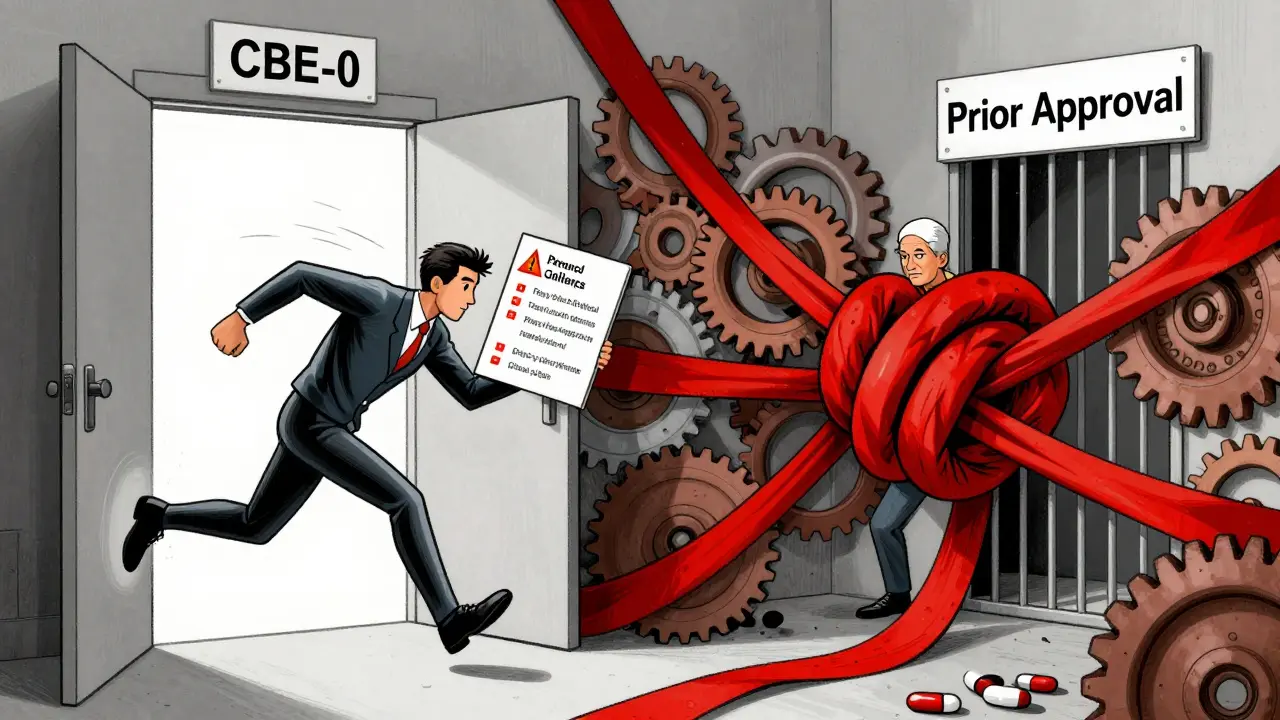
The core of the labeling debate revolves around the "changes-being-effected" supplement, known as CBE-0. This process allows brand-name manufacturers to update warning labels to include new safety information without waiting for prior FDA approval. They simply submit the change and begin using the new label, notifying the FDA concurrently.
Generic manufacturers do not currently have this privilege. According to David Gaugh, Senior Vice President for Sciences and Regulatory Affairs at the Generic Pharmaceutical Association (GPhA), the standard FDA review process for generic label changes typically takes 9 to 12 months. During this window, potentially vital safety information remains absent from the generic packaging.
In 2013, the FDA proposed extending the CBE-0 process to generic manufacturers. The goal was to ensure all patients, regardless of whether they take a brand or generic, receive timely safety updates. As of 2026, this proposal remains under consideration, creating a stalemate between public health advocates and industry players.
| Feature | Brand-Name Manufacturers | Generic Manufacturers |
|---|---|---|
| Label Update Mechanism | CBE-0 (Concurrent submission) | Prior Approval Supplement (PAS) |
| Time to Update Labels | Immediate (upon submission) | 9-12 months (average review time) |
| Legal Liability Risk | High (sued for inadequate warnings) | Lower (historically shielded by preemption) |
| Regulatory Basis | New Drug Application (NDA) | Abbreviated New Drug Application (ANDA) |
Why Industry Resists Change
If updating labels seems like a clear win for patient safety, why has the rule change stalled? The opposition comes largely from generic manufacturers and trade groups like GPhA. Their argument centers on legal liability and market stability.
David Gaugh argues that allowing generics to unilaterally change labels contradicts the goals of the Hatch-Waxman Act. The concern is that if generic companies assume responsibility for evaluating and adding new warnings, they face increased exposure to product liability lawsuits. Brand-name companies already face frequent litigation for failing to add warnings quickly enough. Extending this duty to generics could drive smaller competitors out of the market, reducing competition and ultimately raising prices for consumers.
Furthermore, generic manufacturers contend that the Federal Food, Drug, and Cosmetic Act does not grant them the authority to deviate from the approved RLD labeling. They argue that the FDA should remain the sole arbiter of label changes to maintain consistency across all manufacturers of the same drug substance.
The Push for Patient-Centric Safety
On the other side of the debate are consumer health organizations. In 2022, 27 such groups submitted a statement to the American Association for Justice (AAJ), emphasizing that "requiring all prescription drugs to carry up-to-date safety warnings is essential." Their position is straightforward: patients deserve accurate, current information about the risks and benefits of their medications, irrespective of the manufacturer.
Experts like Dr. Xin Fu, who leads Excipient Safety Assessment at the FDA, highlight another layer of complexity. While active ingredients must be identical, generic drugs can differ in excipients-inactive ingredients like colors, flavors, preservatives, and binders. Although generally safe, differences in excipients can alter the safety profile for specific patient populations, especially regarding allergies or sensitivities. The FDA’s focus on "Context of Use" (dose, route, duration, patient population) underscores that even minor formulation differences require rigorous safety assessment.
Consumer advocates argue that the current system leaves patients vulnerable. When a brand-name drug receives a black box warning or a new contraindication, patients on the generic equivalent may not see that warning on their bottle for nearly a year. This delay undermines the principle of informed consent.
Complex Generics and Future Challenges
The landscape is further complicated by the rise of "complex generic drug products." These are medications with intricate formulations, such as transdermal patches, extended-release injectables, or inhalers. Unlike simple tablets, these products present unique safety monitoring challenges. The FDA has increasingly focused resources on these complex generics, recognizing that bioequivalence is harder to establish and maintain for such delivery systems.
As the market matures and more complex generics enter the pipeline, the pressure to refine safety communication channels will only intensify. The FDA continues to publish resources like "Generic Drugs: Questions & Answers" to help patients navigate these nuances, but the fundamental regulatory tension between speed of information and legal liability remains unresolved.
What Patients Can Do Today
While regulatory debates play out in Washington, patients can take proactive steps to manage their medication safety:
- Check the FDA Website Regularly: Visit the Drug Safety and Availability page for the latest alerts. The FDA posts updates on warnings, recalls, and shortages here.
- Use MedWatch: If you experience unexpected side effects, report them via the MedWatch program. Your report contributes to the data that drives future safety actions.
- Talk to Your Pharmacist: Pharmacists are trained to spot labeling discrepancies. Ask if there are any recent safety updates for your generic medication that might not yet appear on the package insert.
- Review Prescribing Information Online: Don’t rely solely on the paper leaflet. Search for the drug name on DailyMed.gov to access the most recent electronic prescribing information, which may include updates not yet printed on physical packaging.
Are generic drugs as safe as brand-name drugs?
Yes, generic drugs must meet the same high standards for quality, strength, purity, and stability as brand-name drugs. They contain the same active ingredient and work the same way in the body. However, differences in inactive ingredients (excipients) can occasionally cause different side effects in sensitive individuals, which is why monitoring remains important.
Why do generic drug labels lag behind brand-name labels?
Under current regulations, generic manufacturers must copy the brand-name label exactly and cannot update warnings without prior FDA approval. This process can take 9-12 months, whereas brand-name makers can sometimes update labels immediately using the CBE-0 process. This regulatory difference creates a temporary information gap.
What is the MedWatch program?
MedWatch is the FDA’s safety information and adverse event reporting program. It allows healthcare professionals and consumers to report side effects or quality problems with medical products. The FDA uses this data to identify safety signals and issue public alerts.
Will the FDA allow generic makers to update labels faster?
The FDA proposed extending the CBE-0 process to generic manufacturers in 2013, but as of 2026, no final rule has been published. The debate continues between consumer groups who want faster safety info and generic manufacturers who cite legal and competitive concerns.
What are complex generic drugs?
Complex generics are medications with difficult-to-replicate formulations, such as transdermal patches, inhalers, or extended-release injections. They require specialized safety monitoring because ensuring they perform identically to the brand-name version is more challenging than for simple pills.