
Pharmacy Language Access Rights Checker
Check Your Medication Safety Rights
Select the scenario that matches your situation to see what protections apply to you.
Select a scenario to see your legal protections
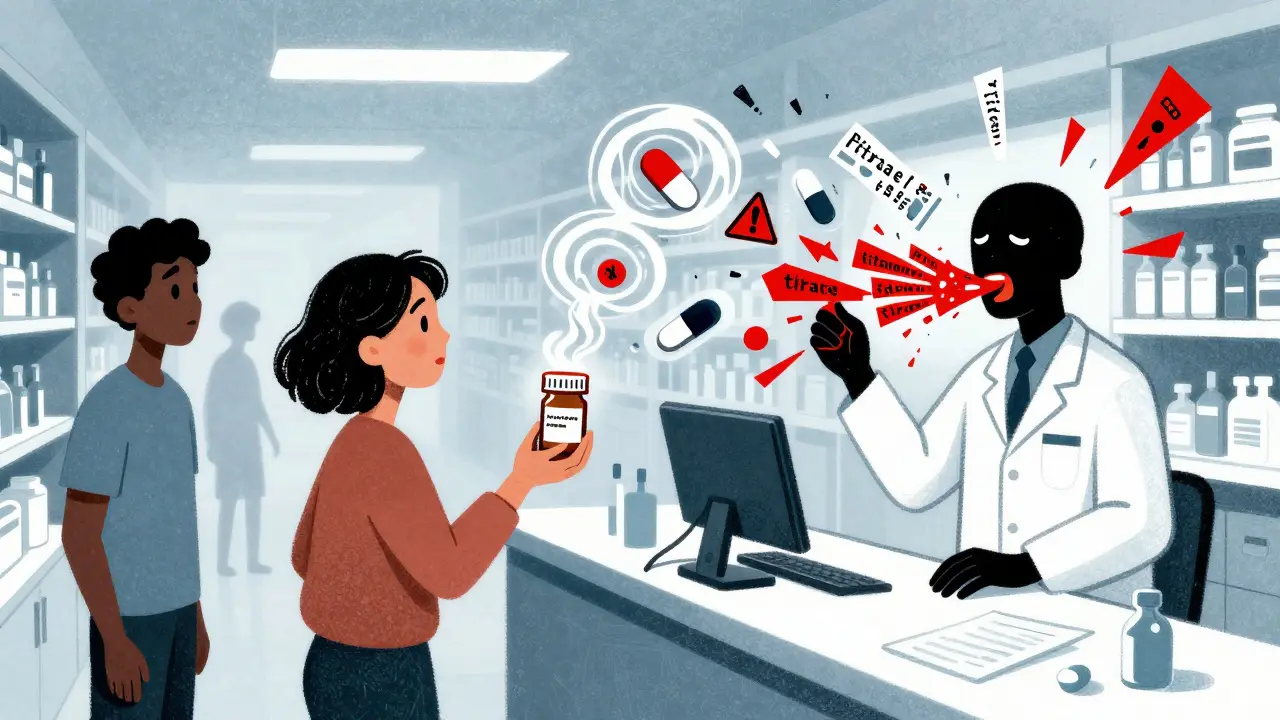
Imagine standing at a pharmacy counter, holding a prescription for a life-saving drug. The pharmacist speaks quickly, using terms like "titrate," "contraindication," and "adverse effects." You nod politely, but you have no idea what they said. This isn't just an awkward moment; it is a dangerous one. For the 25 million people in the United States with Limited English Proficiency (LEP), this scenario plays out daily. It leads to missed doses, accidental overdoses, and preventable hospital visits.
This is why language access for medication counseling is not merely a courtesy-it is a critical component of patient safety plans. Federal laws and state regulations now mandate that pharmacies provide qualified interpreters and translated materials. Understanding these interpreter rights can mean the difference between effective treatment and severe health risks.
The Legal Backbone of Interpreter Rights
You might think that asking for an interpreter is optional or up to the pharmacy's goodwill. In reality, robust legal frameworks protect your right to understand your medication. The cornerstone of this protection is Section 1557 of the Affordable Care Act (ACA), which prohibits discrimination based on national origin in healthcare programs receiving federal funds.
Originally enacted in 2010, Section 1557 was significantly strengthened with new enforcement provisions that took effect on July 5, 2024. These updates explicitly require healthcare providers to offer "meaningful access" to LEP patients. This means more than just handing over a pill bottle; it requires providing accurate pharmaceutical information in the patient's preferred language.
At the state level, New York has set a high bar with its SafeRx regulations (Education Law section 6829). Enacted between 2008 and 2012, these rules require pharmacies to provide free oral interpretation services immediately upon request. Crucially, the law states that the interpreter does not need to be physically present in the store-telephone or video interpretation satisfies the requirement, ensuring speed and accessibility.
- Federal Mandate: ACA Section 1557 requires meaningful access for all federally funded healthcare providers.
- State Specifics: New York’s SafeRx law mandates immediate interpretation and translation of warning labels.
- Prohibition on Family Interpreters: Recent 2024 updates prohibit providers from requiring patients to bring family members as interpreters, except when the patient specifically requests it.
Why Language Barriers Are a Patient Safety Issue
The stakes are incredibly high. Misunderstanding medication instructions is not a minor inconvenience; it is a leading cause of adverse drug events among LEP populations. A pivotal study by Weiss et al., published in PMC in 2018, highlighted that inadequate comprehension of prescription instructions poses a significant risk to these individuals.
Dr. Glenn Flores, a leading researcher in health disparities, published findings in JAMA Internal Medicine in 2021 showing that inadequate language services contributed to 32% of adverse drug events among LEP patients. These errors include taking the wrong dose, mixing incompatible drugs, or stopping essential medication due to fear or confusion about side effects.
Consider the case of insulin therapy. If a patient misunderstands the timing or dosage instructions due to a language barrier, the result can be diabetic ketoacidosis or hypoglycemia, both of which are medical emergencies. The American Pharmacists Association noted in a 2022 position paper that using professional interpretation services reduced medication errors among LEP patients by 67%.
| Metric | Without Professional Interpretation | With Qualified Interpreter |
|---|---|---|
| Medication Error Rate | High (Contributed to 32% of adverse events) | Reduced by 67% |
| Emergency Department Visits | Frequent due to confusion | Reduced by 28% (NYC data 2010-2020) |
| Patient Confidence | Low (Fear of making mistakes) | High (68% felt more confident per 2023 survey) |
What Pharmacies Must Provide Under the Law
If you visit a pharmacy in a regulated area like New York City or California, specific services are guaranteed to you. The regulations define "pharmacy primary languages" as those spoken by one percent or more of the local population, determined by U.S. Census data. In many regions, this includes Spanish, Mandarin, Bengali, Russian, and others, up to a maximum of seven languages per region.
Here is what you should expect to see and receive:
- Multilingual Signage: Pharmacies must post conspicuous notices near the counter using the phrase "Point to your language." This simple visual cue empowers patients who may not speak English to identify their needs without verbal interaction.
- Translated Labels: Prescription medication labels, auxiliary warning labels (such as "May cause drowsiness" or "Take with food"), and other written materials must be translated into the patient's primary language.
- Qualified Interpreters: Staff must provide oral interpretation services. These interpreters must demonstrate proficiency in both English and the target language, including knowledge of specialized medical terminology. They cannot rely on untrained staff or family members unless the patient insists.
- Documentation: Your language preference must be documented in your patient medication profile to ensure consistent service during future visits.
In New York, for example, chain pharmacies are required to translate auxiliary warning labels in addition to the main prescription label. This attention to detail ensures that even small but critical instructions are understood.
Challenges in Implementation
While the intent behind these regulations is clear, implementation varies. Large chain pharmacies like CVS and Walgreens have invested heavily in compliance. They implemented mandatory 10-hour language access training modules for staff in 2023 and use contracted services like LanguageLine Solutions to provide 24/7 interpretation via phone or video.
However, independent pharmacies face steeper hurdles. A 2023 analysis by Rxtran.com found that only 67% of independent pharmacies in New York had fully compliant systems, compared to 92% of chains. The primary barrier is cost. Twenty-three percent of surveyed independent pharmacies reported difficulties maintaining compliance due to the financial burden of hiring interpreters and translating materials.
Patients also report inconsistencies. While the "Point to your language" signage is widely recognized-with an 83% recognition rate among LEP patients in NYC according to the Mayor's Office of Immigrant Affairs-accessing the actual service can sometimes be slow. A Chinese-speaking patient in Queens noted in a 2024 review that while signs were present, staff struggled to activate the interpretation service quickly during peak hours.

How to Exercise Your Interpreter Rights
Knowing your rights is the first step to safe medication management. Here is how you can advocate for yourself or a loved one:
- Identify Your Language Need Early: When checking in, clearly state your preferred language. Look for the "Point to your language" sign if speaking is difficult.
- Request a Qualified Interpreter: Do not settle for a family member or friend, especially children. They may lack medical vocabulary or feel uncomfortable discussing sensitive health issues. Insist on a professional interpreter provided by the pharmacy.
- Verify Translated Materials: Check that your prescription label and any warning stickers are in your language. If they are not, ask the pharmacist to correct this before leaving the counter.
- Document Refusals: If a pharmacy refuses to provide an interpreter or translated materials, note the date, time, and location. You can report violations to the relevant state department of health or education, depending on local jurisdiction.
For instance, in New York, the State Department of Education oversees these regulations. If you encounter barriers, resources like the federally-funded Language Access Help Desk (1-800-688-8814) offer guidance. Remember, you have the right to refuse services if you wish, but the pharmacy must first offer them properly.
The Future of Language Access in Healthcare
The landscape of language access is evolving rapidly. The market for medical interpretation services is projected to reach $3.8 billion by 2027, driven by regulatory compliance and demographic shifts. Key players like LanguageLine Solutions hold a 42% market share, indicating a mature industry capable of supporting widespread adoption.
New technologies are also emerging. The FDA issued draft guidance in 2023 encouraging standardized pictograms on medication labels to supplement language services. Additionally, AI-powered translation tools are being integrated into pharmacy workflows, though current regulations still require human verification for critical medication instructions to ensure accuracy.
Looking ahead, the Long-Term Care Phases of the Affordable Care Act require all Medicare and Medicaid providers to achieve full language access compliance by 2026. This timeline suggests that strict enforcement will become the norm nationwide, not just in states with existing laws. As demographics continue to shift, with immigrant populations growing in diverse neighborhoods, the demand for culturally competent and linguistically accessible care will only increase.
Ultimately, language access is about dignity and safety. When a patient understands their medication, they adhere to their treatment plan, avoid complications, and maintain better health. By enforcing interpreter rights, we close the gap in healthcare disparities and ensure that everyone, regardless of language, receives the same standard of care.
Do I have to pay for an interpreter at the pharmacy?
No. Under federal law (ACA Section 1557) and state regulations like New York's SafeRx law, pharmacies receiving federal funding or operating in regulated jurisdictions must provide interpretation services free of charge to LEP patients.
Can my child interpret for me at the pharmacy?
You can request a family member, but pharmacies are prohibited from requiring you to use one. Using children or non-professionals is discouraged because they may lack medical terminology knowledge or privacy boundaries. Professional interpreters are trained to handle complex pharmaceutical instructions accurately.
What languages are covered under pharmacy language access laws?
Coverage depends on local demographics. Regulations typically define "primary languages" as those spoken by 1% or more of the regional population, based on U.S. Census data. Common languages include Spanish, Mandarin, Bengali, Russian, and Arabic, up to a maximum of seven per region in some states like New York.
What should I do if a pharmacy refuses to provide an interpreter?
If a pharmacy denies your request for a qualified interpreter, document the incident including the date, time, and staff involved. You can file a complaint with your state's Department of Health or Education, or contact the federally-funded Language Access Help Desk for assistance and guidance on next steps.
Are online pharmacies required to provide language access?
Yes, if they receive federal funding or operate under similar regulatory frameworks. Online platforms must provide translated medication guides and access to tele-interpreters via chat or video call. However, enforcement can be less visible than in physical stores, so proactive inquiry is recommended.